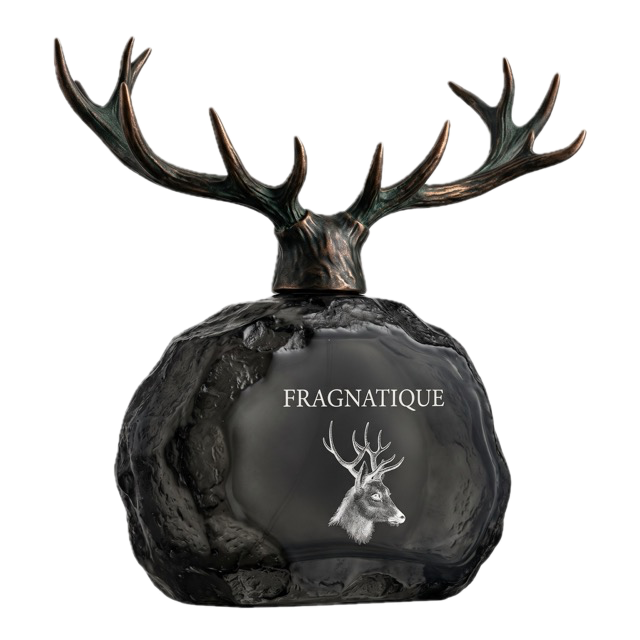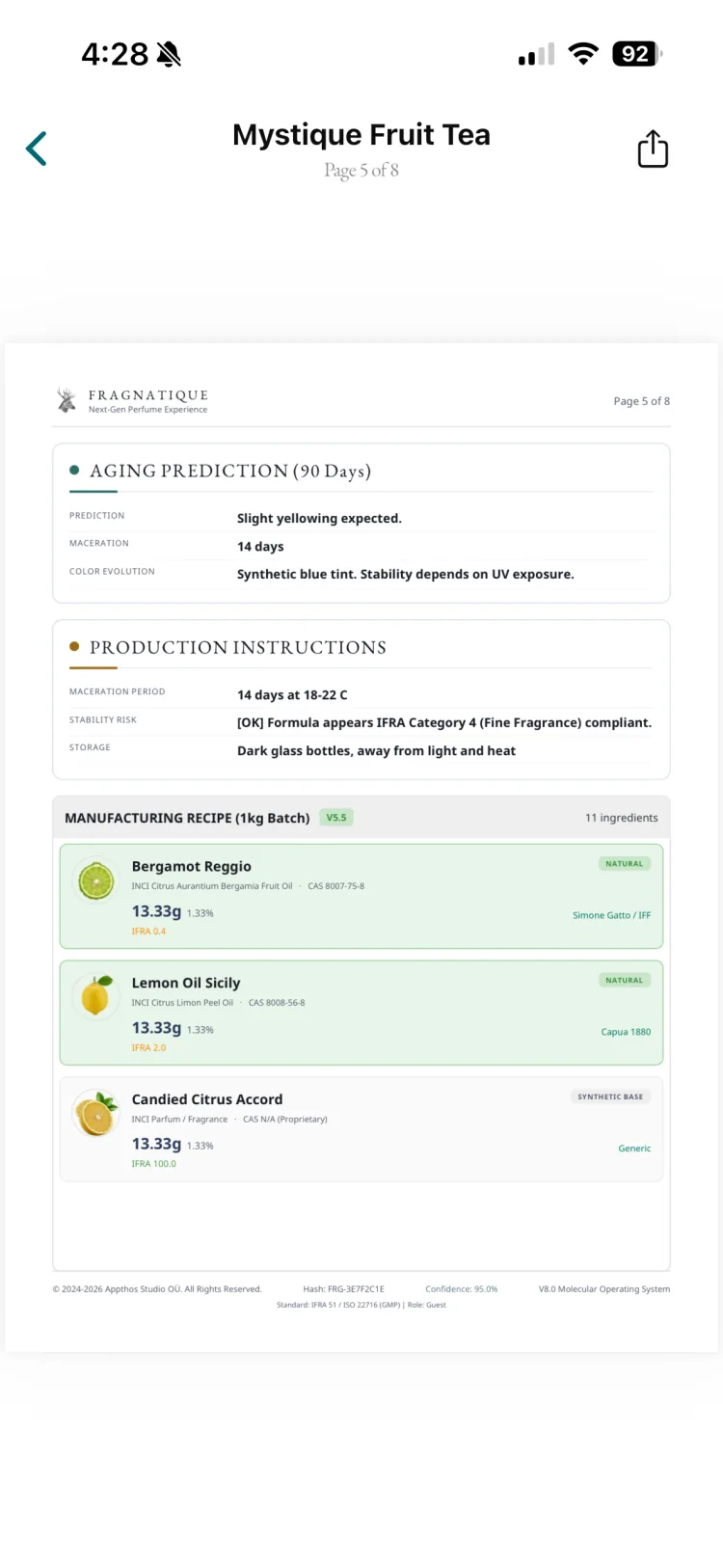
I've been formulating in the Scent Lab for two months and exporting manufacturing PDFs. The app flags certain materials when I push them too high (mostly oakmoss, certain citrus oils, a few rose-derived materials) and suggests adjustments.
Question for the community: how strict is the IFRA compliance built into the Scent Lab actually? Is the exported PDF really ready for a small batch fulfilment, or do I still need outside safety review? And what should a hobbyist formulator know about IFRA limits to begin with?
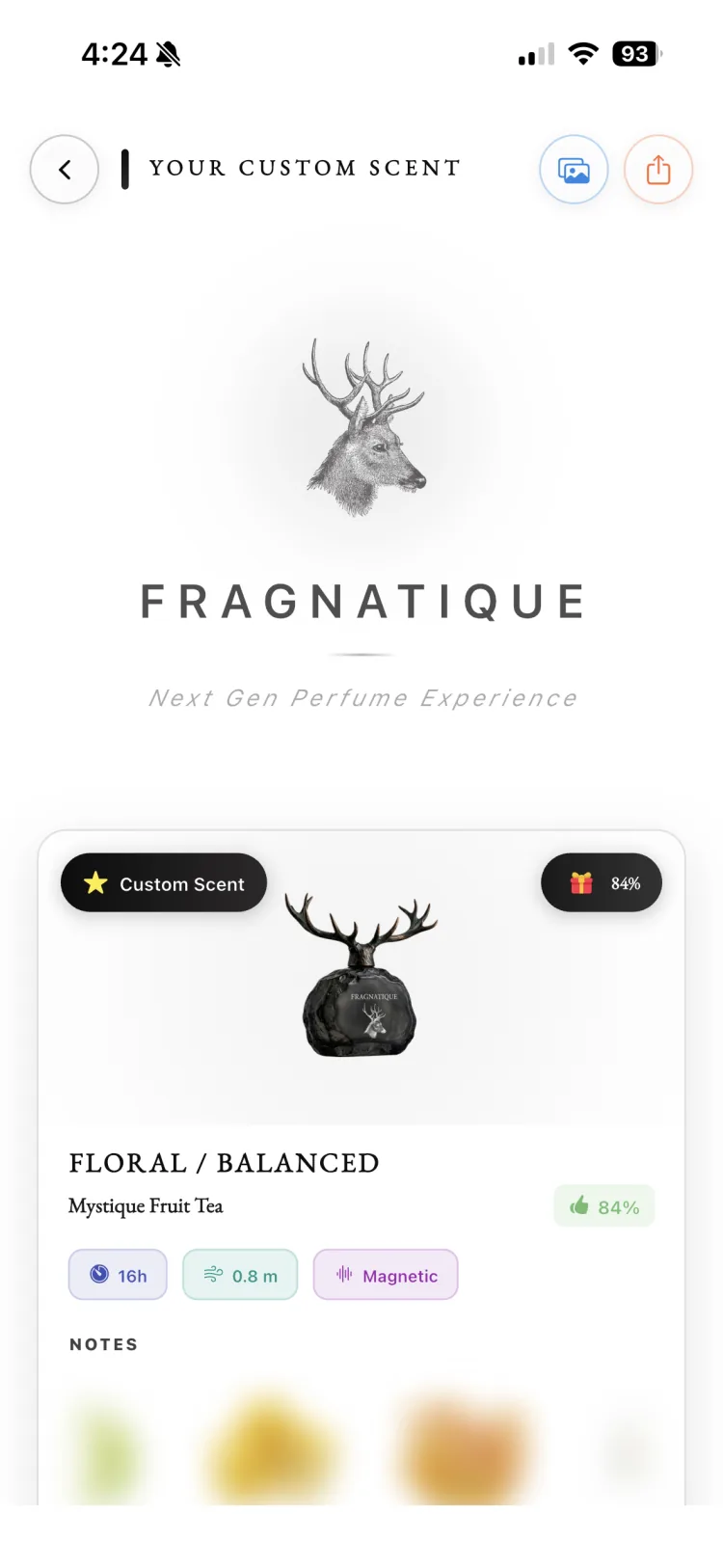
Scent Lab turns an idea into a manufacturing document
Answer the Lab's questions and it returns a formula with a note pyramid, projection and longevity metrics, an IFRA compliance check, a cost analysis and an exportable PDF a producer can actually read.
Open it on iOS6 answers
Most useful answer firstMost useful answer
Long answer because this matters and most casual formulators get it wrong.
What IFRA is:
The International Fragrance Association sets voluntary safety standards for fragrance materials. Most reputable manufacturers and commercial perfume houses follow these standards. The standards specify maximum percentages of certain materials in finished fragrance products, broken down by skin contact category (10 categories ranging from leave-on body products to incense).
What the Scent Lab does:
The Scent Lab in the Fragnatique app uses the current IFRA Standards (the 51st amendment as of 2026 release) to flag material doses that exceed limits in your declared product category. When you formulate a fine fragrance (category 4, a leave-on body product), the limits for things like oakmoss (Atranol-restricted), bergamot (furocoumarin-restricted), citral, eugenol, and others are enforced in the proportions display.
The manufacturing PDF the Scent Lab exports does reflect these limits. If you formulate a fragrance with no flagged warnings, the PDF you export is IFRA compliant in the sense that no individual material exceeds the standard limits.
What that does NOT mean:
- A finished fragrance is not the same as a safety dossier. Commercial release in the EU requires a Cosmetic Product Safety Report under the Cosmetic Products Regulation 1223/2009. That requires a qualified safety assessor and a CPNP notification. The Scent Lab does not produce this.
- Allergen labelling. The 26 listed fragrance allergens (geraniol, limonene, linalool, etc) must be declared on the product label above certain thresholds. The Scent Lab can identify these in your formula but does not generate compliant labelling.
- Manufacturing best practice. Quality of materials, batch testing, fill-and-finish hygiene, packaging compatibility are all separate from IFRA compliance.
For a hobbyist:
You have wide latitude for personal use. IFRA compliance is voluntary, and a fragrance you make for yourself or to share with a friend does not require any formal review. The Scent Lab's IFRA enforcement is a useful you probably will not give yourself or your friend a contact reaction baseline.
For commercial production:
You still need:
- A licensed safety assessor to issue a CPSR for the EU market or equivalent for other markets.
- Allergen labelling worked out for your final product format.
- Stability testing for the formulation in its actual packaging.
- CPNP notification (EU) or equivalent.
The Scent Lab gets you 60 to 80 percent of the way to a commercially safe formula. The remaining 20 to 40 percent is the regulatory and manufacturing layer that requires specialist work
Practical recommendation:
Use the Scent Lab to design and iterate. Use the manufacturing PDF as the technical foundation for outside review when you go commercial. Do not assume IFRA compliance equals market readiness.
One thing worth adding for clarity. IFRA Standards are revised every two to three years. The Scent Lab updates with each amendment, but if you formulated something in 2024 and are checking it in 2026, the limits may have tightened. Re-export the PDF before any commercial decision.
Florist note. Naturals are subject to the same limits as synthetics. Real oakmoss, real bergamot, real rose otto, all of them have IFRA limits because of their allergenic or photo-toxic constituents.
Many home formulators believe natural means safe. It does not. A high dose of natural oakmoss can sensitise more skin than a controlled dose of synthetic ambroxan. Respect the limits
The Scent Lab's flagging in real-time during formulation is genuinely useful. I've learned more about which materials are restricted by hitting the orange-and-red warning triangles in the app than from any reading. The visual feedback teaches you the limits in your bones
For commercial intent specifically: the Scent Lab manufacturing PDF is what you take to a contract manufacturer or to a safety assessor. They'll use it as the formula they assess and produce. The PDF is well-organised for that handoff. I've personally used it with a small Italian fulfilment house for a 100-unit batch. They had no complaints about the format.
Original asker. After this thread I'm clear on the boundary: the Scent Lab is great for design and personal use. A safety assessor is required before any commercial release. I have a friend who works as one in milan and ill route my final formula through her before considering anything beyond gift batches
Best in-depth answer for an underrated question. Thank you mads.
Get personal answers inside the Fragnatique app.
Ask follow-ups, get a match score against your taste profile, and pull curated shortlists into your wishlist. The AI advisor lives where the conversation happens.