What Is an AI Perfume Advisor? A 2026 Field Guide
An AI perfume advisor matches you with fragrances made for your taste. What one does, what separates a good one from a gimmick, and where the limits sit.
An AI perfume advisor is software that recommends fragrances by reading your taste profile, photographs, or scanned bottles, and matching the result against a structured database of perfumes and their notes. Done well, it returns a compatibility score and a written explanation you can argue with. Done badly, it is a horoscope with a logo.
The category did not exist five years ago. Today, after a generation of vision-language models and structured fragrance databases, it is realistic to expect software to surface the right perfume in the same number of taps it takes to order coffee. This guide explains what one does for you, what good looks like, and where the limits sit.
Perfume advisor, scent advisor, fragrance advisor: which is which
Search for perfume advisor and the results split into two things that share a name, which is worth untangling before anything else.
The first is a person. A perfume advisor, or fragrance advisor, is a counter role at a department store or a house boutique: someone who asks what you wear now, hands you blotters, and steers you toward stock. That is why job listings sit high in the results for the bare term.
The second is software, and it is what this piece is about. The same idea without the counter, the commission, or the limit of one house's shelf.
The naming has not settled, and all of these describe the software:
| Term | Where it turns up |
|---|---|
| AI perfume advisor · perfume advisor AI | The commonest pair, in either word order |
| Scent advisor · AI scent advisor | Shorter, and the phrasing app listings tend to prefer |
| Fragrance advisor | The trade's word, and the one most collided with the human job |
| Perfume advisor app | What people search when they already know they want it on a phone |
| Perfume recommender · fragrance recommendation engine | The technical framing, usually in writing about the systems rather than by the people using them |
Nothing distinguishes them in practice. What distinguishes one product from another is not its label but whether it can say why, which the rest of this guide is about.
What an AI perfume advisor actually does
A modern advisor does four jobs:
- Profile. It learns your taste from a short quiz, a single photo, or the fragrances you already like.
- Match. It ranks fragrances for you and attaches a compatibility score, usually a percentage like 88% match.
- Scan. It identifies a bottle from a photograph, often offline, and returns its profile alongside your personal match score.
- Explain. It writes a short rationale for each pick: why it fits, which occasion suits it, and how it differs from your current favorites.
The first three are becoming table stakes. The fourth, explanation, is where a serious advisor separates itself from a marketing wrapper.
What makes a match worth trusting
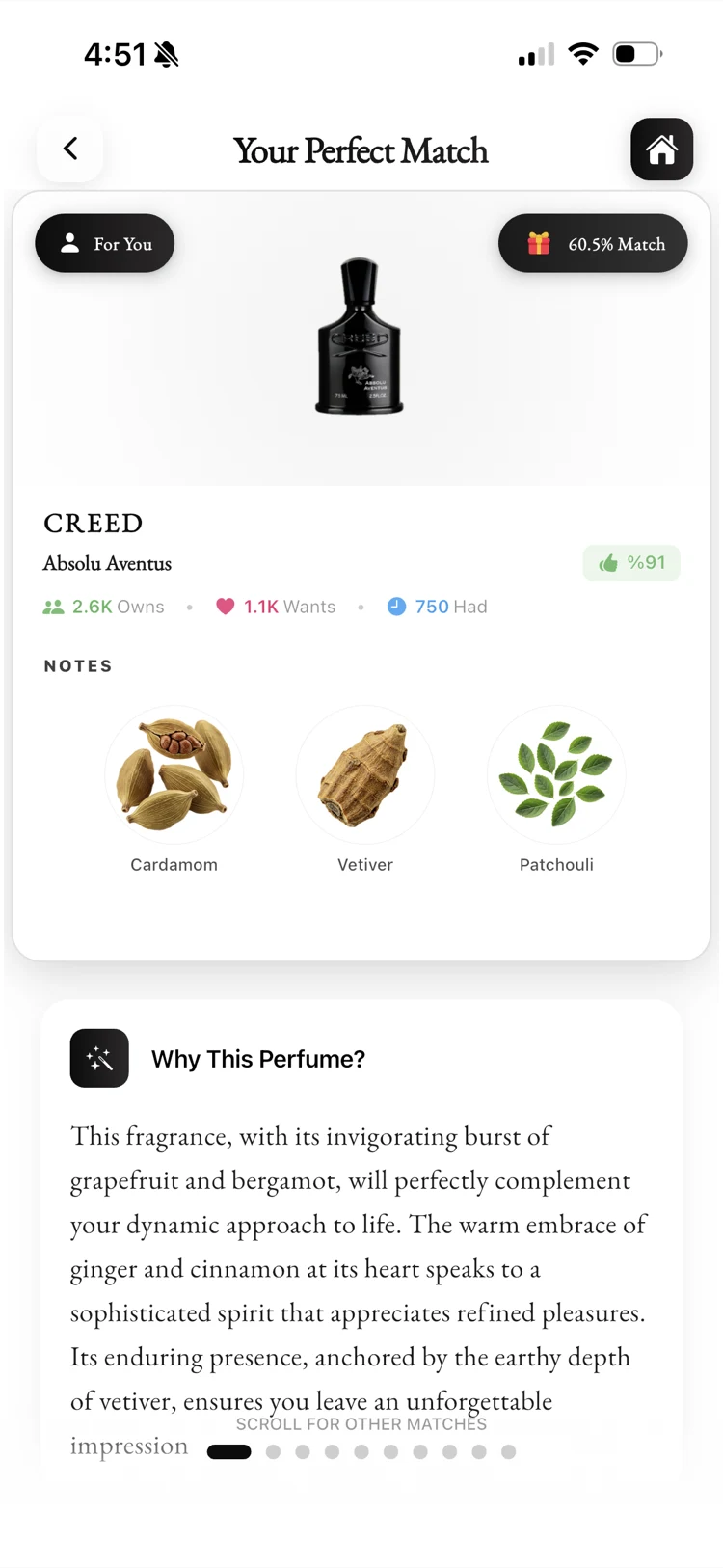
The percentage on its own is the easy part. Plenty of apps will hand you a confident-looking number with nothing behind it. What you should actually weigh is whether the recommendation is defensible: does the app cover enough fragrances to find something genuinely right for you, and can it tell you, in plain language, why a bottle fits?
That is the whole line between a real advisor and a horoscope with a logo. A deep catalogue gives it range across designer, niche, and indie. A written reason gives you something to agree or disagree with. How an app arrives there is its own business, and the good ones keep that machinery out of your way, the way you never think about the engine while you drive.
Every match should answer the question: why this perfume, for this person, today? If the app cannot explain the recommendation, it does not have one.
What separates a good AI perfume advisor from a mediocre one
After auditing the category, four signals reliably predict quality. Use them as a checklist.
| Signal | Mediocre | Good |
|---|---|---|
| Catalogue coverage | Designer counter only, nothing niche | Designer, niche, and indie houses together |
| Note depth | Family labels only (woody, floral) | Every note named (bergamot, oud, white musk) |
| Reasoning | "Recommended for you" | Written rationale citing specific notes |
| Offline | None | Full scanner + match offline |
A handful of additional features push an advisor from good to excellent:
- IFRA-aware formulation. If the app lets you create a perfume, not just discover one, it must check your formula against IFRA Amendment 51 (the international fragrance regulator's 2023 standard) before declaring it shippable. Our own compliance layer is documented in the methodology.
- Photo style analysis. Image-based onboarding is faster and more honest than a quiz, because users describe themselves badly but photograph themselves accurately. The Fragnatique perfume advisor shows what the three-layer photo analysis returns.
- Match-score transparency. A 78% number alone is noise. The same number alongside "Pink pepper opening, cedar and oud at the heart, galbanum closing it out, 88% compatibility with your dry-and-leathery profile" is signal. We dig deeper in What a Perfume Match Score Actually Measures.
Where the Fragnatique perfume advisor fits in
Fragnatique was built in Tallinn, Estonia, around one editorial decision: every recommendation has to be defensible in plain English. The app maps designer, niche and indie houses down to the individual note, returns 40-50 ranked matches per session, and attaches a written Why this perfume? paragraph to each one.
Four feature combinations are unusual enough to call out:
- A scanner that works offline. Point your phone at a Penhaligon's Halfeti or a Mancera Cedrat Boise in-store and Fragnatique surfaces season, longevity, sillage, the full notes pyramid, and your personal match score without a connection. The cached catalogue reaches designer, niche and indie bottles alike.
- A scent map that keeps learning. Every like, dislike, scan, and saved match redraws your personal profile, so the ranked field you get in month three is sharper than the one you got on day one.
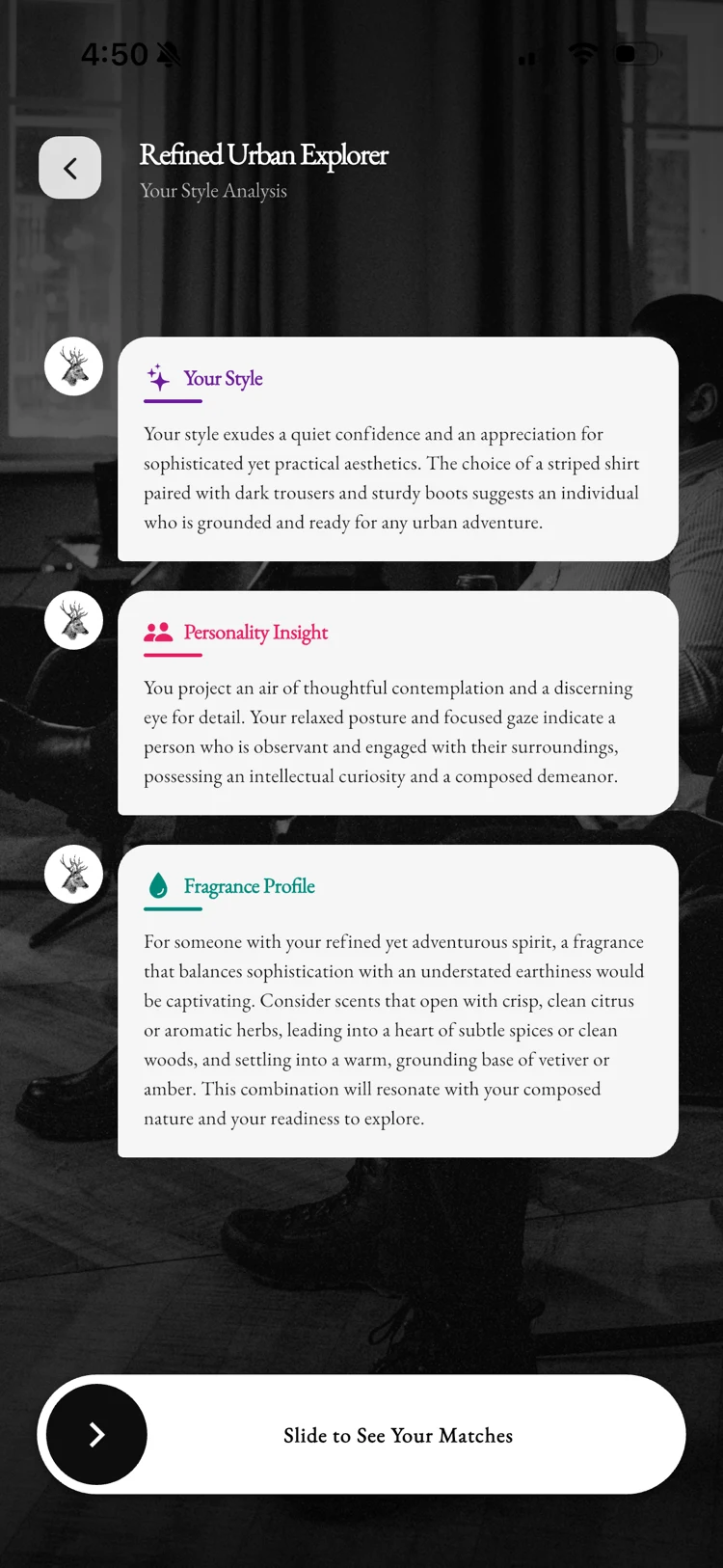
- Photo-first onboarding via vision-language AI. Upload one photo and the model returns a named archetype (Refined Urban Explorer, Quiet Saboteur, Coastal Aesthete) plus a fragrance profile derived from the visual analysis. Photos are processed in real time and never stored server-side.
- A Scent Lab where you create your own scent. Beyond discovery, Fragnatique walks you through fourteen guided formulation steps, checks the result against IFRA Amendment 51, and exports a five-page manufacturing PDF: recipe, batch cost, sensory profile, allergen declaration, and 90-day aging prediction. The Scent Lab has its own page covering the five-page manufacturing document, and how a formula is judged is on the methodology page.
Fragnatique is available on iOS. Pricing is freemium: the scanner and Scent Lab are premium; matching, photo analysis, and the chatbot are free. For the product itself, the Fragnatique AI perfume advisor walks through the match score, the chatbot, and the advisor features in one place.
When to trust the algorithm, and when not to
A good AI perfume advisor narrows the search. It does not finish it.
Trust the algorithm when:
- You have liked at least 20 fragrances. The profile is now data-rich.
- The recommendation is close to your favorites, variations on a theme.
- You are comparing within a category (which woody-amber, which gourmand) rather than across categories.
- The app shows you the reasoning and the reasoning sounds right.
Distrust the algorithm when:
- You are buying full-bottle ($150+) blind. Always sample.
- The recommendation jumps two families. The model is reaching.
- The app refuses to show its reasoning. There is nothing to argue with.
- You have a sensitivity to a specific note (oud, civet, certain aldehydes). The algorithm does not know your skin.
Most users converge on the same workflow within a few weeks: use the app to surface 5 candidates, sample those 5, buy the winner. That is faster than the old way and cheaper than the alternative.
The bottom line
An AI perfume advisor is useful the moment it stops being a vending machine and starts being a colleague, one with strong opinions, a good memory, and the patience to explain itself. The technology to do this well exists today; the differentiator is editorial discipline. Look for advisors that show their work, index niche alongside designer, and treat your nose as the final referee.
Next, see How to Find Your Signature Scent in 7 Honest Steps for the practical workflow, or The Fragrance Families, Decoded if you want to ground the vocabulary first. To meet the underlying app, the Fragnatique perfume advisor walks through how a recommendation is made.
Frequently asked
- What is an AI perfume advisor?
- An AI perfume advisor is an application that recommends fragrances by analyzing your taste profile, photographs, or scanned bottles, and matching them against a structured database of perfumes and their notes. The advisor returns a compatibility score and, in better implementations, a written explanation.
- What is a perfume advisor?
- Two things share the name. A perfume advisor is a counter role in a department store or house boutique: a person who asks what you wear, offers blotters, and recommends from the stock in front of them. It is also software that does the same job from structured data, weighing thousands of fragrances against a personal profile instead of one shop's shelf. This guide is about the second, which is also called a scent advisor, a fragrance advisor, or a perfume advisor app.
- Is there a perfume advisor AI, and is it free?
- Yes. Fragnatique is a perfume advisor AI on iOS and the download is free, along with the profile quiz, the ranked matches with their written reasons, the full note and accord breakdown, and the Perfume Cabinet. A premium subscription adds the offline bottle scanner and the full Scent Lab. Perfume advisor AI, AI perfume advisor, scent advisor and fragrance advisor all name the same category; the word order varies by who is searching.
- Is there a perfume advisor app rather than a website?
- Fragnatique is an iOS app, and the reason is the scanner: identifying a bottle from its glass needs a camera and an on-device fragrance library, which is what lets it work in a duty free corridor or a department store basement with no signal. The website carries this journal and the community; the advisor itself, the profile, the matches and the Scent Lab live in the app.
- How accurate are AI perfume recommendations?
- Accuracy depends on a few things: how many fragrances the app actually covers, how carefully each one is described, and whether it explains its reasoning so you can judge it for yourself. The more useful metric than any headline accuracy figure is whether the written explanation matches your nose, because that is the part you can verify yourself.
- Can an AI advisor replace a human perfume consultant?
- No. An AI advisor is faster, available offline, and consistent across every fragrance in its catalogue. A human consultant smells the perfume on your skin, reads your reaction, and improvises. The two are complementary, many users use the AI to narrow a session of 40 to 50 ranked matches down to 5, then visit a counter to make the final call.
- Do I need to upload a photo of myself?
- Photo style analysis is one input, not a requirement. You can also use a 12-question profile quiz, a scanned bottle, or simply browse curated lists. Fragnatique processes photos in real time and does not store them server-side.
- What is the difference between an AI perfume advisor and a recommender system on a retail site?
- Retail recommenders typically optimize for what is in stock and what other shoppers bought. An AI advisor optimizes for what fits you, regardless of inventory or commercial pressure. The Fragnatique perfume advisor, for example, will recommend a Mancera or Penhaligon's bottle the user has never heard of when the match is genuinely better.
- Is the technology offline-capable?
- The best advisors cache their database on-device so they work without a connection. Fragnatique caches its full fragrance catalogue locally and runs scanning, scoring, and basic matching offline. Cloud connectivity is reserved for image-heavy operations like vision-language photo style analysis.
- How does an AI perfume advisor handle niche houses?
- Coverage of niche houses (Byredo, Diptyque, Penhaligon's, Mancera, Maison Francis Kurkdjian, Andrea Maack, Hormone Paris, and others) is the single best test of an advisor's depth. A serious app indexes designer, niche and indie houses side by side at the note level; a shallow one stops at the designer counter.

Explore Fragnatique