Top, Middle, Base: How the Notes Pyramid Actually Works
The fragrance notes pyramid explained: what top, middle and base notes actually are, why perfume opens with bergamot and dries down to sandalwood, and how to read any pyramid before you buy.
The fragrance notes pyramid is a chemistry diagram that the perfume industry sells as an aesthetic one. Top, heart, base. Three tiers, drawn as a triangle, plastered on every perfume page from department store listings to enthusiast databases. What the marketing rarely says is why the diagram exists: molecules of different sizes evaporate from your skin at different speeds, and the pyramid is a map of that physics.
This piece explains the pyramid as it actually works, the chemistry, the timing, and why it matters when you are choosing or creating a perfume. The Fragnatique perfume advisor uses the pyramid to index every fragrance in its catalogue down to the atomic-note level, but the structure itself is older than every app and is the foundation of how perfume is built.
What the pyramid actually is
A perfume is, mechanically, a cocktail of molecules dissolved in alcohol. When you spray it on skin, the alcohol evaporates first (within seconds), then everything else evaporates in waves, fastest molecules first, heaviest molecules last.
The three tiers correspond to three rough weight bands:
| Tier | Lifespan | Molecular weight (typical) | Examples |
|---|---|---|---|
| Top | 15 min - 2 hr | 130-180 g/mol | Bergamot, lemon, basil, pink pepper |
| Heart | 1 - 5 hr | 150-210 g/mol | Rose, jasmine, cardamom, iris |
| Base | 4 - 12+ hr | 200-300 g/mol | Sandalwood, oud, vanilla, white musk |
These are approximate, there is a meaningful overlap in the middle band, but the principle holds. Smaller molecules evaporate faster because they have higher vapor pressure. The Clausius-Clapeyron equation describes the relationship between molecular weight, temperature, and evaporation rate; perfumers apply it intuitively, and the Fragnatique Scent Lab simulates it numerically when generating an aging prediction.
The pyramid is not a sequence of three perfumes. It is one perfume, viewed at three points in time, as the lightest molecules leave the skin and the heavier ones reveal themselves.
Note pyramid, fragrance triangle, olfactory pyramid: why the name keeps changing
One diagram, six names, and no industry body ever settled on one. In the singular it is the note pyramid, and searches use both forms interchangeably. You will meet all of these, and they all describe the structure above:
| Name | Where you meet it |
|---|---|
| Notes pyramid | Enthusiast databases and most perfume listings |
| Fragrance pyramid | House marketing copy and press releases |
| Perfume pyramid | Retail product pages |
| Olfactory pyramid | Perfumery training material and translations from French (pyramide olfactive) |
| Fragrance triangle | Beginner guides, from the shape it is drawn in |
The French term is the original. Pyramide olfactive entered perfumery vocabulary through Jean Carles, the perfumer who formalised the teaching method at Roure in the 1940s, and everything else is a translation or a retail simplification of it. Nothing changes between the names: top, heart and base, ordered by how fast the molecules leave your skin.
Two related terms are not the same thing and are worth keeping separate. Fragrance families (citrus, floral, woody, gourmand and the rest) classify what a perfume smells like; the pyramid describes when each part of it arrives. A woody perfume and a citrus perfume both have a pyramid. And an accord is a blend of several notes read as one impression, which can sit in any tier of the pyramid rather than forming a tier of its own.
What top notes do
Top notes are the first impression. You smell them in the air before the perfume even touches skin, and they fade within an hour or two. Their job is to be immediately attractive, bright, fresh, clean, and then get out of the way.
Most top notes come from one of three buckets:
- Citrus oils, bergamot (the most common opener in modern perfumery), lemon, grapefruit, mandarin, neroli.
- Light herbs, basil, mint, lavender, rosemary.
- Light spices, pink pepper, cardamom (cardamom straddles top-heart depending on dosage).
The classic perfumer's heuristic is that top notes are the handshake. They are also the easiest tier to fake, many cheap fragrances put their entire budget into a stunning opening and have nothing in the heart or base. This is why smelling a fragrance on paper alone is unreliable: the paper tells you about the handshake, not the conversation.
What heart notes do
Heart notes are the identity of the fragrance. They emerge as the top fades and carry the perfume from roughly hour one to hour five. The heart is what your friends would describe if you asked them what your perfume smells like.
The heart is dominated by:
- Florals, rose, jasmine, tuberose, orange blossom, ylang-ylang, iris.
- Spices, cinnamon, clove, saffron, nutmeg.
- Green or fruity accords, fig, blackcurrant, galbanum, peach.
Iris is a useful illustration. It has a higher molecular weight than most florals, so it sits later in the pyramid and feels powdery rather than vivid. Two perfumes can be "rose-led" and behave completely differently because one centers a fresh rose damascena (lighter, more top-leaning) and the other a Bulgarian rose absolute (heavier, more heart-leaning). The Fragnatique notes database records both as separate atomic notes for exactly this reason.
What base notes do
Base notes are the memory. They are what lingers on a coat hours after you took it off. They are also what other people smell when they hug you at the end of an evening.
The base is dominated by:
- Woods, sandalwood, cedar, oud, vetiver, cypress.
- Resins, amber, labdanum, benzoin, frankincense.
- Musks and animalics, white musk, civet (synthetic now), ambergris (synthetic now), castoreum.
- Gourmands, vanilla, tonka bean, cocoa.
A strong base is what separates a perfume from a body spray. Body sprays are nearly all top-and-heart; they smell great for an hour and then disappear. A real perfume is anchored by a base that holds together for the second half of the day.
A worked example. Tom Ford Tobacco Vanille, classified as a Spicy-Gourmand:
- Top: Spicy notes (clove, cinnamon, ginger) and tobacco leaf, strong but volatile, gone within 90 minutes.
- Heart: Tonka bean, dried fruit accord, carries the fragrance from hour 1 to hour 4.
- Base: Vanilla, cocoa, woody notes, the dry-down that anyone smelling you at hour 6 will associate with you.
Anyone who has worn Tobacco Vanille will tell you the perfume "blooms" around hour 2. That is not aesthetic; that is the spicy top finally clearing and the gourmand-resinous base coming forward.
Why this matters when you buy a perfume
If you only sample a perfume on a paper blotter, you are evaluating the top notes only. The blotter is not skin, it cannot warm the heavier molecules into evaporation, and even if it did, you would have walked away before the base emerged. This is the single most common reason people buy perfumes they later hate.
The disciplined version of sampling is covered in How to Find Your Signature Scent, but the short version is: spray on skin, walk away, return at hours 1, 4, and 8. Almost every perfume you will love or hate will reveal itself by hour 4.
How an AI perfume advisor uses the pyramid
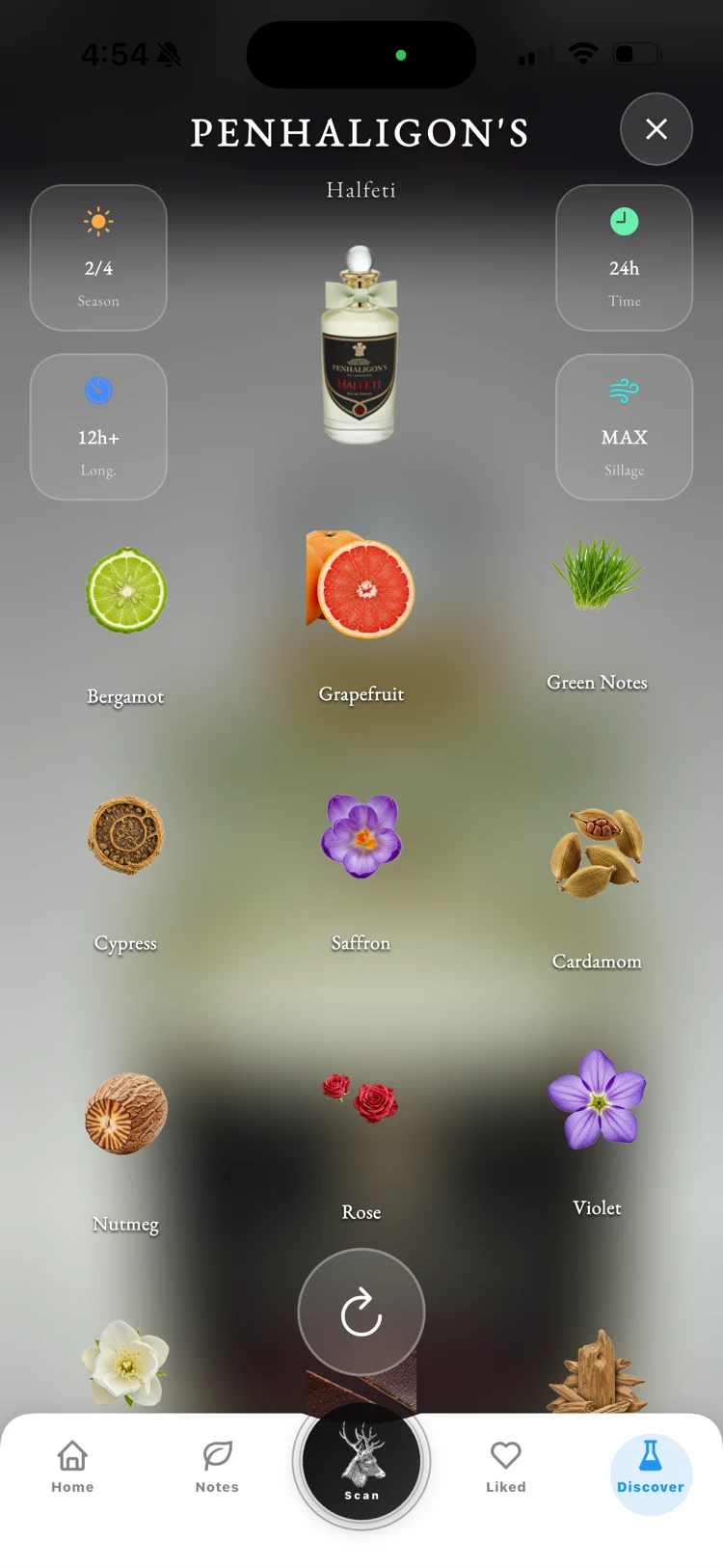
A serious AI perfume advisor cannot operate without the pyramid. Here is how Fragnatique uses it concretely:
- Search by base note. "Show me sandalwood-base perfumes under €120." This is a query you cannot run on a retail site, because retail sites index by brand and price. Fragnatique indexes by note and tier.
- Compare like-for-like. When the match score recommends a perfume "as an alternative to MFK Baccarat Rouge 540," it is matching at the base-note level (saffron-amberwood-ambergris), not just the family.
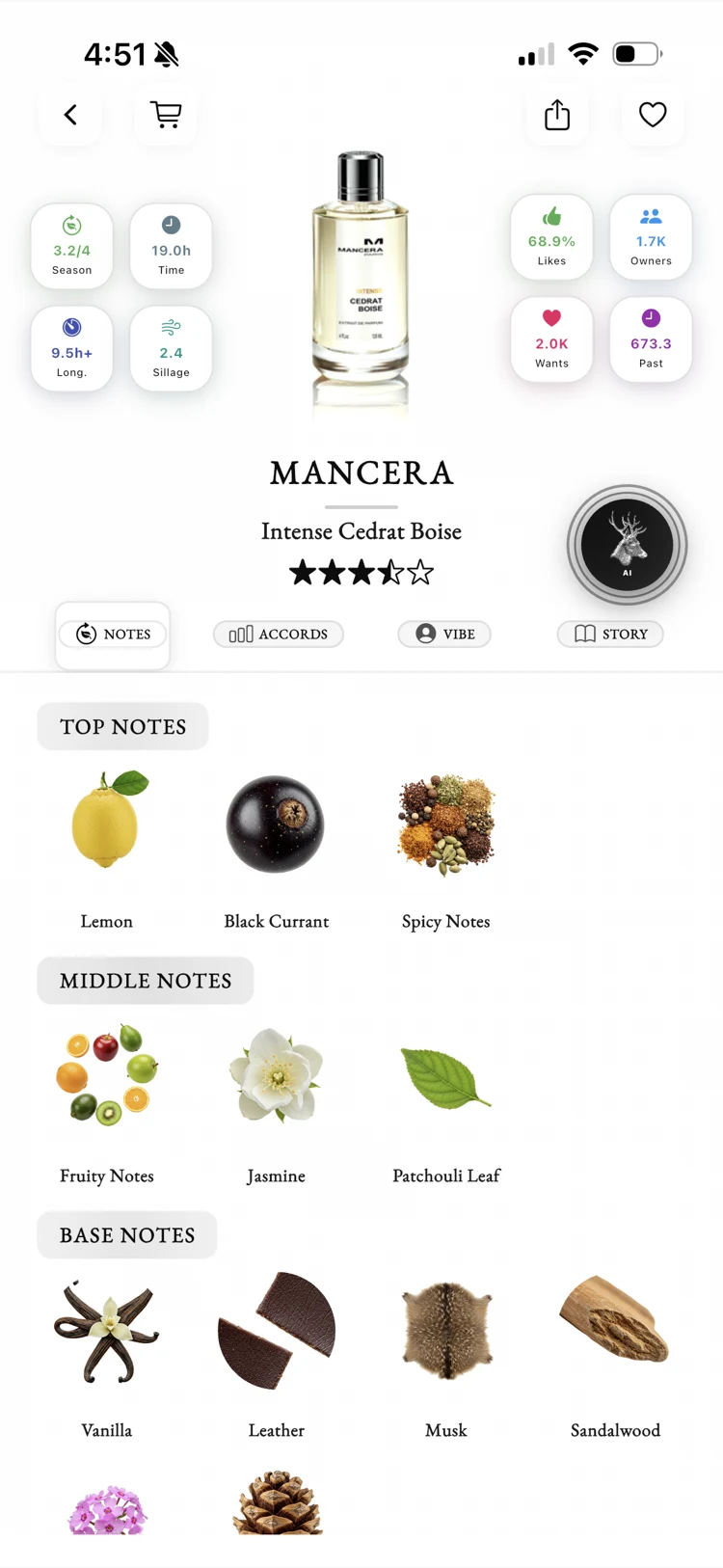
- Scan and decompose. Point the scanner at a Mancera Cedrat Boise bottle and you see all three tiers before you spray.
- Predict aging. The Scent Lab's 90-day aging prediction is computed from the volatility profile of every note in the formula. Perfumes whose top notes are unusually volatile (e.g. heavy citrus) shift more in storage; perfumes whose base is dominated by stable resins drift less.
The bottom line
The notes pyramid is the difference between buying a perfume because the bottle was on a shelf and buying one because you understand what will happen on your skin between minute 5 and hour 8. Once you can read the three tiers, every perfume page on every site becomes legible, and an AI perfume advisor that exposes the pyramid is genuinely useful rather than decorative.
For deeper reading, the Fragrance Families guide covers the categories that the notes inhabit, and the Wikipedia entry on the notes pyramid is a clean technical reference.
Frequently asked
- What is a fragrance notes pyramid?
- The notes pyramid is a three-tier diagram that describes how a perfume evolves on skin: top notes appear first (15 min - 2 hr), heart notes carry the middle (1-5 hr), and base notes anchor the dry-down (4-12+ hr). The structure exists because different molecules evaporate at different speeds, it is a chemistry diagram disguised as a marketing tool.
- Is a fragrance pyramid the same as a notes pyramid?
- Yes. Fragrance pyramid, perfume pyramid, notes pyramid, olfactory pyramid and fragrance triangle are five names for one diagram: top, heart and base notes ordered by how fast their molecules evaporate. The French *pyramide olfactive* is the original term, from Jean Carles' teaching method at Roure in the 1940s; the rest are translations or retail simplifications. There is no difference in what they describe.
- What is the difference between a fragrance pyramid and fragrance families?
- The pyramid describes *when* each part of a perfume arrives on skin; families describe what it smells *like*. A perfume belongs to one or two of the eight families (citrus, floral, woody, spicy, gourmand, aromatic, resinous, earthy) and separately has a pyramid of top, heart and base notes. Every perfume has both. An accord is a third thing again: several notes blended into one impression, which can sit in any tier.
- How long do top notes last?
- Top notes typically last 15 minutes to 2 hours. They are made of small, volatile molecules, citrus oils, light herbs, ozonic accords, that evaporate first because of their low molecular weight. Bergamot, lemon, mandarin, and basil are textbook top notes.
- What is the difference between heart notes and middle notes?
- They are the same thing. 'Heart notes' is the perfumer's term, 'middle notes' is the consumer-facing translation. Both describe the layer that carries the fragrance from hour one to hour five, typically florals (rose, jasmine), spices (cardamom, pink pepper), and green notes (galbanum, fig leaf).
- Are base notes always strong?
- Base notes are *long-lasting*, not necessarily strong. Sandalwood and white musk are famously soft yet last 8-12 hours; oud and leather are loud and last just as long. Longevity is a function of molecular weight; intensity is a separate axis.
- Can a perfume have only one or two layers?
- Yes. Linear perfumes (often called *skin scents* or *soliflores*) skip the dramatic pyramid evolution and stay close to one note throughout. Le Labo Santal 33 reads almost linearly. Most modern niche fragrances do still use the three-tier structure, just with shorter top notes.
- How does an AI perfume advisor use the notes pyramid?
- A serious AI perfume advisor indexes every fragrance at the atomic-note level for all three tiers. The Fragnatique perfume advisor maps designer, niche and indie houses against the atomic notes in each tier, which means you can search 'show me sandalwood-base perfumes under €150' or scan a bottle in-store and see the full pyramid before you spray. Without the pyramid, all you have is family-level guesswork.
- Why do top notes evaporate so fast?
- Volatility is governed by molecular weight and vapor pressure. Citrus oils contain small molecules (limonene, linalool) with low molecular weight (around 136-154 g/mol), high vapor pressure, and consequently fast evaporation. Base notes like sandalwood (santalol, ~220 g/mol) are heavier and evaporate over hours. The Clausius-Clapeyron equation models this, perfumers approximate it intuitively, and apps like Fragnatique simulate it numerically.

Explore Fragnatique