How to Find Your Signature Scent in 7 Honest Steps
How to find your signature scent in 7 honest steps, without wasting money on full bottles: fragrance family, a sample list, skin testing, and the final call.
A signature scent is a fragrance that other people associate with you on contact, not a fragrance you happen to own. That distinction is the entire game. Most fragrance shopping fails because it optimizes for the bottle on the shelf instead of the impression left in the room.
Finding the signature is a structured process, not an aesthetic awakening. The seven steps below take a few weekends of work and roughly the cost of two full bottles. They map cleanly onto how an AI perfume advisor narrows the search, which is the fastest version of the same path.
Signature scent, signature fragrance, signature perfume
Three names, one thing. Scent is the most common in English-language search and writing, fragrance is the trade's preferred word, and perfume is used interchangeably in retail even though, strictly, "perfume" names a concentration (parfum, 20 to 30 percent oil) rather than a category. Nothing in the seven steps below changes depending on which word you use.
People also phrase the question a dozen ways: how to find a signature scent, how to find your signature fragrance, how to find my signature scent. The phrasing changes nothing, because it is one question with one method. And how to find your signature scent online is really the first half of this guide: Steps 1 and 2 happen entirely at a desk, and the Fragnatique profile does both in twelve questions. From Step 3 the work moves to skin, and no screen replaces that. Finding your signature scent is a process with a beginning and an end, not a personality trait you either have or lack.
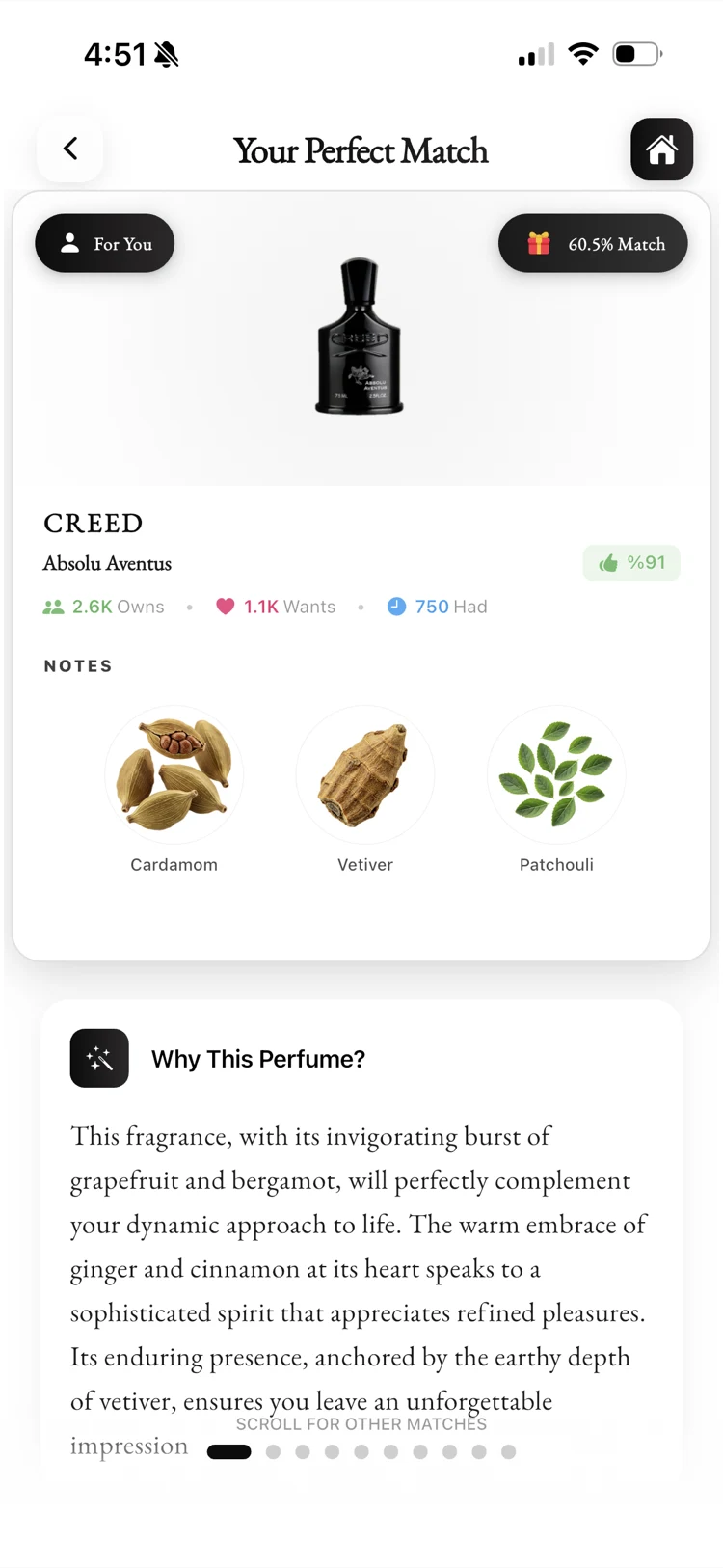
If you are looking for a signature scent finder, that is what Fragnatique is. Twelve questions build a personal scent map, and the app returns forty to fifty ranked matches from designer, niche and indie houses, each carrying a compatibility percentage and a written paragraph naming the notes and occasions behind it. Photograph an outfit and it reads a style archetype into the same profile. Scan a bottle in a shop and it scores that bottle against you on the spot, with no connection needed. Every like, dislike and scan redraws the map, so the shortlist sharpens the more you use it.
That is the front of the funnel solved: thousands of releases down to a ranked handful, in the order worth sampling. The back of the funnel is still skin, and it always will be, because nothing predicts how a base note behaves on your chemistry at hour six except wearing it. The seven steps below are how you close that last stretch, and they are the same process the app runs, done by hand.
Step 1. Identify your fragrance family
You cannot land on a signature scent without first knowing which of the eight olfactory families pulls you in. The shortcut is to look at what you already love eating, drinking, and wearing.
- Coffee, vanilla, leather, tobacco → Gourmand or Resinous
- Pine, cedar, sandalwood interiors → Woody
- White flowers in cooking, fresh laundry → Floral or Aromatic
- Citrus zest, gin and tonic, sea air → Citrus or Aromatic
- Soil after rain, mushrooms, mossy walks → Earthy
A 12-question quiz on a fragrance app does this work in three minutes. A walkthrough of every family is in The Fragrance Families, Decoded. Either path is better than browsing brand websites blind.
Step 2. Build a sample list of 8-12 candidates
The mistake here is sampling too few or too many. Eight is the floor, fewer and you cannot triangulate. Twelve is the ceiling, more and your nose fatigues before you finish.
Mix three sources:
- Two anchor recommendations from inside your top family (e.g. if Woody, then a cedar-forward and an oud-forward).
- Four cross-family bridges, one Citrus-Aromatic, one Floral-Woody, one Gourmand-Resinous, one Spicy-Floral. Bridges are where most signature scents actually live.
- Two outliers the algorithm thinks fit you but that you would not have picked yourself. The Fragnatique perfume advisor labels these "You probably haven't considered, but...".
Source samples through the brand's own site for niche houses (Diptyque, Penhaligon's, Mancera) and through decant marketplaces for everything else. Budget €30-€50 for the full set.
Step 3. Wear each one for a full day, on skin
This is the step almost everyone short-circuits. Paper blotters show the top notes, the first 15 minutes, and tell you nothing about the heart or base. A signature scent lives in the dry-down, which is hours four through eight. You need skin time.
The disciplined version of this looks like:
| Day | Action | Note |
|---|---|---|
| 1 | Spray fragrance A on inner wrist + neck. | Wear all day. |
| 2 | Skip, let your nose reset. | Drink water, no scented products. |
| 3 | Fragrance B. | Same protocol. |
| 4 | Skip. |
A working week handles three fragrances. Two weeks finishes the sample list of eight. Keep a one-line note per fragrance: first hour, fourth hour, evening verdict.
Step 4. Test across seasons or simulate them
Fragrance behaves differently in heat than in cold. A scent you love at 8°C in March might suffocate at 28°C in July, or, more often, the reverse: a glorious summer chypre falls flat in winter air.
Heat amplifies projection and shortens longevity. Cold dampens both. A signature scent has to work in your actual climate, not a brand's marketing photographs.
If you cannot wait for the seasons, simulate. Wear the candidate fragrance after a hot shower (mimics summer skin) and again after coming in from the cold (mimics winter projection). The candidates that survive both are signature material.
Step 5. Score against your real occasions
The day-to-day life test trumps the abstract aesthetic test. Force each candidate through three contexts:
- Office or daily transactions. Does it project enough to be noticed but not enough to be commented on?
- Date or formal evening. Does it make a second impression, three hours in, that is different from the first?
- Casual close-quarter, gym, café, commute. Does it sit close to skin, or does it announce you?
A signature scent passes at least two of three. The one that passes all three is rare and worth a full bottle.
Step 6. Narrow to two finalists, then commit
By week three, you should have eliminated five or six of the eight. Two finalists is the right number. Do not pick yet.
The deciding test is a week each of exclusive wear. Wear finalist A every day for seven days. Track:
- Comments received from people who don't know it's a test.
- Your own boredom level by day five.
- How the scent reads in unexpected contexts (rain, after exercise, late at night).
A signature scent does not bore you in a week. If it does, it was a fling, not a marriage.
Step 7. Buy a full bottle and wear it for 30 days straight
This step sounds extreme. It is also what locks the signature in. Wearing one fragrance daily for 30 days does three things:
- Anchors it as your signature in the noses of everyone you see regularly.
- Reveals whether you actually love it or were attracted to its novelty.
- Builds the muscle memory of how you apply it (number of sprays, which pulse points, when in the morning).
If at the end of 30 days you still want to wear it on day 31, you have your signature. If by day 14 you are reaching for something else, you skipped Step 5 and need to go back.
Where AI perfume matching cuts the path in half
The honest version of this process takes 4-8 weeks. An AI perfume advisor does not eliminate the smelling, it cannot, but it compresses Steps 1-3 from weeks to a weekend.
A serious advisor like the Fragnatique perfume advisor does three things that meaningfully shorten the loop:
- Profiles you in three minutes via a 12-question quiz or a single photograph (the Photo Style Analysis feature reads palette and posture and projects them onto a fragrance archetype).
- Returns 40-50 ranked candidates with a written Why this perfume? paragraph each, so you can build a shortlist of 8 with intent rather than at random. The mechanics of the score are explained in What a Perfume Match Score Actually Measures.
- Scans bottles in-store, with no connection required, so when you encounter an unfamiliar Penhaligon's Halfeti or Mancera Cedrat Boise on a counter, you see your match score and the full notes pyramid before you spray.
The app does the front of the funnel. Your skin does the back. That division of labor is, in 2026, the fastest path to a signature scent that other people actually notice.
What "honest" really means here
The seven steps work because they refuse two myths.
The first myth is that a signature scent is one perfume forever. It is usually two or three, and they evolve. Treat it as a chapter.
The second myth is that you will know your signature the moment you smell it. You will not. You will think you know on day one and be wrong by day five. The structure exists to outlast the first impression.
If you want to dig into the underlying science, Top, Middle, Base: How the Notes Pyramid Actually Works is the next read. If you want to skip the discovery and create a scent designed for you alone, the Scent Lab covers the fourteen-step formulation flow and the IFRA-checked manufacturing document it produces at the end.
Frequently asked
- How long does it take to find a signature scent?
- Realistically, 4 to 8 weeks of structured sampling. The bottleneck is not how many fragrances you smell, but how long you wear each one, at minimum 6 hours on skin, ideally a full day. Tools that score matches in advance (a 12-question quiz, a photo analysis, or a match-score app) shorten the front of the funnel from hundreds of options to fewer than ten.
- How do I find a signature scent without spending a fortune?
- Sample before you buy, and never buy blind. Steps 1 and 2 cost nothing: identify your fragrance family and build a candidate list, which the free tier of the Fragnatique app does from a twelve-question profile. From there, 2ml samples or decants cost a few euros each, so testing ten candidates on skin costs less than one wrong 50ml blind buy. The full bottle comes last, after a finalist has survived a full day on your skin.
- How do I find my signature scent?
- Narrow by family first, then sample on skin. Identify the two or three fragrance families you already lean toward, build a list of eight to twelve candidates inside them, wear each for a full day rather than sniffing a paper strip, and score them against the occasions you actually dress for. Two finalists, then thirty days with the winner before you call it a signature. The seven steps on this page are that process in full.
- Is there a signature scent finder or quiz?
- Fragnatique is one. Its twelve-question profile builds a personal scent map and returns forty to fifty ranked matches across designer, niche and indie houses, each with a compatibility percentage and a written reason. A photo of an outfit feeds a style archetype into the same profile, and scanning a bottle in a shop scores it against you offline. The app is a free download on iOS. It gives you the shortlist worth sampling; the last step is still wearing the finalists on skin, because nothing predicts a base note at hour six except skin.
- What is the difference between a signature scent, a signature fragrance and a signature perfume?
- Nothing, in ordinary use. All three name the fragrance other people associate with you. *Scent* is the commonest word in search, *fragrance* is the industry's term, and *perfume* is used interchangeably in retail even though it strictly names a concentration (parfum, 20 to 30 percent oil) rather than a category.
- Should I have one signature scent or several?
- Two or three is more honest than one. A modern fragrance wardrobe usually splits by season (a summer fresh, a winter warm) and occasion (work, evening, weekend). The fragrance that anchors all of them, the one a partner or coworker associates with you, is the signature.
- What's the difference between a signature scent and a favorite perfume?
- A favorite perfume is a fragrance you enjoy. A signature scent is one others recognize as yours. The distinction matters because the second requires consistent wear, not constant rotation. You can love Tom Ford Tobacco Vanille and still have Maison Francis Kurkdjian Baccarat Rouge 540 as your signature, because Baccarat is what your friends smell when you walk in.
- How do I test a fragrance without buying a full bottle?
- Decants and samples. Most niche houses (Diptyque, Byredo, Penhaligon's) sell 1.5ml or 2ml samples directly. Decant marketplaces like MicroPerfumes or Scent Split offer 5-10ml decants of almost everything. Always test on skin, paper strips show the top notes only, not the dry-down.
- Does an AI perfume advisor actually help with this?
- Yes, in two ways. First, it narrows the field across designer, niche and indie houses to 40-50 high-scoring matches before you smell anything. Second, it explains *why* each one might fit, so you sample with intent rather than at random. The Fragnatique perfume advisor does both, plus a Scent Lab where you create your own scent if you eventually want to design one.
- Can my signature scent change over time?
- It will. Most people cycle through three to five signature fragrances across their adult life, usually anchored to life-stage shifts (a relationship, a city move, a job). Treat the signature as a current chapter, not a permanent identity.

Explore Fragnatique