The Fragrance Families, Decoded: From Chypre to Gourmand
A complete guide to the eight fragrance families with named examples from Tom Ford, Mancera, and Diptyque. For fragrance buyers who want clarity, not poetry.
The eight fragrance families are the closest thing perfumery has to a periodic table. They do not capture everything, fragrance, unlike chemistry, is partly cultural, but they give you the language to compare a Tom Ford Tobacco Vanille to a Diptyque Philosykos and not sound foolish.
This guide covers each family with named examples from Creed, Tom Ford, Maison Francis Kurkdjian, Diptyque, Mancera, Penhaligon's, and other houses you will actually encounter. The Fragnatique perfume advisor uses the same eight categories internally, indexed note by note across designer, niche and indie houses, but the framework predates any single app and will outlive them all.
Why fragrance families exist
The fragrance wheel was popularized in 1983 by Michael Edwards as a teaching tool for fragrance counter staff. Before it, perfumes were sold by brand and concentration (eau de toilette, eau de parfum), categories that told a buyer nothing about how the perfume actually smelled. Edwards grouped fragrances by olfactory similarity, and the industry did not look back.
Today, every retailer, every database, and every AI perfume advisor uses some variant of the fragrance wheel. Fragnatique, for example, organizes every indexed note into the eight families below, then layers a notes pyramid on top so a fragrance can be searched by its top, heart, or base.
A fragrance family is not a personality. It is a starting coordinate. The personality is what happens when notes from two or three families collide.
Fragrance families, olfactory families, perfume families
The same classification under three names. Olfactory families is the technical term and the one perfumery training uses, translated from the French familles olfactives. Fragrance families is the English trade standard. Perfume families is the retail phrasing. A fourth term, the fragrance wheel, is not a synonym: it is Michael Edwards' particular arrangement of those families into a circle, with neighbouring families sharing character and opposite families contrasting. The families are the categories; the wheel is one way of drawing the relationships between them.
Worth separating from all of these: a family says what a perfume smells like, while the notes pyramid says when each part of it arrives on skin. Every perfume has both, and they answer different questions.
The eight families, in plain language
1. Citrus
The brightest, lightest family. Citrus notes are dominated by bergamot, lemon, neroli, and grapefruit. They evaporate fast, most citrus-led perfumes need a substantial base from another family to last past hour two.
- Mainstay examples: Acqua di Parma Colonia, Atelier Cologne Orange Sanguine, Hermès Eau d'Orange Verte
- Niche examples: Diptyque L'Eau de Tarocco, Aesop Tacit
- Wears best in: late spring, summer
- Bridges to: Aromatic (citrus-aromatic colognes), Floral (citrus-neroli)
2. Floral
The largest single family. Florals split between white flowers (jasmine, tuberose, orange blossom, gardenia) and rich flowers (rose, ylang-ylang, peony, magnolia). White-flower fragrances are heady; rich-flower fragrances are layered.
- Mainstay: Chanel No. 5, Dior J'adore, Tom Ford White Patchouli
- Niche: Frédéric Malle Carnal Flower, Byredo Rose of No Man's Land, Penhaligon's Halfeti
- Wears best in: all seasons, with white flowers tilting summer and rose-rich tilting autumn
- Bridges to: Woody (rose-oud, jasmine-sandalwood), Spicy (carnation-clove)
3. Woody
Cedar, sandalwood, oud, vetiver, cypress. Woody fragrances are usually the base of a perfume rather than the heart, which is why "Woody" can mean a clean cedar opening or a smoky oud finish.
- Mainstay: Tom Ford Oud Wood, Le Labo Santal 33, Creed Royal Oud
- Niche: Mancera Cedrat Boise, Initio Oud for Greatness, Diptyque Tam Dao
- Wears best in: autumn, winter
- Bridges to: Spicy (oud-saffron), Resinous (sandalwood-amber), Aromatic (cedar-lavender)
4. Spicy
Pink pepper, black pepper, cardamom, cinnamon, saffron, ginger, clove. Spicy notes are almost always paired with another family, pure spice is too sharp to wear alone for hours.
- Mainstay: Yves Saint Laurent L'Homme Le Parfum, Tom Ford Tobacco Vanille (spicy-gourmand)
- Niche: Maison Francis Kurkdjian Baccarat Rouge 540 (spicy-floral-resinous), Xerjoff Accento
- Wears best in: late autumn, winter, evenings
- Bridges to: Gourmand (cinnamon-vanilla), Woody (cardamom-cedar), Floral (rose-saffron)
5. Gourmand
Vanilla, tonka bean, honey, coffee, cocoa, almond, fig, caramel. The youngest family. Thierry Mugler Angel (1992) is widely credited with inventing modern gourmand. Wearable but easily overpowering.
- Mainstay: Tom Ford Tobacco Vanille, Mugler Angel, Yves Saint Laurent Black Opium
- Niche: By Kilian Love Don't Be Shy, Initio Musk Therapy, Maison Francis Kurkdjian Baccarat Rouge 540
- Wears best in: autumn, winter, evening
- Bridges to: Resinous (vanilla-amber), Spicy (vanilla-cardamom), Floral (honey-rose)
6. Aromatic
Lavender, mint, rosemary, basil, sage. Aromatic notes are cool, herbal rather than floral or sweet. The family anchors classic male colognes (the fougère structure, French for fern) but is increasingly genderless in 2026.
- Mainstay: Jean Paul Gaultier Le Beau, Dior Fahrenheit, Guerlain Jicky
- Niche: Maison Francis Kurkdjian L'Homme à la Rose, Penhaligon's Sartorial
- Wears best in: spring, summer, daytime
- Bridges to: Citrus (lavender-bergamot fougères), Woody (rosemary-cedar)
7. Resinous
Amber, leather, tobacco, musk, white musk, labdanum, benzoin. The warm family. Resinous bases are what make a winter perfume feel like a winter perfume.
- Mainstay: Tom Ford Tuscan Leather, Serge Lutens Ambre Sultan, Givenchy Gentleman Society
- Niche: Amouage Interlude Man, Parfums de Marly Layton, Mancera Roses Greedy
- Wears best in: autumn, winter, evening
- Bridges to: Woody, Gourmand (amber-vanilla), Spicy (tobacco-cinnamon)
8. Earthy
Oakmoss, patchouli, vetiver, soil, mushroom. The darkest family. Earthy notes are the backbone of classic chypres and modern niche compositions that lean autumnal regardless of season.
- Mainstay: Guerlain Mitsouko (the canonical chypre), Chanel Sycomore, Diptyque L'Ombre dans l'Eau
- Niche: Frédéric Malle The Night, Le Labo Patchouli 24, Hermès Vétiver Tonka
- Wears best in: autumn, winter, rainy weather
- Bridges to: Resinous (patchouli-amber), Woody (vetiver-cedar), Floral (rose-patchouli)
How families combine into actual perfumes
Almost no perfume is a pure family. The interesting fragrances live at the bridges, and the dominant family in the dry-down (hours 4-8) is what classifies the perfume.
A worked example. Maison Francis Kurkdjian Baccarat Rouge 540, one of the most worn niche fragrances of the last decade, combines:
- Top: Saffron (Spicy), Jasmine (Floral)
- Heart: Amberwood (Resinous), Cedar (Woody)
- Base: Ambergris (Resinous), Fir Resin (Resinous)
It is classified as Resinous-Floral. Saffron and jasmine are the headline; ambergris is the foundation. A Citrus-led summer fragrance like Acqua di Parma Colonia inverts this: bright bergamot top, neroli-rose heart, light vetiver base. Citrus dominant, with a Floral-Earthy whisper.
Once you can read a fragrance this way, the match score on any AI perfume advisor stops being a black box. A 78% match on a Resinous-Floral, for someone whose profile is Resinous-Spicy, is the algorithm telling you the family is right, the heart is a stretch.
Where the Fragnatique perfume advisor fits in
Fragnatique catalogs designer, niche and indie fragrances against the atomic notes inside these eight families. Each fragrance carries:
- Family classification at the dry-down level.
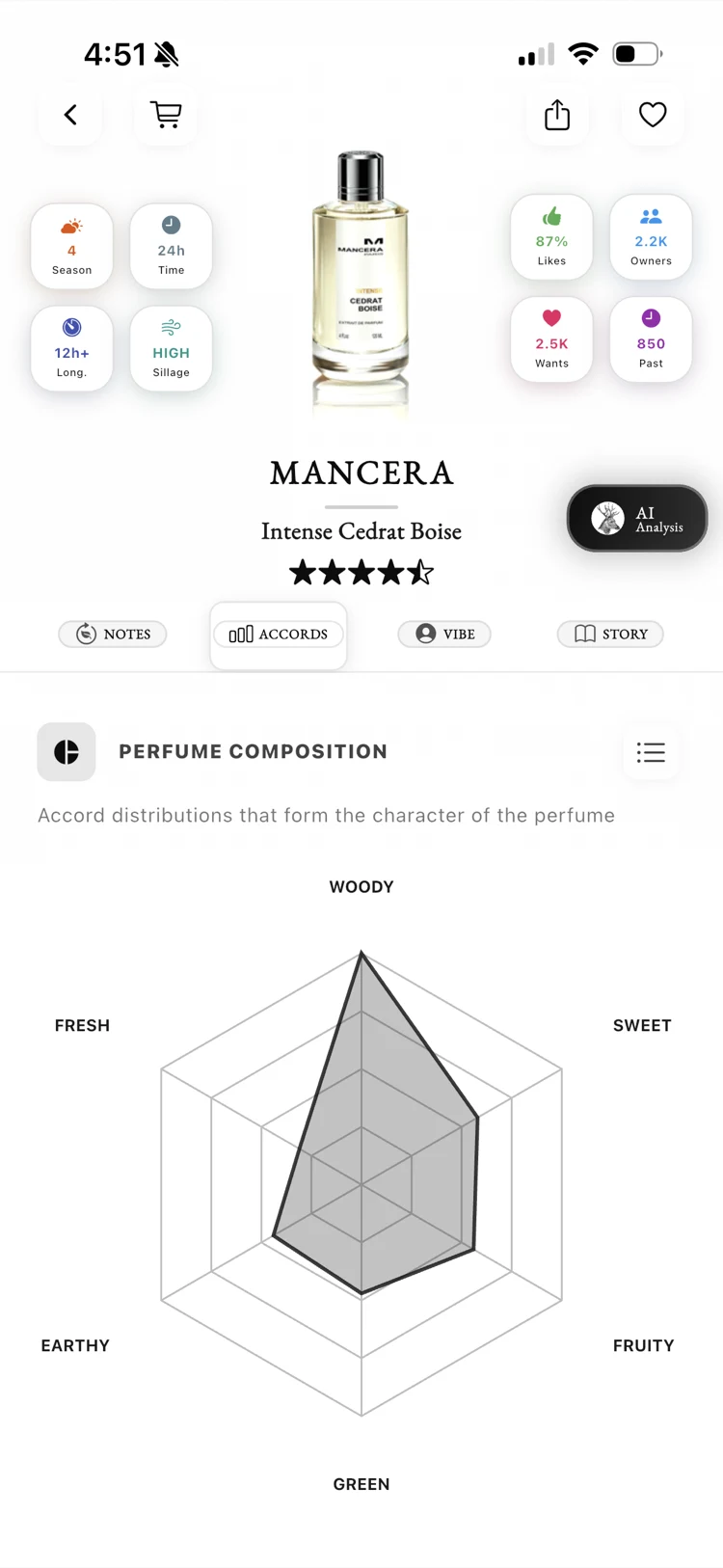
- Accord radar across six axes (Woody, Fresh, Sweet, Earthy, Fruity, Green), a finer-grained map than family alone.
- Vibe gauge for season, occasion, age, and gender.
- Match score against your personal profile, with written reasoning.
- Scent map placement, redrawn every time you like, dislike, or scan something, so later sessions sharpen.
The result is that a search like "Resinous-Floral, low projection, autumn evenings, alternative to MFK Baccarat Rouge 540" returns 8-12 candidates, most of them niche, several you have never heard of, all defensible. The full mechanics are unpacked in our AI perfume advisor field guide.
What to do next
If you have read this far, the sensible next step depends on where you are.
- Just starting? Run a 12-question profile through the app, then read How to Find Your Signature Scent in 7 Honest Steps.
- Wanting depth? Top, Middle, Base: How the Notes Pyramid Actually Works goes one level deeper, into the chemistry of why the families behave the way they do.
- Curious about creating? The Scent Lab lets you create your own scent within or across families and exports an IFRA-compliant manufacturing PDF.
The families are a map. The signature is the trip you take with it.
For the official industry reference, see Michael Edwards' Fragrance Wheel and the Wikipedia overview for context.
Frequently asked
- How many fragrance families are there?
- Modern fragrance taxonomy uses 7 to 10 families, depending on the source. Michael Edwards' Fragrance Wheel (the industry-standard reference) lists 4 main families subdivided into 14 subfamilies. Fragnatique uses a working set of eight: Citrus, Floral, Woody, Spicy, Gourmand, Aromatic, Resinous, and Earthy, granular enough to compare similar fragrances without overwhelming a first-time buyer.
- Are olfactory families the same as fragrance families?
- Yes. Olfactory families is the technical term, translated from the French *familles olfactives* and used in perfumery training; fragrance families is the English trade standard; perfume families is the retail phrasing. All three name the same classification. The fragrance wheel is different: it is Michael Edwards' arrangement of those families into a circle showing which sit next to each other and which contrast.
- What is the difference between a fragrance family and a fragrance note?
- A note is a single ingredient or accord (bergamot, sandalwood, oud, tonka bean). A family is a category that groups dozens of related notes. Bergamot and lemon are both Citrus notes; sandalwood and cedar are both Woody. A perfume usually contains notes from 2-4 families and is classified by whichever family dominates the dry-down.
- Is chypre a fragrance family?
- Chypre is a classic structure, a fragrance built around a citrus top, a labdanum-oakmoss base, and a floral or woody heart, that overlaps Earthy and Resinous in modern taxonomies. Pure chypres are rarer post-2009 because the EU restricted oakmoss; most contemporary 'chypre-style' perfumes are Earthy-Floral hybrids.
- What are the most popular fragrance families in 2026?
- Gourmand, Woody, and Floral lead in mainstream sales. Niche shoppers tilt toward Resinous (oud, amber, leather) and Earthy (vetiver, oakmoss, patchouli). Aromatic and Citrus dominate summer; Spicy and Resinous dominate winter.
- How do I know which fragrance family I prefer?
- Look at what you already love eating, wearing, and inhabiting. Coffee and vanilla → Gourmand. Pine, cedar, woody interiors → Woody. White flowers and fresh laundry → Floral. The fastest formal method is a 12-question quiz on an AI perfume advisor. Fragnatique scores you across all eight families in 3 minutes.
- Can a perfume belong to more than one family?
- Almost every perfume does. Classification is by dominant accord. A 'Woody-Floral' is a fragrance whose base is woody but whose heart is floral; a 'Spicy-Gourmand' is exactly what it sounds like. The bridges are where the most interesting signature scents live.

Explore Fragnatique