Every recommendation I get comes with a percentage attached. Creed Aventus came back at 87 percent for me, Baccarat Rouge 540 at 61, and I have seen the same bottle scored differently for a friend.
What is the number actually measuring? Is it how good the perfume is, how close it is to what I already own, or something else? And at what point does a score stop being worth paying attention to?
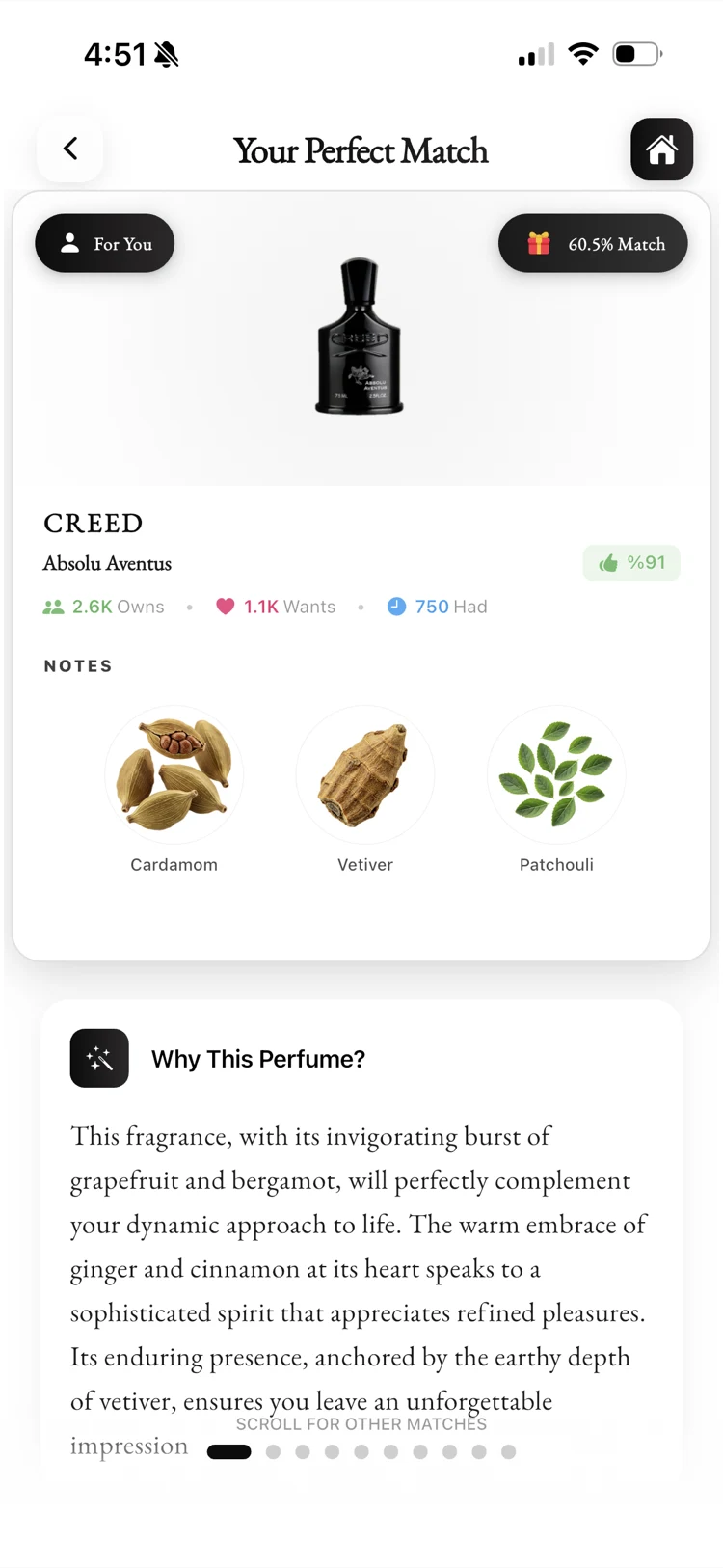
Every bottle here carries a personal match score
Open any perfume named in this thread and the app scores it against your own profile, with the reason written out: which notes align, which occasions fit, and how it differs from what you already wear. 40 to 50 ranked matches per session.
Open it on iOS4 answers
Most useful answer firstMost useful answer
The single most useful thing to understand: it is a compatibility reading between one fragrance and one person, not a quality rating. There is no score a perfume carries on its own. Aventus is the same perfume whether it reads 87 for you and 40 for someone else.
What goes into it, in plain terms:
- Your profile. The questions you answered, the fragrances you marked as liked or disliked, and the bottles sitting in your cabinet. That is the reference the perfume is compared against.
- The composition. Not the marketing note list, but the structure: what sits in each tier of the pyramid, which accords the blend actually produces, and how loudly it projects.
- Context. Season, occasion and time of day, because a fragrance that suits you at a winter dinner is not automatically the one for a July commute.
Why two bottles with near-identical note lists score twenty points apart: a note list tells you which materials are present, not what they are doing. Sandalwood as the spine of a composition and sandalwood as a soft finish under vanilla are the same word and two different experiences. The score reads the second thing.
The practical rule: a score above roughly 80 is worth ordering a sample of. Between 60 and 80 is worth reading the reason before you decide. Below that, it is telling you something in the structure works against your profile, and it is usually right about which part.
Adding the part people skip: the paragraph next to the number is worth more than the number.
A percentage compresses a lot of reasoning into one figure, and compression loses the thing you actually need, which is why. The written reason names the notes that aligned, the occasions it fits, and often the way it differs from something you already wear. That last part is the one I use most, because "you like this but it is drier and louder" is an instruction I can act on, and "74 percent" is not.
I have bought two bottles in the last year that scored in the sixties. Both times the reason said something like "shares the woody-amber base you keep returning to, but opens sharper than your usual". That was exactly right, and the sharpness was the part I wanted. The number was reading me accurately and I still disagreed with the conclusion, which is allowed.
Worth knowing that the number moves. It is not stamped on the perfume once.
The profile it compares against is redrawn every time you like something, dislike something, or scan a bottle in a shop. A fragrance that read 62 in your first week can read 78 three months later, not because the perfume changed but because the picture of you got more complete. Early scores are working from twelve answers; later ones are working from twelve answers plus everything you have done since.
Which is why the advice for a new profile is not "trust the top result" but "sample across the top ten". You are teaching it as much as it is teaching you.
Where the number stops being useful, from someone who over-indexed on it for a while:
It cannot smell your skin. Two people with identical profiles can wear the same 90 percent match and get different results, because skin chemistry moves the base around in ways no data model sees. It also cannot know that a fragrance is tied to a memory you would rather not revisit, or that your partner hates it.
So: excellent at narrowing a catalogue of thousands to a shortlist of ten. Useless at making the final call between two finalists. That last step is a full day of wear each, on skin, and no percentage substitutes for it.
- Creed Silver Mountain Water
- Maison Francis Kurkdjian Baccarat Rouge 540
Get personal answers inside the Fragnatique app.
Ask follow-ups, get a match score against your taste profile, and pull curated shortlists into your wishlist. The AI advisor lives where the conversation happens.