The app offered to read a photo of me and produce a style archetype, then recommend from that. I uploaded one, got back something like an urban archetype with a written analysis, and the matches did shift.
My question is whether this is a real signal or a well-dressed party trick. Why would what I wear have anything to do with what I should smell like?
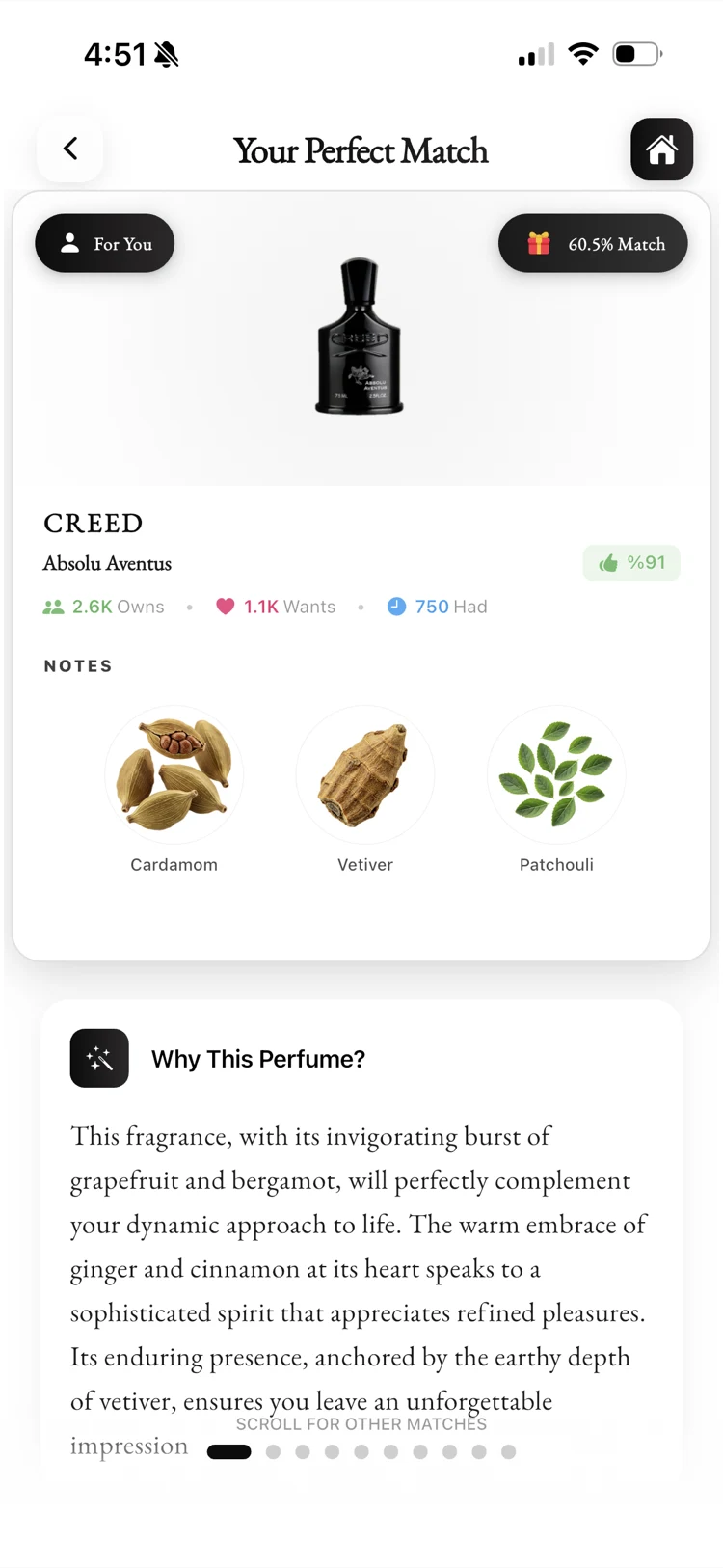
Every bottle here carries a personal match score
Open any perfume named in this thread and the app scores it against your own profile, with the reason written out: which notes align, which occasions fit, and how it differs from what you already wear. 40 to 50 ranked matches per session.
Open it on iOS4 answers
Most useful answer firstMost useful answer
It is a real signal, and the reason is narrower than it first sounds.
Dressing and choosing a fragrance are the same category of decision: how much space you want to take up in a room. Someone in unstructured linen in muted tones has already told you they do not want to arrive before they arrive. Someone in sharp tailoring and high contrast has told you the opposite. That preference transfers almost directly onto projection, sillage and how sweet or how dry a composition should read.
What it is actually looking at:
- Palette. Muted and earthy versus saturated and high contrast.
- Fabric and texture. Matte wool and linen behave differently as a signal than satin and leather.
- Silhouette. Structured versus loose, and how deliberate the whole thing looks.
- Setting. A city street at dusk and a kitchen in daylight are different briefs.
What comes back is three layers written out: a style reading, a personality note, and a fragrance profile derived from them. The archetype is the compression of all three into a name you can remember.
It is a hypothesis, not a diagnosis. But it is a better first guess than "what do you like", which most people cannot answer usefully about a sense they have never had to describe.
The honest limits, because I tested it with three photos of myself on purpose.
A work photo, a weekend photo and a photo from a wedding produced three different readings, and all three were defensible. That is not a failure. It is telling you something true: most people are not one archetype, they are two or three depending on the day, which is exactly why a fragrance wardrobe beats a single signature for most of us.
What it cannot see: your budget, your climate, whether you are allergic to something, and whether the clothes in the photograph are the clothes you want to wear or the ones your job requires. If you dress for an office you dislike, the reading will be accurate about the photograph and wrong about you. Upload the weekend one.
Practical note that made it far more useful for me: the archetype does not replace the profile, it feeds into it.
I did the twelve questions first, then added a photo. The matches after the photo were not a different list, they were the same list reordered, with the reasoning changed. Things that had been ranked on note preference alone started being ranked on note preference plus how loudly they project. That reordering is where the value was.
Doing the photo first and skipping the questions gave me a shallower result. It is a second input, not a shortcut past the first one.
One more thing worth saying because it is the part people are quietly worried about: it is reading the clothes and the setting, not scoring your face.
The written analysis it returns is about palette, texture, posture and environment, and you can check that yourself, because it tells you what it saw before it recommends anything. If the reading does not describe your photograph, the matches built on it are not worth much either, and you should try a different picture. Being able to audit the reasoning is the reason to trust it at all.
- Le Labo Santal 33
- Mancera Cedrat Boise
Get personal answers inside the Fragnatique app.
Ask follow-ups, get a match score against your taste profile, and pull curated shortlists into your wishlist. The AI advisor lives where the conversation happens.