How to Tell If Perfume Is Fake: A Step-by-Step Check
How to tell if perfume is fake: check the seller, box, batch code, bottle, sprayer and scent in order, which signs prove nothing, and how to get a refund.
- 01Where you bought it is the strongest proof: houses guarantee only what is sold through their own shops and the retailers they authorise.
- 02On the bottle in hand, check the wrap, the print, a batch code that matches on box and bottle, the cap, the sprayer collar and dip tube, and the juice.
- 03Batch code sites only read a date, a barcode prefix does not show where a perfume was made, and colour can vary between genuine batches.
You can tell if a perfume is fake by checking, in this order: where you bought it, the box, the batch code, the bottle and sprayer, the juice, and how the scent wears over a few hours. The seller is the strongest proof, because houses guarantee only what is sold through their own shops and authorised retailers. After that, one odd detail proves little, but several red flags together are a strong sign of a counterfeit.
This guide is built to be used with the bottle in your hand. It starts with the checks that settle the most and ends with the ones that are often misread. A counterfeit is a copy sold under the real house's name and packaging; a dupe sold under its own name is a different thing, covered in our piece on whether perfume dupes are legal.
The Quick Checklist
| Check | What an original shows | Red flag |
|---|---|---|
| Seller | The house's own shop or a retailer it lists | Unknown seller, social media shop, no address |
| Price | The usual price, or a sale you can trace | Far below the usual price, with no clear reason |
| Cellophane | Tight and clear, with neat folded seams | Loose or wrinkled, extra glue or tape, or no wrap at all |
| Box print | Sharp, straight, correctly spelled | Blurry print, typos, thin card |
| Batch code | On the box and on the bottle, the same code | Missing, or different on box and bottle |
| Barcode | A product number | Not a sign either way: it does not show where a perfume was made |
| Cap | Sits straight and closes firmly | Wobbles or feels loose |
| Sprayer collar | An even, tight metal ring | Dents, glue, scratches, a tilted sprayer |
| Dip tube | Thin, cut to reach the bottom | Thick, coiled or far too long |
| Juice | Clear, close in colour to a known original | Cloudy or oily |
| Scent | Matches the house's notes and changes over hours | Harsh, sour, or gone within half an hour |
| House check | The QR code opens the house's own site and confirms it | A different domain, an unknown code, a high scan count |
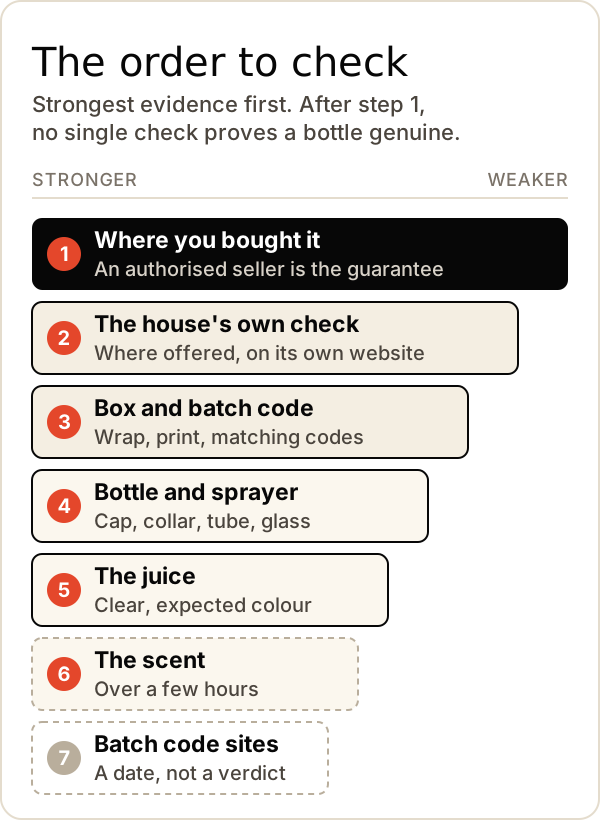
The order of the checks below, strongest evidence first. Tap the diagram to open it full size.
Step 1: Check Where You Bought It
This is the check that settles the most, and it is the one you can do before you pay.
Authorised sellers. Chanel's anti-counterfeit page puts it plainly: "Authenticity is only guaranteed if the product has been purchased from a CHANEL Boutique or from an authorized retailer", and it points to its store locator for the full list. Chanel also says that authenticating products "is not a service offered by CHANEL", so the seller has to be right from the start. Most houses publish a store locator or a list of stockists; look the shop up there rather than trusting a "100% authentic" line on the shop's own page. In 2025 Chanel began marking its authorised online beauty retailers with an e-logo, FashionNetwork reported. Memo Paris gives the same advice in its own words: buy "from authorized retailers, reputable perfume stores, or directly from this website", adding that counterfeits "are not covered by manufacturer warranties and return policies".
Prices that are too good. In August 2026 the Korea Consumer Agency warned against products "priced excessively low compared to typical market prices" after testing counterfeits seized by police. Royal Greenwich Trading Standards tells traders to "be suspicious of prices that seem too low for famous-name products as they're unlikely to be genuine". A real sale exists; a large discount on a scent that is full price everywhere else, from a seller you cannot place, is the pattern to avoid. Our Black Friday perfume guide has more on telling a real discount from an inflated one.
Marketplace and social media sellers. The same Korean report found the counterfeits were sold mainly through social networks and online platforms. Its advice for buying there: check the seller's information and reviews. In practice, that means a business name and address you can verify, a history of selling the same products, and a listing that shows the actual bottle rather than the house's own photos.
Step 2: Check the Box
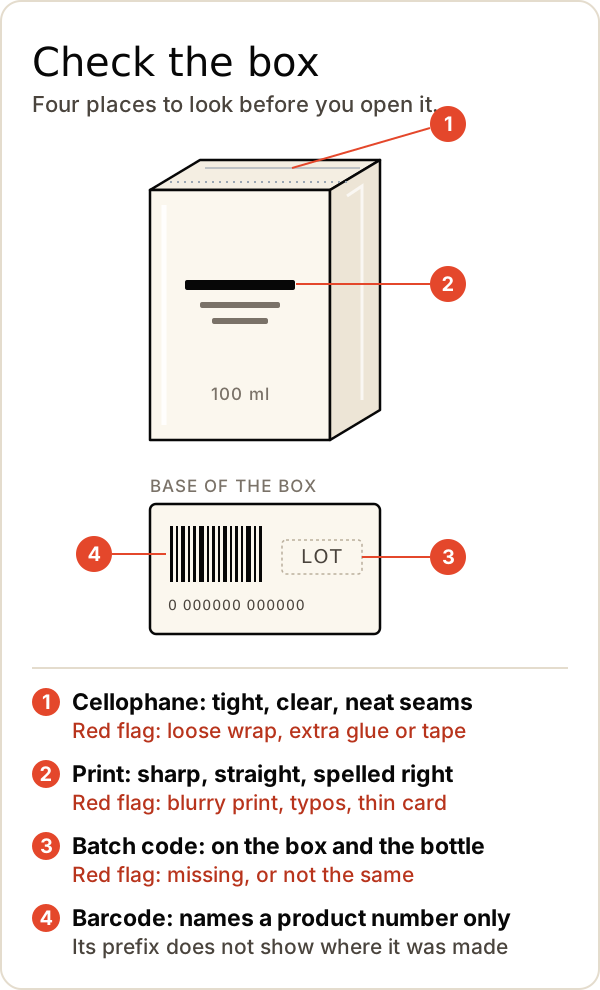
Four places to look before you open the box. Tap the diagram to open it full size.
The cellophane. On a well-made perfume, ABC's Good Morning America wrote, "the cellophane is wrapped closely around the box"; if it is "messy or moving around the box", treat it as a fake. It added a second sign: "If there is a lot of tape or glue inside the perfume box or on the exterior of the packaging," the perfume is probably not genuine. UK trading standards teams list "no cellophane wrapping" or "no outer wrapping" among their warning signs for perfume. Look at the seams too: on a factory wrap they are folded and sealed neatly, not bunched.
The print. Staffordshire Trading Standards says a perfume sold without its packaging, or with packaging that "appears to be of low quality, or includes printing errors (for example blurry pictures, typos, spelling or grammatical errors), it is probably counterfeit". Read every line on the box, including the small print on the back: the house name, the perfume name, the concentration and the volume. If the box says eau de toilette and the listing said eau de parfum, ask why; our guide to EDT, EDP and parfum explains what each label means.
The inside. Once open, look at how the bottle is held. In a side-by-side comparison by the Australian consumer group Choice, the counterfeit sat in an otherwise empty box while the genuine bottle was held in place by extra packaging.
The batch code. In the European Union the law requires one. The cosmetics regulation lists "the batch number of manufacture or the reference for identifying the cosmetic product" among the details that the container and the packaging must both carry, in "indelible, easily legible and visible lettering"; only a product too small to take it may carry it on the packaging alone. So a genuine bottle sold in the EU should have a code on the box and on the bottle, and since both come from the same batch, they should match. Trading standards teams name "no batch code numbers" as a warning sign for perfume. Retailers who check stock also look at how the code is applied: printed or embossed into the box, not on a loose sticker.
The barcode. It is useful for one thing: the number should identify the product. It is not a guide to where the perfume was made. GS1, the organisation that issues barcode numbers, answers that question directly: "No, The GS1 Prefix does not show the country of origin", and a product "may have been produced anywhere in the world". The prefix shows which national GS1 office issued the number. A barcode is also printed like the rest of the box, so a correct one proves nothing on its own.
Step 3: Check the Bottle
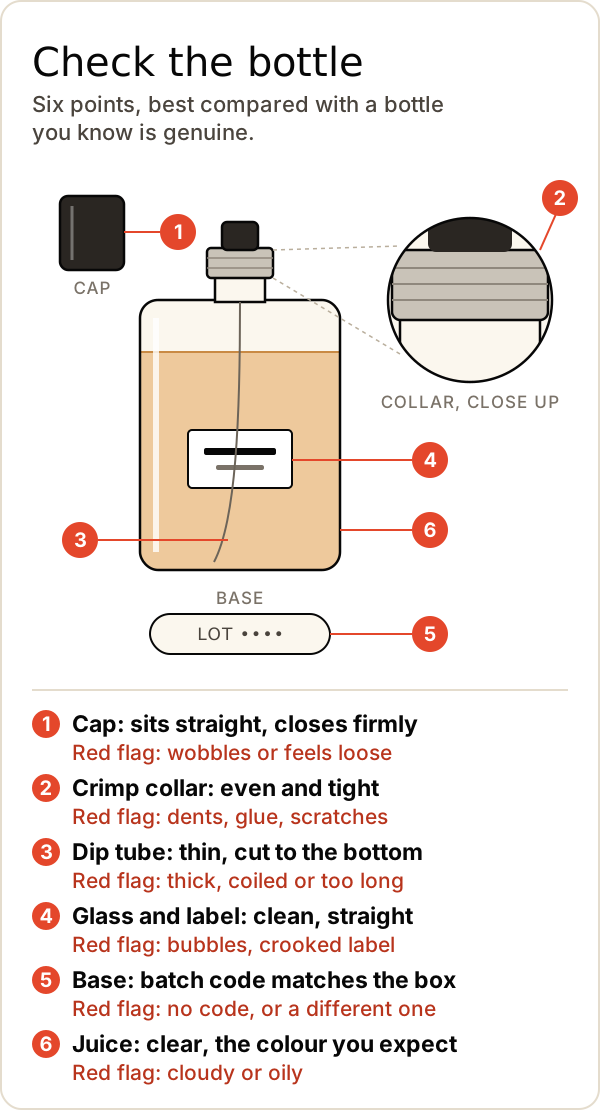
Six points on the bottle and sprayer. Tap the diagram to open it full size.
The bottle is where a side-by-side comparison helps most. Use a bottle you know is genuine, a tester at an authorised counter, or the photos on the house's own product page, and go point by point. Lattafa says its genuine perfumes "are produced with premium materials, precise wrapping", while "counterfeits often use cheap materials, low-quality printing".
- The glass. Clean and even, without bubbles, rough patches or a cloudy look. Moulded glass can show a faint line where the mould met; compare it with your reference rather than reading any seam as a fake.
- The weight. Retailers who authenticate stock often note that counterfeit bottles feel lighter. That only works against a genuine bottle of the same size.
- The cap. It should sit straight and close firmly. A cap that wobbles, sits crooked or feels hollow next to the original is a red flag. If the original cap closes with a magnet or a click, the copy should too.
- The label or engraving. Straight, centred and crisp, with the same font as the house's own photos. Smudged letters, a label that sits at an angle, or a name engraved where the original is printed (or the reverse) all deserve a closer look.
- The base. The batch code should be there, and it should be the same code as on the box.
Step 4: Check the Sprayer and the Dip Tube
Two small parts that counterfeits often get wrong, because they are hard to copy cheaply.
The crimp collar. This is the metal ring that clamps the sprayer to the neck of the bottle. On a genuine bottle it is usually even, tight and clean, and the sprayer sits straight. Dents, scratches, glue at the base of the collar or a sprayer that leans are worth comparing against your reference.
The dip tube. Look through the glass. Retailers who authenticate stock describe a genuine tube as thin, often nearly invisible in the juice, and cut to reach the bottom of the bottle. A thick, coiled or bent tube that is clearly too long is a common sign of a copy.
The spray. Press once, away from your face. A genuine sprayer usually gives a fine, even mist; spitting drops or a jet are a red flag on a bottle that should be new.
Step 5: Check the Juice
Colour. Compare it with a known original: a tester, a friend's bottle or the house's own photos. Expect a match in the general shade, not an exact one. Genuine batches vary: Malin+Goetz explains that with natural ingredients and essential oils, "different batches of the same product can occasionally vary in color, texture and fragrance", and that "storage conditions, including temperature and light exposure, can also have an effect". A bright blue juice where the original is pale gold is a different matter.
Clarity. Choice puts the rule simply: the liquid "should be clear and not overly oily". Cloudiness or floating particles in a new bottle are a reason to stop and ask the seller.
Step 6: Check the Scent Over a Few Hours
The opening is the weakest test, because the first minutes are the part a copy most often gets close to. What gives a fake away is how it wears.
- Compare with the house's notes. Lattafa says each of its fragrances has a profile described on its website, and that "counterfeit versions rarely match these notes accurately and may smell harsh or fade quickly". Read the notes on the house's own page, then smell for them as the scent settles. Our guide to the fragrance notes pyramid explains which notes show first and which come later.
- Watch for harsh, bitter or sour. Choice says a perfume "shouldn't be bitter or sour".
- Try the card test. Choice suggests spraying a piece of card and coming back after half an hour; an expert it quoted said "if it only lasts 30 minutes, it's probably a dud".
- Compare side by side. Spray your bottle on one wrist and a tester from an authorised counter on the other, and check both at intervals over a few hours.
Keep the result in proportion. How long a genuine perfume lasts depends on its concentration and your skin; the houses' own figures run from about 3 to 8 hours on skin, as our guide to how long perfume lasts sets out. A short-lived scent is a reason to look harder at the other checks, not proof on its own.
Step 7: Batch Code and QR Lookups: What They Can and Cannot Prove
Batch code websites. Sites that decode batch codes read a production date from the code; the best known, CheckFresh, describes its job as reading the manufacturing date. A code that decodes to a sensible date shows only that it follows the house's pattern. A counterfeiter can copy the code of a genuine bottle onto every box. A code that decodes to nothing, or to a date before the perfume was launched, is the useful result: that is a red flag.
The house's own QR check. Some houses now run their own verification, and these settle far more than a batch code site, as long as you check where the link goes.
- Lattafa puts a 3D holographic security label with a QR code on its packaging. Its "Spot a fake" page says to make sure the link "matches exactly: verify.lattafa.com". A code "scanned over 1,500 times" is flagged as suspicious, which "suggests a cloned label", and a code the system "does not recognize" indicates "a complete counterfeit".
- Rasasi uses a 3D holographic security label too; its authenticity page says the link should start with "authentication.rasasistore.com".
- Afnan places its hologram label inside the packaging, with "www.afnan.com printed beside the code"; the scan should open "the official Afnan verification page at b.afnan.com or verify.afnan.com". Green confirms the product, amber means the code "has been scanned more times than usual" and red means it may not be genuine.
The scan counts are the point. A QR code is easy to photograph and reprint, which is why these houses watch how often each code is checked. A QR code that opens any other domain, however official it looks, proves nothing.
House Resources Worth Bookmarking
- Lattafa: the Spot a fake page and its verification system at verify.lattafa.com. To report a suspected fake, it asks for the seller's name or link, where you bought it, and photos of the product and packaging, including the QR code label.
- Rasasi: the product authenticity page.
- Afnan: the security label guide.
- Chanel: the anti-counterfeit page and the store locator. Chanel says it cannot share detailed information on identifying genuine products "as this information could be used by the counterfeiters", and takes reports at [email protected].
For any other house, look for a store locator, a list of authorised retailers or an anti-counterfeit page on its own website, and use its customer service address if you are unsure.
Is Fake Perfume Dangerous?
No one outside the counterfeiter knows what is in the bottle. US Customs and Border Protection warns about "the potential harm associated with counterfeit perfumes, which can sometimes contain unknown chemicals". In August 2026 the Korea Consumer Agency reported on 34 counterfeit cosmetics seized by police, 18 of them perfumes. Six of the perfumes contained methanol at 73.7 to 96.9 percent, against a permitted standard of 0.2 percent or less. The agency said counterfeits "are likely to lack verified safety of their main ingredients" and advised people to stop using counterfeit products from unclear sources.
What to Do If You Bought a Fake
- Stop using it and keep everything. The bottle, the box, the receipt or order confirmation, the listing and your messages with the seller. Photograph the bottle, the box, the batch codes and any QR label.
- Ask the seller for a refund. In the UK, Citizens Advice says "you're legally entitled to a full refund on fake goods within 30 days of paying for them"; up to six months, the seller can offer a genuine replacement first, and must refund if it cannot. A seller who says the low price made it obvious has no excuse: "they're breaking the law by selling fake items and your legal rights still apply". Rules differ in other countries, so check your local consumer body.
- Use the marketplace's guarantee. eBay's Money Back Guarantee covers an item that is not as described, including when "there are strong indicators that the item is counterfeit"; the buyer must request a return "but may not be required to ship the item back to the seller", and the request is due within 30 days of delivery. PayPal's buyer protection terms list an item advertised as authentic that is not authentic among the "significantly not as described" cases they cover. Other marketplaces have their own buyer guarantees; read the one you bought through.
- Ask your card provider. Citizens Advice notes that a debit card payment can be disputed through chargeback, and a UK credit card purchase between £100 and £30,000 through a Section 75 claim.
- Report it. Tell the house: Lattafa and Chanel both ask for reports. In the UK, report the seller to Trading Standards through Citizens Advice; Citizens Advice says Trading Standards can take action against the seller but cannot get your money back. In the US, the government's STOPfakes site points to the IPR Center referral form and CBP's e-Allegations form.
Myths: What Is Not a Reliable Sign
| Claim | Verdict | Why |
|---|---|---|
| The barcode shows where the perfume was made | False | GS1 says the prefix does not show the country of origin |
| A batch code that decodes to a date proves it is real | False | Code sites read a date; a genuine code can be copied onto a fake box |
| Any QR code on the box proves it is genuine | False | Only the house's own system can confirm it, and only on the house's own domain |
| A different colour from my last bottle means it is fake | Not on its own | Genuine batches can vary in colour, and light and heat can change it |
| If it smells a little different, it is fake | Not on its own | Batches can vary in fragrance too; compare with a current tester |
| If it does not last all day, it is fake | Not on its own | Lasting power depends on concentration and skin |
| Fakes only come from street stalls | False | Korea's 2026 cases were sold mainly through social networks and online platforms |
| It was cheap, so I cannot complain | False in the UK | Citizens Advice says your legal rights still apply |
| Shake it: fake perfume makes bubbles that vanish | Unproven | None of the houses or consumer bodies we read uses this test |
The pattern behind the table: each of these looks at one detail that a genuine bottle can also fail, or that a counterfeiter can copy. That is why the seller comes first and why several red flags together count for more than any single one. For more claims about perfume put to the test, see our perfume myths and facts.
Check You Have the Right Perfume in the Fragnatique App
The perfume scanner in the Fragnatique app names a bottle from a photo, with no box, barcode or batch code needed, and shows its notes. That helps with one part of this guide: making sure the bottle in front of you is the perfume the listing says it is, and knowing which notes to expect when you wear it.
It does not tell you whether a bottle is genuine. A scanner reads what a bottle looks like, and a counterfeit is made to look the same, so for authenticity go back to the seller, the box and the house's own check. If you are still choosing what to buy, the perfume finder ranks perfumes for your taste, and you can then buy your pick from the house or one of its authorised retailers.
Frequently asked
How can I tell if my perfume is original?
Start with the seller: the house's own shop or a retailer it lists as authorised is the only route the houses guarantee. Then check the bottle in hand: tight cellophane and clean print on the box, a batch code that is the same on the box and the bottle, a cap that sits straight, an even sprayer collar, a thin dip tube, clear juice and a scent that matches the house's notes for a few hours. If the house runs its own QR check, use it. One odd detail proves little; several together are a strong sign of a fake.
Can I check a perfume's authenticity with the batch code?
Only partly. A batch code should be on the box and the bottle, and the two should match. Batch code websites read a production date from the code, which shows the code follows the house's pattern, not that your bottle is genuine, because a code can be copied from a real bottle. Houses that run their own checks, such as Lattafa, Rasasi and Afnan, use a QR security label rather than the batch code.
Does fake perfume smell the same as the real one?
Sometimes close at first, which is why the opening is a poor test. Lattafa says counterfeits rarely match its listed notes and may smell harsh or fade quickly, and the Australian consumer group Choice says a perfume should not smell bitter or sour. Wear it for a few hours, or spray a card and come back after half an hour, and compare it with a tester at an authorised counter.
Is it safe to use fake perfume?
No one can say what is inside a counterfeit. US Customs and Border Protection warns that counterfeit perfumes can contain unknown chemicals, and in 2026 the Korea Consumer Agency found methanol far above the legal limit in six of 18 counterfeit perfumes it tested. Its advice was to stop using counterfeits from unclear sources.
Can a barcode tell me if perfume is fake?
No. GS1, the organisation behind retail barcodes, says the first digits of the barcode show which national GS1 office issued the number, not the country where the product was made. A barcode is printed like the rest of the box, so a correct one is not proof either.
What should I do if I bought a fake perfume?
Stop using it, keep the bottle, box and receipt, and photograph everything. Ask the seller for a refund, then use the marketplace's buyer guarantee or your card provider if the seller will not help. Report the seller to the house and to your local consumer or trading standards body. In the UK, Citizens Advice says you are entitled to a full refund on fake goods within 30 days.

Written by Fragnatique Team
Published