EDC, EDT, EDP, Parfum, Intense and Extrait: What the Labels Really Mean
No EU or US law defines EDT, EDP or parfum. The percentages Dior, Frédéric Malle and Floris state, side by side, and what Intense, Elixir and cologne mean.
- 01The labels say how much perfume concentrate is dissolved in the alcohol, and no EU or US law defines them: Frédéric Malle's own FAQ calls the classifications not official, and the EU cosmetics regulation names perfumes, toilet waters and eau de Cologne without defining any of them.
- 02The houses do not agree on the numbers. Malle's glossary puts an eau de toilette at 5 to 10 percent and an eau de parfum at 10 to 20; Dior's Miss Dior page and Floris London give 5 to 15 and 15 to 20, with 20 to 30 for a parfum.
- 03Hours on skin are house claims, not measurements: Dior's Miss Dior page gives an eau de toilette 3 to 5 hours, its Sauvage page 6 to 8, and Floris London 4 to 6; both houses give an eau de parfum 6 to 8.
- 04Intense, Elixir and Eau Fraîche are names, not rungs: Chanel sells Coco Mademoiselle Intense as an eau de parfum and Chance Eau Fraîche as both an eau de toilette and an eau de parfum, and Dior describes its Elixir as typically above 20 percent fragrance oil.
- 05Concentration is one input, not the whole answer: by Dior's and Floris London's own account, the formula, the number of sprays and your skin also decide how long a bottle lasts.
EDC, EDT, EDP, parfum and extrait describe one thing: how much perfume concentrate is dissolved in the alcohol, from the lightest eau de Cologne to the densest extrait. No EU or US law defines the rungs, and the houses give different numbers: Frédéric Malle's glossary puts an eau de toilette at 5 to 10 percent and an eau de parfum at 10 to 20, where Dior and Floris London give 5 to 15 and 15 to 20. Intense, Elixir and Eau Fraîche are product names that sit on those rungs, not rungs of their own.
What do EDC, EDT, EDP, parfum and extrait mean?
Each label is a band of concentration, defined by the house that uses it. One sentence per rung, lightest first:
- Eau de Cologne (EDC) is a light, citrus-led fragrance named after the city of Cologne. Germany's patent office, the DPMA, calls it "the generic term for a light perfume with about 3 to 5 per cent perfume content".
- Eau de toilette (EDT) is, in Merriam-Webster's definition, "a perfumed liquid containing a lower percentage of fragrant oils than is contained in ordinary perfume or eau de parfum"; Frédéric Malle's glossary says the concentration "usually stands between 5% and 10%".
- Eau de parfum (EDP) holds more fragrant oil than an eau de toilette and less than perfume, in Merriam-Webster's words; Malle's glossary puts it "between 10% and 20%", Dior's Miss Dior page at 15 to 20 percent.
- Parfum, extrait de parfum or extract is the top rung. Malle's glossary defines extract as a concentration that "exceeds 20%" and "the most concentrated form of perfume"; its parfum entry reads, in full, "See extract." Dior gives 20 to 30 percent for "a Parfum or Extrait".
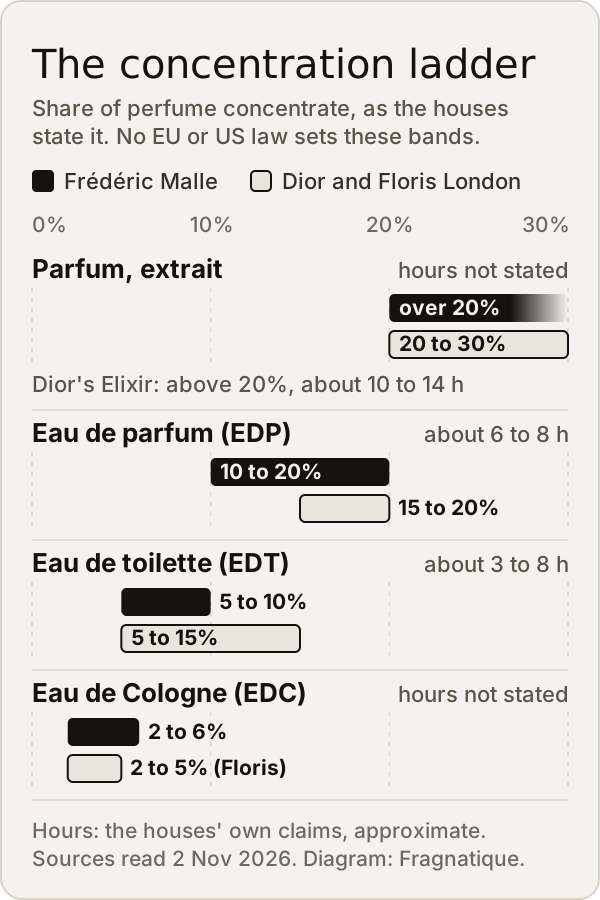
The ladder as three houses draw it. Each bar is a house's own figure for the share of perfume concentrate in the bottle; from eau de toilette up, Dior and Floris London give the same bands, so they share a bar. The hours are the span of the houses' own claims, approximate by their own wording. Tap the diagram to open it full size.
Is there an official standard for perfume concentrations?
No law in the EU or the US defines them, and we found no international standard that does. The clearest statement comes from a house: Frédéric Malle's FAQ says "The classifications (EDT, EDP, Extract, etc…) are not official, but they are supposed to indicate the concentration level of each fragrance and to the quality of the ingredients that are in their formulae." It adds that lately they "have often been used as a way of positioning fragrances, rather than as a way of describing their true nature, which can be confusing."
The law leaves the numbers alone. Regulation (EC) No 1223/2009, the EU cosmetics regulation, lists "perfumes, toilet waters and eau de Cologne" among cosmetic products in its seventh recital and defines none of them. Its annex of restricted substances does use the term eau de toilette: in the text as adopted, it allows 0.004 percent methyl eugenol in an eau de toilette against 0.01 percent in a "fine fragrance", without saying what makes a product one or the other. In the United States, the FDA lists perfume, cologne and aftershave as fragrance products regulated as cosmetics, and its page gives no strength for any of them.
The one place the EU regulation uses the word parfum is Article 19, which requires perfume compositions and their raw materials to appear on the ingredient list as "parfum" or "aroma", the sense explained in our check of natural and synthetic perfume safety. That parfum is the fragrance compound itself, at any strength: Chanel's ingredient list for Chance Eau Fraîche Eau de Toilette begins "ALCOHOL | PARFUM (FRAGRANCE) | AQUA (WATER)".
One official standard we found does draw lines between the labels, and it is regional. Russia's standards agency, Rosstandart, describes GOST 31678-2012, the standard for liquid perfumery, as telling perfumes, colognes, eaux de parfum, eaux de toilette and scented waters apart by their alcohol content, the persistence of the scent, the clarity of the liquid and their total share of fragrance substances. Everywhere else we looked, the rungs are a convention each house fills in for itself.
The words are younger than the bottles. Merriam-Webster records eau de cologne in English from 1802, eau de toilette from 1907 and eau de parfum from 1941. Malle's glossary dates the eau de parfum designation to the late 1970s, and its FAQ adds that in the 1980s "many brands started offering the same formulae in several concentrations". The ladder people shop by today is, by the house's own account, a few decades old.
Perfume concentration chart: how much oil is in each label?
Roughly 2 to 6 percent perfume concentrate for an eau de Cologne, 5 to 15 for an eau de toilette, 10 to 20 for an eau de parfum and over 20 for a parfum or extrait, depending on which house you ask. The chart sets the figures we read on the houses' own pages side by side, with Germany's patent office for eau de Cologne; none is a measurement anyone outside the house can check.
| Label | Share of perfume concentrate, as stated | Hours on skin, as stated (approximate) | On the shelf |
|---|---|---|---|
| Eau de Cologne (EDC) | Malle 2 to 6%; Floris 2 to 5%; DPMA about 3 to 5% | None stated; Floris: "lightest and shortest lasting" | Frédéric Malle's Cologne Bigarade, which the house places below an EDT |
| Eau de toilette (EDT) | Malle 5 to 10%; Dior 5 to 15%; Floris 5 to 15% | Dior 3 to 5 (Miss Dior page) or 6 to 8 (Sauvage page); Floris 4 to 6 | Dior Sauvage Eau de Toilette |
| Eau de parfum (EDP) | Malle 10 to 20%; Dior 15 to 20%; Floris 15 to 20% | Dior 6 to 8; Floris 6 to 8 | Dior Sauvage Eau de Parfum |
| Parfum, extrait | Malle over 20%; Dior 20 to 30%; Floris 20 to 30% | None stated; Floris: "longest lasting" | Chanel N°5 Extrait de Parfum |
| Elixir | Dior: typically above 20%, "between a Parfum and a pure extract" | Dior 10 to 14 | Dior Sauvage Elixir |
| Intense | A name, not a rung: no house figure | None stated | Chanel Coco Mademoiselle Eau de Parfum Intense |
| Eau Fraîche | A name, not a rung: no house figure | None stated | Chanel Chance Eau Fraîche, sold as an EDT and as an EDP |
Floris London gives its figures in a guide on its own site; the Chanel and Diptyque answers quoted below give no percentages. Britannica draws the ladder in two bands only: perfumes, "also called extraits, extracts, or handkerchief perfumes", at about 10 to 25 percent, and toilet water and cologne, which it says are "commonly used interchangeably", at about 2 to 6. It adds a rung below the ladder: aftershave lotions and splash colognes, at about 0.5 to 2 percent perfume oil.
Read across a row and the bands overlap. Dior's and Floris's eau de toilette, 5 to 15 percent, covers Malle's eau de toilette and the lower half of Malle's eau de parfum; Britannica's perfume band, 10 to 25, covers everything Malle calls an eau de parfum. A bottle labeled EDP at one house can, on paper, hold the same share of concentrate as an EDT at another.
Malle's glossary also records why the rungs once meant quality as well as strength. Eaux de toilette, it says, were originally made for a house's best-selling perfumes as "a lighter version using slightly less precious raw materials", while extracts were originally sold "in bottles without sprays" and "the quality of the raw materials was superior to all other versions of the same fragrance". That is the "quality of the ingredients" its FAQ has in mind, and it is one house's account of a tradition, not a rule.
EDP vs EDT: is eau de parfum just a stronger eau de toilette?
No: the houses that sell both say the formula changes, not only the strength. Diptyque answers the question in so many words: "The eau de parfum is not an eau de toilette with a higher concentration of essences. It is a more intense but also different interpretation of the olfactory story." The perfumer, it says, highlights one trait "using new ingredients or a new accord while remaining faithful to the original story". Its example is Do Son: the eau de toilette is a tuberose with pink pepper grafted onto sambac jasmine, the eau de parfum "a headier fragrance, with creamy, slightly milky facets".
Chanel's FAQ puts the formula first and the strength second: "All share the same olfactive identity; however, each formula contains variations that amplify or enhance the perfume wearer's desired effects. In addition, their concentrations are often different and more suited to certain lifestyles." Its product pages show it. Both versions of Chance Eau Fraîche list citron, jasmine and teak wood, but the Eau de Toilette is "a fresh, floral-sparkling expression of CHANCE", while in the Eau de Parfum, "a woody floral-sparkling expression", the teak wood note turns "deep and ambery" and "leaves a lingering trail".
Dior spells out the change for Sauvage. The eau de toilette, its page says, is the "original and lightest interpretation" of the collection, with a cleaner bergamot opening and "without the vanilla depth of the Eau de Parfum"; the eau de parfum "wraps the bergamot in spicy notes before settling into a Papua New Guinean vanilla and ambroxan dry-down". Two recipes, one name.
Frédéric Malle took the opposite route and sells each perfume in one concentration only. Its FAQ: once brands sold the same formula at several strengths, "It was then obvious that there is an ideal concentration for each perfume. For this reason, we sell each perfume in the collection in its optimum concentration." In the same answer, the house places its own bottles on the ladder: Cologne Bigarade and Angéliques sous la Pluie are "lighter than Eaux de Toilettes", Vétiver Extraordinaire and En Passant sit "halfway between Eaux de Toilette and Eaux de Parfums", Musc Ravageur and Iris Poudre "should be considered Eaux de Parfums", and Portrait of a Lady and Carnal Flower count as perfume extracts.
So the label on the box gives the band of strength, not the recipe. This is why Fragnatique gives each version its own perfume page: Dior Sauvage, Sauvage Eau de Parfum, Sauvage Parfum and Sauvage Elixir each have their own notes and their own longevity and sillage reading, and so do Bleu de Chanel, its Eau de Parfum and its Parfum.
Does eau de parfum last longer than eau de toilette?
Usually, by the houses' own figures, but the figures are claims rather than measurements, and one house gives two of them. Dior's Miss Dior Blooming Bouquet page says an eau de toilette lasts 3 to 5 hours on average and an eau de parfum 6 to 8, and Floris London gives an eau de toilette 4 to 6 hours against 6 to 8. Dior's Sauvage page says "Sauvage Eau de Toilette typically lasts 6 to 8 hours on skin, which is standard for an Eau de Toilette concentration", and that after two hours of projection it "winds down into a woody, ambery skin-close scent"; the same page still calls the eau de parfum "stronger, more sensual and longer-lasting". Dior's Sauvage Elixir page gives an elixir 10 to 14 hours. The Chanel, Malle and Diptyque pages we read give no hours.
Concentration is one of several things that decide the hours. The formula is another: Dior's own explanation is that an EDT "feels fresher and lighter because its lower fragrance oil concentration allows citrus and floral top notes to dominate over the heavier base notes". Which base notes a perfume has, and how much of them, is the chemistry the notes pyramid describes: the lightest molecules leave first, the heaviest stay. The dose is a third. Dior says Sauvage Eau de Parfum "requires 3 to 4 sprays daily" where the Elixir "typically requires 1 to 2", so the stronger bottle is also the smaller dose. Skin is a fourth, by the houses' own advice: Dior suggests applying Sauvage to "moisturized pulse points" to extend its longevity, and Floris adds that perfume "interacts with your unique body chemistry, including skin type and pH levels", which it says can change how a fragrance smells on you.
So the label predicts the hours only roughly: Dior gives Sauvage Eau de Toilette the same 6 to 8 hours its Miss Dior page gives an eau de parfum. The only way to know how a given bottle wears is to wear it, as our method for finding a signature scent sets out. Fragnatique's Cabinet keeps a journal for exactly that: each wear you log there answers "How long did it last?" and "How loud was it?", so your own record builds up bottle by bottle.
Parfum vs eau de parfum: what changes at the top?
Mostly the share of concentrate, and at some houses the raw materials and the hour of wear. Dior and Floris London give 15 to 20 percent for an eau de parfum against 20 to 30 for a parfum; Malle gives 10 to 20 against over 20. Malle's glossary adds that extracts were originally sold without sprays, with finer raw materials, and that "a few drops or sprays are enough to reveal the perfume over a very long period". Chanel's FAQ separates the two by the time of day: "A parfum is traditionally worn in the evening, whereas eau de parfum and eau de toilette formulas are more suited for daytime wear."
Parfum and extrait are usually two names for the same rung. Malle's glossary sends parfum straight to extract, Dior's Miss Dior page groups "a Parfum or Extrait" at 20 to 30 percent, Britannica treats extrait as another word for perfume, and Chanel sells N°5 as an Extrait de Parfum. Dior's Elixir page shows that the names still belong to each house: it places the elixir "between a Parfum and a pure extract in intensity", so at Dior an extract can sit above a parfum, and its site sells a Sauvage Extrait as "the ultimate expression of a fragrance".
What do Intense, Elixir and Eau Fraîche mean on a bottle?
They are names a house chooses, and each house places them differently. Three cases, each from the house's own page:
- Intense is, at Chanel, a new facet of an existing eau de parfum. Coco Mademoiselle Intense is sold as an "Eau de Parfum Intense Spray"; Chanel calls it "an intense facet of the COCO MADEMOISELLE personality" and describes it through its composition, "an extreme, luminous concentration of patchouli" with tonka bean and vanilla, not through a percentage.
- Elixir is a tier Dior defines for itself: "a highly concentrated format", typically above 20 percent fragrance oil, "that sits between a Parfum and a pure extract in intensity". The house adds that Sauvage Elixir "is not a cologne in the traditional sense", and the Haute Parfumerie menu of its US site gives "Esprits de Parfum and Elixirs" a category of their own.
- Eau Fraîche is a product name, not a rung. Chanel sells Chance Eau Fraîche as an "Eau de Toilette Spray (EDT)" and as an Eau de Parfum, so the same "fresh water" comes as both. Where a house wants something lighter than an eau de toilette, it says so in its own words: Malle's glossary calls "eaux" at 2 to 6 percent "the lightest way to wear scent".
None of the three names is defined outside the house that uses it, which is Malle's point about positioning. A chart that gives Eau Fraîche 1 to 3 percent, or Intense a fixed percentage, quotes no house we could find.
Cologne vs perfume: what does cologne mean?
Cologne has two meanings: the lightest rung on the ladder, and a men's fragrance of any strength. The older one is a strength and a style: eau de Cologne is the light citrus water Johann Maria Farina named after his adopted city. Germany's patent office dates the Farina firm to 13 July 1709 and says his fragrance water was "not based on musk essences but on notes of bergamot, lemon and orange"; the story is in our article on Farina and Napoleon's cologne. Merriam-Webster glosses the name as French for "Cologne water" and records it in English from 1802. The DPMA defines it by strength, about 3 to 5 percent, and notes that the term "cannot be protected as a trademark" for perfume. Malle's glossary gives the recipe in proportions: 80 to 90 percent citrus notes, up to 10 percent orange blossom, 1 to 2 percent rosemary and aromatics.
The newer meaning is a men's fragrance of any strength. Malle's glossary records both drifts: "Today the term 'cologne' is widely used to describe fresh perfumes that don't only have citrus notes. It is also used interchangeably as a term for men's fragrance." Dior's US page for Sauvage Eau de Toilette calls it "this cologne for men" and "a fresh, citrus-driven men's cologne", at a concentration Dior itself sells as an eau de toilette.
So "cologne vs perfume" has two answers. In the old sense, cologne is the lightest rung and perfume the heaviest: Floris puts them at 2 to 5 and 20 to 30 percent. In the newer sense, the two words sort bottles by who they are marketed to and say nothing about concentration, which is why our fall colognes for men include a parfum and three eaux de parfum, and none that its house sells as an eau de Cologne.
Which concentration should you buy?
Choose by four questions, in this order.
- How many hours do you need? Take the house's own figure for the bottle you are considering, and treat it as a claim. Dior and Floris put an eau de parfum at 6 to 8 hours; for an eau de toilette they give 3 to 5, 4 to 6 or 6 to 8, depending on the page; Dior gives its elixir 10 to 14.
- Where and when will you wear it? Chanel suggests a parfum for the evening and eau de parfum or eau de toilette for the day. Floris calls an eau de toilette "perfect for daytime or warmer weather". Dior says its Elixir suits fall, winter and evenings, and that "for daily office wear or during summer, Elixir can feel overpowering".
- Which version do you actually like? If Chanel and Diptyque are right that the eau de parfum is a different interpretation, smell both on skin before deciding; the stronger one may not be the one you prefer.
- What does a wear cost? Dior's own arithmetic, 1 to 2 sprays of Elixir against 3 to 4 of eau de parfum, means the dearer bottle is not always the dearer habit.
The first question narrows the choice fastest, because it is the one the houses answer in numbers. Set against their own figures:
Matching the hours to the label
| Hours you want | Label that fits, by the houses' figures | Source |
|---|---|---|
| A light touch, briefly | Eau de Cologne | Floris London: "lightest and shortest lasting" |
| 3 to 6 | Eau de toilette | Dior's Miss Dior page, 3 to 5; Floris London, 4 to 6 |
| 6 to 8 | Eau de parfum, or some eaux de toilette | Dior and Floris London, 6 to 8; Dior's Sauvage page gives its EDT the same |
| 8 or more | Parfum, extrait or elixir | Dior's Sauvage Elixir page, 10 to 14; Floris London calls parfum "longest lasting" |
The season shifts the answer. Floris calls an eau de toilette "perfect for daytime or warmer weather", and Dior says its Elixir suits fall, winter and evenings but can feel overpowering at the office or in summer. None of these hours is a measurement: the houses give them as averages or as what a bottle "typically" does, and Floris adds that body chemistry can make the same perfume wear differently on two people.
The app's perfume finder asks the same two things, the hours and the strength you want, and weighs both in what it suggests. Each perfume page then shows a longevity and a sillage reading, so Sauvage Eau de Toilette and Sauvage Elixir can be compared on the same two scales before the first spray.
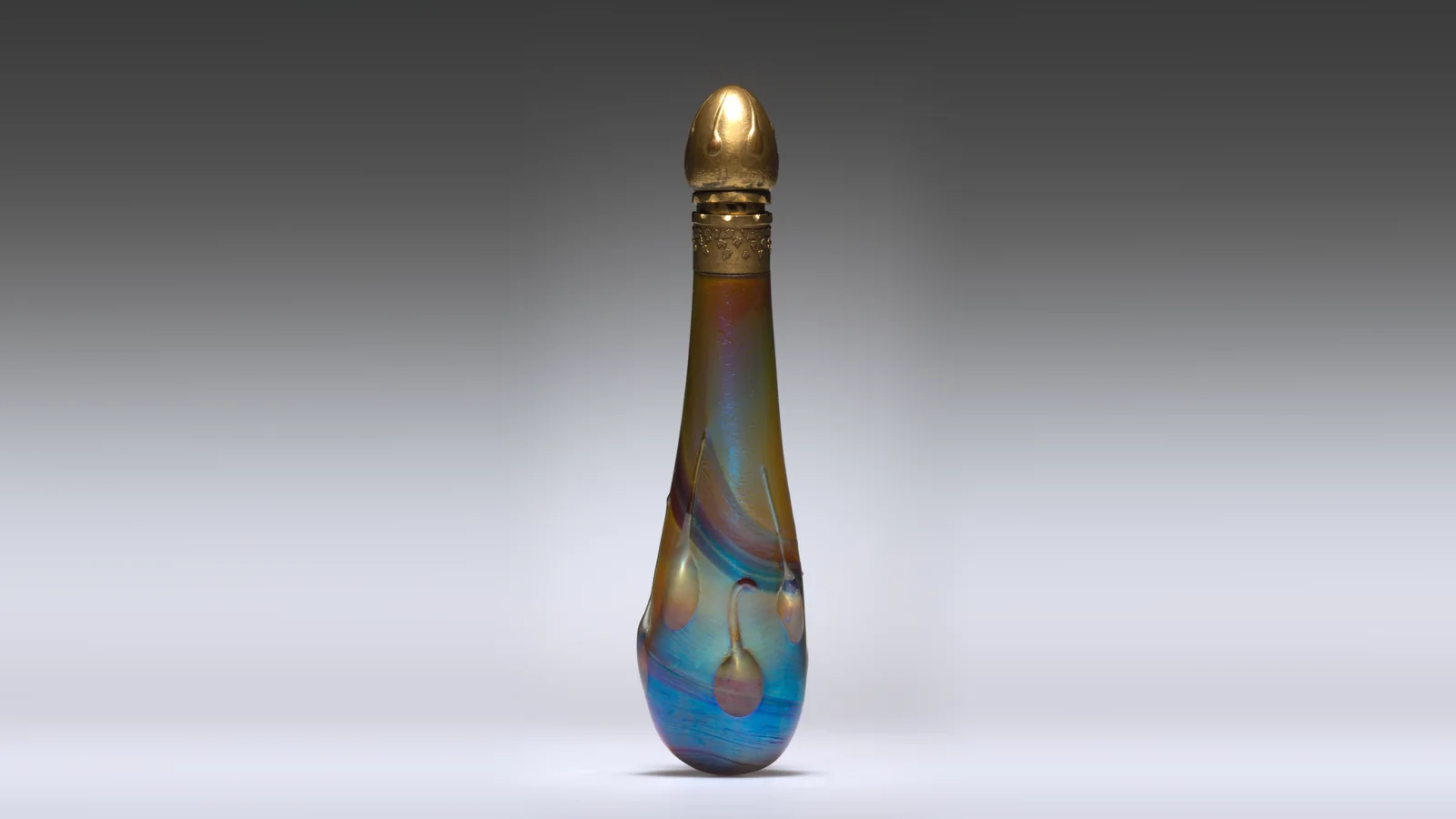
Our cover shows a Favrile glass perfume bottle with a gilt metal cover, 13.4 centimeters tall, made by Tiffany Studios in New York around 1905 to 1910 and photographed by the Cleveland Museum of Art for its open-access collection. It was made to be filled and carries no label at all; in Merriam-Webster's dating, eau de toilette entered English at about the same time, in 1907, and eau de parfum only in 1941. If the bottle in your hand does have a label, the bottle scanner identifies it from a photo and opens its page, with its notes and its longevity and sillage readings.
Frequently asked
Is eau de parfum stronger than eau de toilette?
By concentration, usually: Frédéric Malle's glossary puts an eau de toilette at 5 to 10 percent and an eau de parfum at 10 to 20, while Dior and Floris London give 5 to 15 against 15 to 20. But the houses say the formula changes too. Diptyque writes that its eau de parfum is not an eau de toilette with a higher concentration of essences but a different interpretation, and Chanel's FAQ says each formula contains variations. Dior's Sauvage Eau de Parfum adds spice and a vanilla dry-down that the eau de toilette does not have.
Does eau de parfum last longer than eau de toilette?
As the houses state it, usually, but the figures are claims rather than measurements. Dior's Miss Dior page gives an eau de toilette 3 to 5 hours on average and an eau de parfum 6 to 8, and Floris London gives 4 to 6 against 6 to 8. Yet Dior's Sauvage page says Sauvage Eau de Toilette typically lasts 6 to 8 hours. Base notes, dose and skin matter too. In Fragnatique every perfume page carries a longevity and a sillage reading, so two versions of one fragrance can be compared before buying.
What is the difference between parfum and eau de parfum?
Mostly strength: Dior and Floris London give 15 to 20 percent for an eau de parfum and 20 to 30 for a parfum, and Frédéric Malle gives 10 to 20 against over 20. Malle adds that extracts were originally sold without sprays and made with finer raw materials than the other versions of the same fragrance, and Chanel's FAQ says a parfum is traditionally worn in the evening and an eau de parfum in the day. Parfum and extrait de parfum are usually two names for the same top rung, though Dior places its elixir between a parfum and a pure extract.
What does Intense or Elixir mean on a perfume bottle?
They are product names, not standard concentrations. Chanel sells Coco Mademoiselle Intense as an Eau de Parfum Intense and describes it through an extreme concentration of patchouli, not a percentage. Dior defines a fragrance elixir as a highly concentrated format, typically above 20 percent fragrance oil, between a parfum and a pure extract, with 10 to 14 hours of wear against 6 to 8 for an eau de parfum. Both are the house's own description of its bottle.
Is cologne weaker than perfume?
In the original sense, yes: eau de Cologne is the lightest rung, about 3 to 5 percent perfume content for Germany's patent office and 2 to 5 for Floris London, against 20 to 30 for a parfum. But cologne also means any men's fragrance: Frédéric Malle's glossary notes that the word is used interchangeably for men's fragrance, and Dior's US site calls Sauvage Eau de Toilette a cologne for men. A bottle sold as a cologne in that sense can be an eau de toilette, an eau de parfum or stronger.

Written by Fragnatique Team