AI perfume tools often describe their results as accurate, and some quote percentages. People want to know how far they can actually rely on a recommendation before spending money on a bottle, which kinds of mistake these systems make, and how to tell a good tool from a confident one.
This guide answers those questions without overselling any tool, including ours.
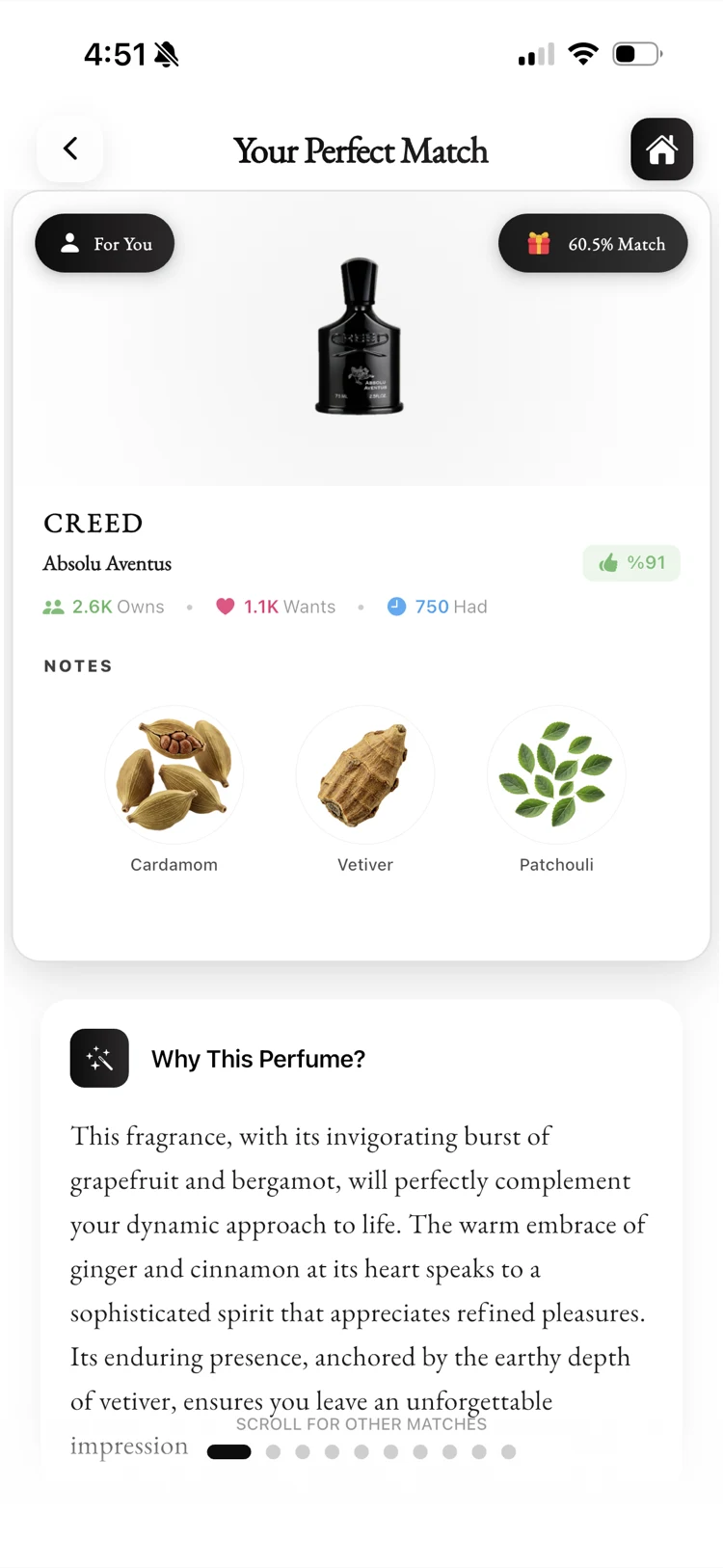
Every bottle here carries a personal match score
Open any perfume named in this thread and the app scores it against your own profile, with the reason written out: which notes align, which occasions fit, and how it differs from what you already wear. Ranked matches every session.
Open it on iOS1 answer
Most useful answer firstMost useful answer
The honest starting point: we know of no independent, published test of consumer AI perfume recommenders. Accuracy figures you see in marketing rarely say what was measured, on whom, or against what. So the useful question is not "what is the accuracy?" but "accurate at what?"
What they are usually good at
- Narrowing the field. Going from many thousands of perfumes to twenty that share the families, accords and intensity you like is where data beats browsing.
- Catching structure. A good system can see that two perfumes you love share a dry woody-amber base even though their note lists look unrelated.
- Avoiding known dislikes. If you reject a note or a style, filtering it out is straightforward and dependable.
Where they predictably miss
- Your skin and climate. The same perfume can project and last very differently from one person to another and from winter to summer. No dataset contains your skin.
- Thin profiles. A recommendation built from a few quiz answers is a rough sketch. Accuracy usually improves as the tool learns from perfumes you actually like and reject.
- Description gaps. Recommenders work from how perfumes are described. A perfume described vaguely, or reformulated since its data was gathered, can be misplaced.
- Personal associations. A scent tied to a memory, or one your partner dislikes, is invisible to any model.
- Commercial bias. A recommender that only draws from one seller's stock can be accurate within that range and still miss the best fit for you.
How to test a tool yourself
- Give it two perfumes you know well, one you love and one you dislike, and see whether it scores or explains them sensibly.
- Read the reasons. If the written explanation for a match does not describe what you know about your taste, the score is not trustworthy for you.
- Sample the top five. Wear each for a full day. If two or three are perfumes you would happily wear, the tool is doing its job for your taste.
- Feed back and repeat. A good system should get closer as it learns. If its suggestions stay the same after clear feedback, it is not learning.
How to read a match score
A match score is a compatibility reading between one perfume and your profile, not a rating of the perfume. A high score is a good reason to sample, a middling one a reason to read the explanation, and a low one usually names the part of the structure that works against your taste. None of them is a reason to buy blind.
In Fragnatique
Our matches come as a compatibility percentage with a written reason naming the notes and accords behind it, and a session returns a ranked shortlist rather than one verdict, because the last step has to be wear on your skin. The methodology page explains what the score means, how the data is checked and where the score stops. To try it against perfumes you already know, start with the AI perfume finder.