Fragrance finder quizzes are everywhere, on brand sites, at retailers and in apps, and newer tools add "AI" to the name. People want to know what actually happens between their answers and the list of perfumes, whether the AI versions are genuinely different, and how to get a useful result from either.
This guide explains both mechanisms and how to judge the output.
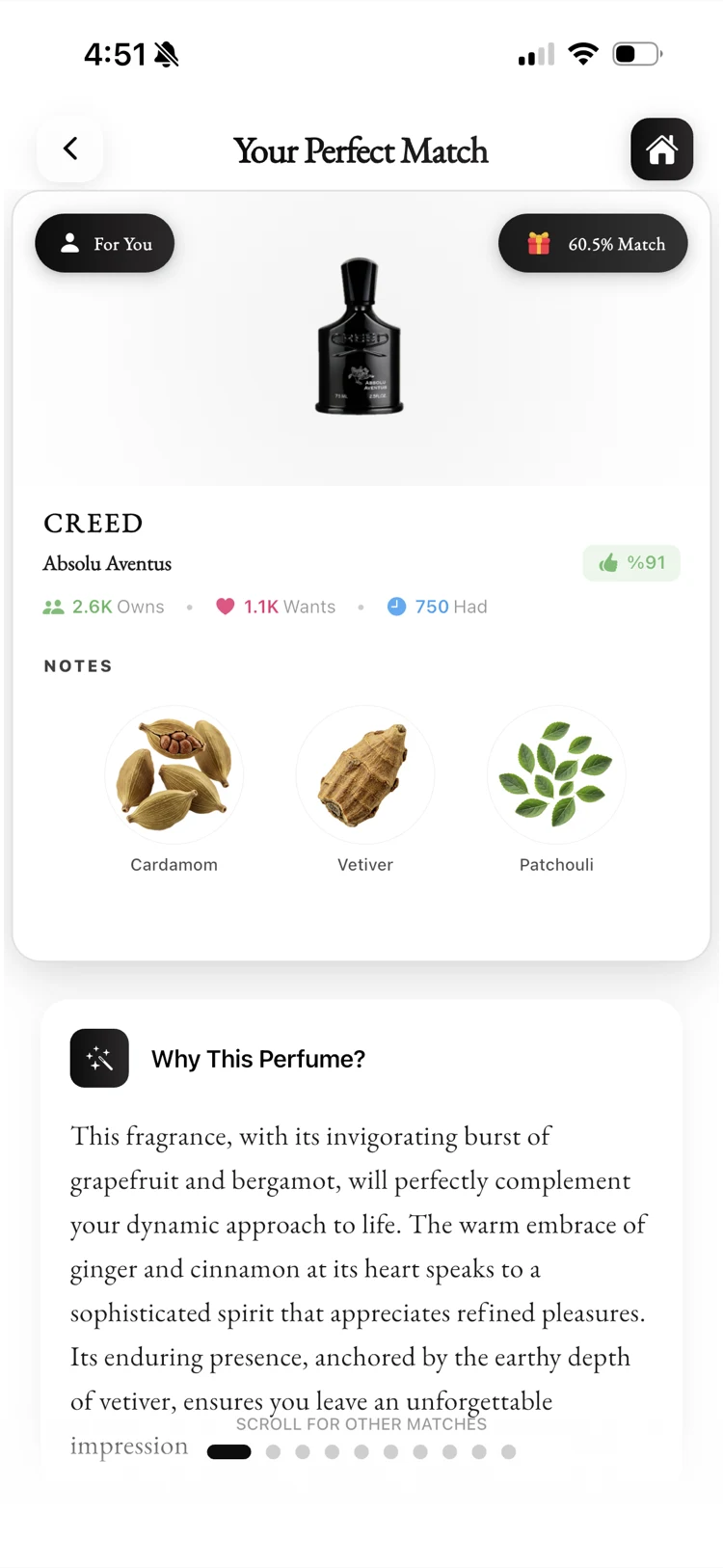
Every bottle here carries a personal match score
Open any perfume named in this thread and the app scores it against your own profile, with the reason written out: which notes align, which occasions fit, and how it differs from what you already wear. Ranked matches every session.
Open it on iOS1 answer
Most useful answer firstMost useful answer
How a classic perfume quiz works
Most quizzes are a decision tree. Each answer ("cosy evenings or summer mornings?") adds points to a few broad buckets such as fresh, floral, woody or warm. At the end, the winning bucket returns a short list from the catalogue the quiz was built for, often a single brand's or a single shop's range. It is quick and useful for orientation. Its limits are built in: a handful of buckets, a catalogue chosen by the seller, and a result that ends when the quiz ends.
How an AI perfume finder works
An AI finder replaces buckets with a comparison between two structured profiles:
- The perfume side. Each perfume is described in the same structured way: notes by tier, families, accords, and traits such as sweetness, projection and season.
- Your side. The finder builds a picture of your taste, starting from what you tell it and growing as you use it.
- The comparison. Every perfume is scored against your profile and ranked. Good finders write out the reason for each match: which notes and accords aligned, and where it differs from what you already wear.
- Feedback. When you like or reject a suggestion, the profile changes, and so do the next suggestions.
The practical differences
| Classic quiz | AI perfume finder | |
|---|---|---|
| Output | A few products | A ranked shortlist with reasons |
| Catalogue | Usually the seller's | Can span designer, niche and indie houses |
| Learns from you | No, it ends | Yes, if it keeps a profile |
| Explains itself | Rarely | Should, for every match |
| Can smell your skin | No | No |
How to get a good result from either
- Name references. "I love this perfume but find it too sweet" is the most informative thing you can give any finder.
- Be honest about dislikes. A strong dislike of a note, such as oud or heavy vanilla, removes more wrong answers than a vague like adds right ones.
- Read the reasons, not just the order. If the explanation does not match what you know about your taste, the match is probably wrong.
- Sample the top five to ten. Wear each for a full day before buying a bottle.
- Ask who chose the catalogue. A finder that only recommends one shop's stock is a sales tool, which is fine as long as you know it.
Is AI better?
It is better at breadth and explanation: it can compare thousands of perfumes on the same terms and show its reasoning. It is not better at the final decision, because no software can know how a perfume develops on your skin. The right expectation is a sharper shortlist, not a verdict.
In Fragnatique
Our AI perfume finder starts from a short quiz, a photo or a bottle you already own, returns a ranked list from designer, niche and indie houses, and writes out the notes and accords behind every match; it sharpens the longer you use it. The methodology page explains what the score means and where it stops.