"What smells like my favourite perfume?" is one of the most searched fragrance questions, usually because a perfume was discontinued, reformulated, costs too much, or simply because someone wants more of the same feeling. People want a method that works better than scrolling through lists of perfumes that share one or two notes.
This guide gives that method, for both near copies and perfumes that are related without being the same.
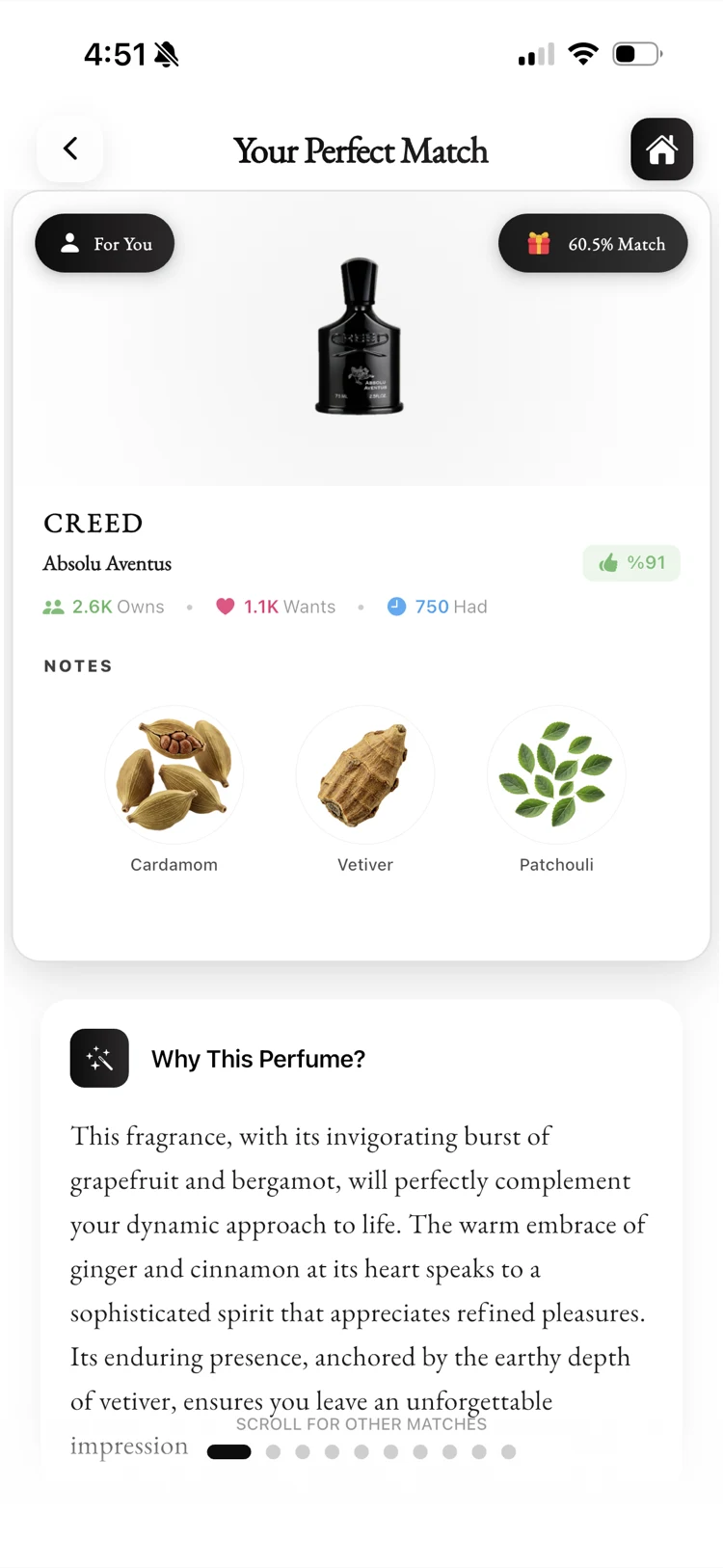
Every bottle here carries a personal match score
Open any perfume named in this thread and the app scores it against your own profile, with the reason written out: which notes align, which occasions fit, and how it differs from what you already wear. Ranked matches every session.
Open it on iOS1 answer
Most useful answer firstMost useful answer
Step 1: decide what "similar" means to you
There are two different searches hiding in the question:
- A near copy. You want the same smell, cheaper, or a replacement for a discontinued bottle. That points to dupes and "inspired by" perfumes, and to checking whether the original has a close sibling in the same house.
- A relative. You want the same character in a new perfume: the same warmth, the same freshness, the same mood, but not the same scent. That is a different search and usually more rewarding.
Step 2: name what you love about it
Wear the perfume and note four things:
- Family: citrus, floral, woody, spicy, gourmand, aromatic, resinous or earthy.
- Dominant accord: the impression that defines it, such as creamy sandalwood, smoky incense, sweet amber or salty-fresh.
- The base: what is still on your skin after four hours. This is what you live with most, and it is often the real reason people love a perfume.
- Intensity: how far it projects and how long it lasts.
If you only love the opening, look for perfumes with a similar opening; if you love the drydown, match on the base.
Step 3: match on structure, not on note lists
Note lists mislead. Many perfumes list bergamot, pink pepper and sandalwood and smell nothing alike, because the proportions and the dominant accord differ. Look instead for perfumes in the same family with the same dominant accord and a similar base. For example, someone who loves Le Labo Santal 33 for its dry, creamy woods may also enjoy Diptyque Tam Dao, a sandalwood-led perfume with a softer, quieter character, even though the two are far from identical.
Step 4: look in the obvious places first
- The same house. Houses often release flankers and siblings that share a structure.
- The same perfumer. Perfumers often return to a signature style across houses.
- Dupe ranges, if a near copy is the goal. Quality varies widely; sample before buying.
Step 5: sample side by side
Spray the original on one wrist and the candidate on the other. Compare at the opening, after an hour and after four hours. Most "it smells the same" claims hold for the first minutes and fall apart in the drydown.
How a finder helps
A recommendation tool that describes perfumes by structure can do Steps 2 and 3 for you across a much larger catalogue. In the Fragnatique app you can scan or add a perfume you love and the AI perfume finder anchors your profile to it, then looks for perfumes that share its character without repeating it, with a written reason for each. The methodology page explains the eight families and the accords shown for every perfume. Treat the result as a sampling list; your wrists make the final comparison.