Skip to content
Free tool

Perfume Concentration Guide

EDC, EDT, EDP or parfum: what is in the bottle?

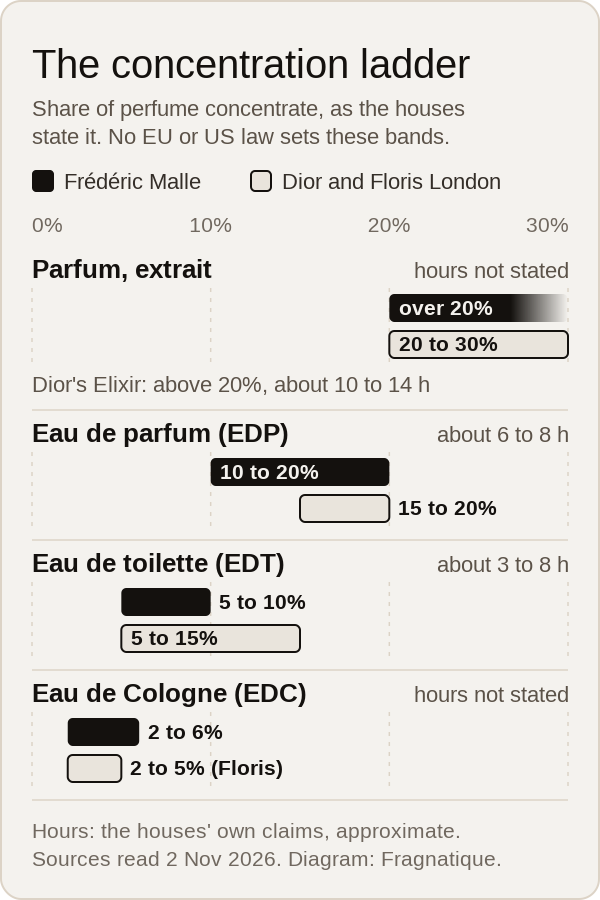
An eau de toilette holds 5 to 15 percent perfume concentrate, an eau de parfum 10 to 20 and a parfum over 20, by the figures Frédéric Malle, Dior and Floris London state. No EU or US law defines the labels. Pick one to see each house's figure.

EDC
2to6 percent
EDT
5to15 percent
EDP
10to20 percent
Parfum
over20 percent

A free tool by Fragnatique

Free, no sign-up.

1 Pick a labeldrawn to scale

Names, not rungs

2 Or: how long should it last?

By the houses' own figures. Claims, not measurements.

Eau de parfum: Frédéric Malle 10 to 20%; Dior 15 to 20%; Floris London 15 to 20%.

Eau de Cologne · EDC

Eau de Cologne: perfume concentrate, as stated2to6%

Lowest to highest of Frédéric Malle, Floris London and Germany's patent office (DPMA).

Share of concentrate

  • Frédéric Malle2 to 6%
  • Floris London2 to 5%
  • Germany's patent officeabout 3 to 5%

Hours on skin, as claimed

None stated. Floris London calls it the "lightest and shortest lasting".

On the shelf Frédéric Malle Cologne Bigarade, which the house places below an EDT

House figures, not measurements. No EU or US law defines the label.

Eau de toilette · EDT

Eau de toilette: perfume concentrate, as stated5to15%

Lowest to highest figure of Frédéric Malle, Dior and Floris London.

Share of concentrate

  • Frédéric Malle5 to 10%
  • Dior5 to 15%
  • Floris London5 to 15%

Hours on skin, as claimed

  • Dior, Miss Dior page3 to 5 h
  • Dior, Sauvage page6 to 8 h
  • Floris London4 to 6 h

On the shelf Dior Sauvage Eau de Toilette

House figures, not measurements. No EU or US law defines the label.

Eau de parfum · EDP

Eau de parfum: perfume concentrate, as stated10to20%

Lowest to highest figure of Frédéric Malle, Dior and Floris London.

Share of concentrate

  • Frédéric Malle10 to 20%
  • Dior15 to 20%
  • Floris London15 to 20%

Hours on skin, as claimed

  • Dior6 to 8 h
  • Floris London6 to 8 h

On the shelf Dior Sauvage Eau de Parfum

House figures, not measurements. No EU or US law defines the label.

Parfum or extrait

Parfum or extrait: perfume concentrate, as statedover20%

As Frédéric Malle puts it. Dior and Floris London say 20 to 30%.

Share of concentrate

  • Frédéric Malleover 20%
  • Dior20 to 30%
  • Floris London20 to 30%

Hours on skin, as claimed

None stated. Floris London calls it the "longest lasting".

On the shelf Chanel N°5 Extrait de Parfum

House figures, not measurements. No EU or US law defines the label.

Elixir

Elixir: perfume concentrate, as statedabove20%

As Dior describes its own elixir: typically above 20%, "between a Parfum and a pure extract".

Share of concentrate

  • Diortypically above 20%

Hours on skin, as claimed

  • Dior, Sauvage Elixir page10 to 14 h

On the shelf Dior Sauvage Elixir

House figures, not measurements. No EU or US law defines the label.

Intense

Intense: a name, not a rungNo house figure

A name, not a rung. At Chanel it is a new facet of an existing eau de parfum, described by its notes, not by a percentage.

Where it sits

Chanel sells it as an eau de parfum. On the shelf above: EDP.

Hours on skin, as claimed

None stated.

On the shelf Chanel Coco Mademoiselle Eau de Parfum Intense

House figures, not measurements. No EU or US law defines the label.

Eau Fraîche

Eau Fraîche: a name, not a rungNo house figure

A name, not a rung. Chanel sells Chance Eau Fraîche both as an eau de toilette and as an eau de parfum.

Where it sits

Chanel sells it as an EDT and as an EDP. On the shelf above: EDT and EDP.

Hours on skin, as claimed

None stated.

On the shelf Chanel Chance Eau Fraîche, sold as an EDT and as an EDP

House figures, not measurements. No EU or US law defines the label.

Perfume concentration chart

How much perfume oil is in an EDT, an EDP and a parfum?

Roughly 2 to 6 percent perfume concentrate for an eau de Cologne, 5 to 15 for an eau de toilette, 10 to 20 for an eau de parfum and over 20 for a parfum or extrait, depending on which house you ask. The chart sets each house's own figure side by side; none is a measurement anyone outside the house can check.

Perfume concentration chart: the share of perfume concentrate and the hours on skin each house states, by label
LabelShare of perfume concentrate, as statedHours on skin, as claimedOn the shelf
Eau de CologneEDCThe lightest rung: a light, citrus-led fragrance named after the city of Cologne.
  • Frédéric Malle2 to 6%
  • Floris London2 to 5%
  • Germany's patent officeabout 3 to 5%

None stated. Floris London calls it the "lightest and shortest lasting".

Frédéric Malle Cologne Bigarade, which the house places below an EDT
Eau de toiletteEDTLighter than an eau de parfum. Dior says its lower concentration lets the citrus and floral top notes lead.
  • Frédéric Malle5 to 10%
  • Dior5 to 15%
  • Floris London5 to 15%
  • Dior, Miss Dior page3 to 5 h
  • Dior, Sauvage page6 to 8 h
  • Floris London4 to 6 h
Dior Sauvage Eau de Toilette
Eau de parfumEDPMore fragrant oil than an eau de toilette and less than a parfum.
  • Frédéric Malle10 to 20%
  • Dior15 to 20%
  • Floris London15 to 20%
  • Dior6 to 8 h
  • Floris London6 to 8 h
Dior Sauvage Eau de Parfum
Parfum or extraitThe top rung. Parfum and extrait de parfum are usually two names for it.
  • Frédéric Malleover 20%
  • Dior20 to 30%
  • Floris London20 to 30%

None stated. Floris London calls it the "longest lasting".

Chanel N°5 Extrait de Parfum
ElixirDior's own tierA tier Dior defines for itself: "between a Parfum and a pure extract".
  • Diortypically above 20%
  • Dior, Sauvage Elixir page10 to 14 h
Dior Sauvage Elixir
Intensea name, not a rungA name, not a rung. At Chanel it is a new facet of an existing eau de parfum, described by its notes, not by a percentage.

No house figure. Chanel sells it as an eau de parfum.

None stated.

Chanel Coco Mademoiselle Eau de Parfum Intense
Eau Fraîchea name, not a rungA name, not a rung. Chanel sells Chance Eau Fraîche both as an eau de toilette and as an eau de parfum.

No house figure. Chanel sells it as an EDT and as an EDP.

None stated.

Chanel Chance Eau Fraîche, sold as an EDT and as an EDP

Each bottle shows its label's perfume concentrate as a layer, drawn to scale. The figures are the houses' own, read on 2 November 2026: Frédéric Malle's glossary, Dior's Miss Dior Blooming Bouquet page and Floris London's guide, with Dior's Sauvage pages for the second set of hours and Germany's patent office for eau de Cologne. Every quote is in our article on what the labels mean, and the same chart is there as a diagram to keep.

Label against label

EDT vs EDP, EDP vs parfum: what changes?

By concentration, the stronger label usually holds more: Dior and Floris London give an eau de toilette 5 to 15 percent and an eau de parfum 15 to 20. But the bands overlap from house to house, so an EDP at one house can hold the same share as an EDT at another.

  • EDT5 to 15percent, as stated
    EDP10 to 20percent, as stated

    EDT vs EDP

    Frédéric Malle puts an eau de toilette at 5 to 10 percent and an eau de parfum at 10 to 20; Dior and Floris London give 5 to 15 against 15 to 20. Both give an eau de parfum 6 to 8 hours. The houses that sell both say the formula changes too: their own words are in our article.

  • EDP10 to 20percent, as stated
    Parfumover 20percent, as stated

    EDP vs parfum

    Dior and Floris London give 15 to 20 percent for an eau de parfum and 20 to 30 for a parfum; Frédéric Malle gives 10 to 20 against over 20. No house states hours for a parfum; Floris London calls it the "longest lasting". Parfum and extrait are usually two names for the same top rung.

  • EDC2 to 6percent, as stated
    Parfumover 20percent, as stated

    Cologne vs perfume

    In the original sense cologne is the lightest rung: Floris London puts an eau de Cologne at 2 to 5 percent and a parfum at 20 to 30. The word is also used for any men's fragrance, at any strength. The first cologne is in our article on Farina.

  • Parfumover 20percent, as stated
    Elixirabove 20percent, as stated

    Parfum vs elixir

    Elixir is a tier Dior defines for itself: typically above 20 percent, "between a Parfum and a pure extract", with 10 to 14 hours on skin against 6 to 8 for an eau de parfum. Like Intense and Eau Fraîche, the name belongs to the house that uses it.

How to use it

Three steps to read a label

  1. Pick the label on your bottle

    EDC, EDT, EDP, parfum or elixir, each under its own bottle. Intense and Eau Fraîche are there too, as names.

  2. Read each house's figure

    The panel shows the share of perfume concentrate and the hours on skin as Frédéric Malle, Dior and Floris London state them.

  3. Or start from the hours

    Say how long the perfume should last, and the guide marks the labels that fit by the houses' own figures.

The Fragnatique app

You know the label. Now find the perfume.

The Fragnatique app suggests perfumes that fit your own taste, made by Fragnatique's proprietary matching algorithm.

Download on the App Store
The rules

Is there an official standard for perfume concentrations?

No. No law in the EU or the US defines eau de toilette, eau de parfum or parfum, and the hours on skin are the houses' own claims, not measurements. Each house fills in the rungs for itself.

  • European Union

    Named, not defined

    Regulation (EC) No 1223/2009, the EU cosmetics regulation, lists "perfumes, toilet waters and eau de Cologne" among cosmetic products and defines none of them.

  • United States

    No strength given

    The FDA lists perfume, cologne and aftershave as fragrance products regulated as cosmetics. Its page gives no strength for any of them.

  • The houses

    Not official

    Frédéric Malle's own FAQ says the classifications (EDT, EDP, extract) "are not official", and that they are often used to position a fragrance rather than to describe it.

  • The hours

    Claims, not measurements

    One house, two figures: Dior's Miss Dior page gives an eau de toilette 3 to 5 hours, its Sauvage page 6 to 8. Floris London says 4 to 6. Formula, dose and skin decide the rest.

Short answers

Perfume concentrations: questions people ask

Each house's own words are in our article on EDC, EDT, EDP and parfum. To see how long a bottle lasts at your own dose, use the perfume spray calculator.

Back to the guide
What is the difference between EDT, EDP and parfum?

The label says how much perfume concentrate is dissolved in the alcohol. By the houses' own figures an eau de toilette holds 5 to 10 percent for Frédéric Malle and 5 to 15 for Dior and Floris London, an eau de parfum 10 to 20 for Malle and 15 to 20 for Dior and Floris, and a parfum or extrait over 20. The houses that sell several versions say the formula often changes too.

Is eau de parfum stronger than eau de toilette?

By concentration, usually: Frédéric Malle puts an eau de toilette at 5 to 10 percent and an eau de parfum at 10 to 20, while Dior and Floris London give 5 to 15 against 15 to 20. The bands overlap between houses, so an eau de parfum at one house can hold the same share as an eau de toilette at another.

Does eau de parfum last longer than eau de toilette?

As the houses state it, usually, but the figures are claims, not measurements. Dior's Miss Dior page gives an eau de toilette 3 to 5 hours and an eau de parfum 6 to 8; Floris London gives 4 to 6 against 6 to 8. Dior's Sauvage page gives its eau de toilette 6 to 8 hours, the same as an eau de parfum. Formula, dose and skin matter too.

What percentage of perfume oil is in an eau de parfum?

10 to 20 percent for Frédéric Malle, and 15 to 20 percent for Dior and Floris London. An eau de toilette is 5 to 10 percent for Malle and 5 to 15 for Dior and Floris. An eau de Cologne is 2 to 6 percent for Malle, 2 to 5 for Floris and about 3 to 5 for Germany's patent office.

What is the strongest perfume concentration?

Parfum, also sold as extrait de parfum: over 20 percent for Frédéric Malle and 20 to 30 percent for Dior and Floris London. Dior also sells an elixir, which it describes as typically above 20 percent, between a parfum and a pure extract, with 10 to 14 hours on skin.

Is parfum the same as extrait de parfum?

Usually, yes: they are two names for the same top rung. Dior groups "a Parfum or Extrait" at 20 to 30 percent, and Chanel sells N°5 as an Extrait de Parfum. The names still belong to each house: Dior places its elixir between a parfum and a pure extract.

What do Intense, Elixir and Eau Fraîche mean on a bottle?

They are product names, not standard concentrations. Chanel sells Coco Mademoiselle Intense as an Eau de Parfum Intense and describes it through its notes, not a percentage, and it sells Chance Eau Fraîche both as an eau de toilette and as an eau de parfum. Dior defines its elixir as a highly concentrated format, typically above 20 percent, with 10 to 14 hours of wear.

Is cologne weaker than perfume?

In the original sense, yes: eau de Cologne is the lightest rung, 2 to 5 percent for Floris London and about 3 to 5 for Germany's patent office, against 20 to 30 for a parfum. But cologne is also used for any men's fragrance, and a bottle sold as a cologne in that sense can be an eau de toilette, an eau de parfum or stronger.

Is there an official standard for EDT, EDP and parfum?

No law in the EU or the US defines them. The EU cosmetics regulation names perfumes, toilet waters and eau de Cologne without defining any, the FDA gives no strength for perfume or cologne, and Frédéric Malle's own FAQ calls the classifications not official. Each house sets its own bands.

Which perfume concentration should I buy?

It depends on the hours you want and on which version you like on your own skin. By the houses' figures: an eau de Cologne for a light touch, an eau de toilette for 3 to 6 hours, an eau de parfum for 6 to 8, and a parfum, extrait or elixir for 8 or more. Smell both versions before deciding: the stronger one is not always the one you prefer.