The Jean Carles Method: How Perfumers Still Train Their Noses
The Jean Carles method sorts raw materials by similarity and contrast; Givaudan, which runs the school he founded in 1946, calls it the training standard.
- 01Jean Carles, a Grasse perfumer at Roure, founded in 1946 the perfumery school Givaudan runs today, according to Givaudan and France's 2014 Grasse heritage inventory.
- 02Givaudan says his method, which organizes raw materials by similarity and contrast, is still the standard for perfumery training.
- 03Writing for the school's 70th anniversary, Givaudan said its students took the Jean Carles test daily: smell one ingredient, then pick it out of some 500.
- 04Harper's Magazine reports a widely held belief that Carles had lost his sense of smell by the time of his 1940s perfumes; we found no first-hand record.
- 05Givaudan counts Miss Dior among Carles's perfumes, while Dior's own history says Christian Dior commissioned it from the perfumer Paul Vacher in 1947.
Before Jean Carles, a would-be perfumer in Grasse served years as an apprentice while the masters let out their methods a little at a time, as Scott Sayare's essay "The Odor of Things" in Harper's Magazine tells it. Carles replaced that slow initiation with a system and a school, and both outlived him. This chapter of our guide to famous perfumers in history sets out the method, what is documented about the man and what is only reported.
Who was Jean Carles?
Jean Carles was a Grasse perfumer who worked for the Roure company and, in 1946, turned the perfumer's apprenticeship into a formal school. The Library of Congress name record for Jean Carles gives his dates as 1892 to 1966 and places his birth and his death in Grasse. Harper's, calling him "a son of Grasse", dates his training to early in the 20th century.
France's 2014 inventory of the Grasse perfume skills, filed with UNESCO, says each Grasse factory formed its own perfumers, the "nez" of Grasse, and that Carles founded the perfumery school of the Roure factory in 1946. Our history of Grasse tells how the town turned to perfume in the first place.
Givaudan, which runs the school today, calls him the first to conceive of "a true form of apprenticeship for perfumers", in its profile of the company's pioneers.
The school changed hands and towns after him. A 2016 report from inside the school in Perfumer & Flavorist says Roure merged with Givaudan in 1992, the two companies' schools became one, and the school left Grasse for the Paris suburb of Argenteuil in 1997. Givaudan now describes it as based in Paris, and its Perfumery School page dates a second campus, in Singapore, to 2015.
His ideas survive in writing. Givaudan quotes from a work it calls Méthode de création en parfumerie (below), and the Library of Congress record cites one book, Perfume (1974), whose title page lists additional text by him; the Open Library record of that edition describes it as a book of photographs and text.
What is the Jean Carles method?
It is a way of learning perfume materials by comparison: Givaudan's heritage page "Perfumery: art or science?" says Carles organized raw materials by similarity and contrast, grouping those that smell alike and setting them against those that smell different. He built it out of frustration. Perfumers worked, he later wrote (as Harper's quotes him), "in haphazard fashion, in the expectation of a potential miracle", and many of the best formulas had been found "almost by chance".
In Harper's account, he began with two dozen families of smell, among them citrus, minty, woody, jasminic, musky and animalic, then ranked the materials in each family by how they behave over time. The quickest to vanish became top notes, the middling ones modifiers or heart notes, and the longest-lasting base notes: the tiers our notes pyramid guide explains. He composed from the bottom up, "like pyramids", choosing an accord for each level before searching its families for ingredients.
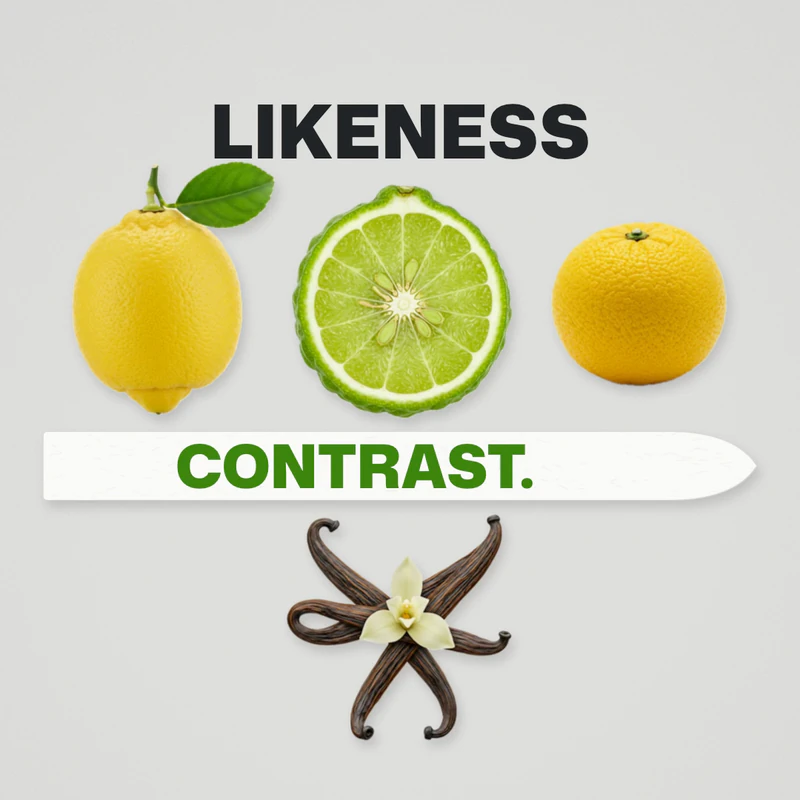
Our video's citrus-against-vanilla grouping illustrates the idea; it is not a list from Carles. His own writing argued for boldness, as Givaudan quotes it:
When you try too hard to balance a perfume, you extinguish it, you suppress its character.
Jean Carles, Méthode de création en parfumerie, as quoted by Givaudan
In practice, Harper's says, he urged perfumers to try a material at two, three, even ten times the dose that seemed reasonable, then smell the result.
How does the method train a perfumer's nose?
By repetition, one material at a time: Givaudan says students at the school Carles founded take "the Jean Carles test" every day, smelling a single ingredient and learning to pick it out of a palette of some 500. Givaudan's article for the school's 70th anniversary describes eight students starting almost every morning that way.
The first months decide who stays. Perfumer & Flavorist reported in 2016 that students had four to seven months to learn 350 synthetic and 150 natural materials, then sat an exam on any of the 500; failing it ended their time at the school. They smelled eight hours a day, with memory aids of their own devising, and those who passed committed to four years of school and five at Givaudan.
The steps below come from our sources, Carles's principles first and the school's course after them:
| Step | What it involves | Described by |
|---|---|---|
| Group and contrast | Materials sorted into families of similar smell, then compared with very different ones | Givaudan; Harper's |
| Rank by time | Top, heart (modifier) and base, by how fast each material fades | Harper's |
| Build from the base | An accord chosen for each level, then the ingredients | Harper's |
| Learn the palette | About 500 materials memorized and tested daily | Givaudan; Perfumer & Flavorist |
| Make accords | How ingredients relate and contrast at different ratios | Perfumer & Flavorist; Givaudan |
| Study the classics | Classic formulas copied and analyzed | Perfumer & Flavorist; Givaudan |
Givaudan's page on its course today describes a single four-year curriculum, from raw materials and the school garden to accords, classic fragrances and internships. To try composing a formula of your own, start in our Scent Lab.
Is the Carles method still used?
Yes, at the school he founded, and Givaudan claims more for it than that:
Carles' method of olfactive study, which organised raw materials by similarity and contrast, is still the standard for perfumery training.
Givaudan, "Perfumery: art or science?"
Other accounts agree, with different reach. Perfumer & Flavorist wrote in 2016 that "the pedagogy is still based on that of Jean Carles". In 2019, Givaudan announced that it was "evolving the Jean Carles' method" and adding digital tools, while apprentices would still memorize over 500 ingredients. Harper's goes furthest, with no school named: one version or another of the method is "now the standard curriculum for trainee perfumers".
Those are descriptions, not measurements: we found no survey of perfumery schools, so "standard" rests on the school's word and on Harper's. Harper's also names the limits: his categories were "basically arbitrary", it argues, matched to scents as he knew them, and they could not say which formulas would smell good, or why.
In a release of 16 September 2026 for the school's 80th anniversary, Givaudan counted 28 perfumers in its Hall of Fame, and the director, the master perfumer Calice Becker, traced the school to Carles and "a radically new idea: that a perfumer's job is not to reproduce formulas, but to create."
The series follows other noses too: see Hedione and Dior's Eau Sauvage and Alberto Morillas and his perfumes.
Did Jean Carles lose his sense of smell?
Possibly, but the story is reported rather than recorded. Harper's says it is "widely believed" that he had lost it by the time he made Ma Griffe and Miss Dior, which it places in the 1940s, and that those perfumes were works of memory and imagination, guided by his system.

Harper's explains it this way: before his nose gave out, he had run years of experiments and remembered the results. The essay names no source for the belief, and we found no first-hand account. Givaudan's pages on Carles, which quote his writing and list his perfumes, do not mention it.
The timing is part of the same report. Born in 1892, Carles was in his fifties for most of the 1940s (our arithmetic from the Library of Congress dates), so even on Harper's dating the loss came later in life, the phrase our video uses, together with "reportedly".
Which perfumes did Jean Carles create?
Givaudan names two, Dior's Miss Dior and Schiaparelli's Shocking, and Harper's adds Carven's Ma Griffe, but Dior's own history names a different perfumer for Miss Dior. Four accounts, side by side:
| Source | What it says about Miss Dior |
|---|---|
| Dior, "Christian Dior, Couturier-Perfumer" | Christian Dior commissioned the perfumer Paul Vacher; Miss Dior scented the salons at his first show, 12 February 1947 |
| LVMH, "Six iconic fragrances of LVMH Group" (2026) | "Created in 1947 by Christian Dior himself" |
| Givaudan, "Perfumery: art or science?" | One of Carles's perfumes, later renamed Miss Dior Eau de Toilette Originale |
| Harper's Magazine (2021) | Created by Carles in the 1940s |
Each primary source speaks for its own side: Dior's page on the couturier as perfumer for whom the house commissioned, Givaudan for its own perfumer. They may describe different roles, but none mentions the others or publishes the records of 1947, so we report the credit as divided between accounts, not settled. LVMH's guide to six of its fragrances adds that the perfume was inspired by Christian Dior's sister Catherine; our Miss Dior article tells her story.
Shocking and Ma Griffe rest on one source each: Givaudan gives no date for Shocking, and Harper's places Ma Griffe in the 1940s, calling it and Miss Dior "green-floral chypres".
Part of Eau Facts, the Fragnatique team's series on fragrance history and science, also told in short videos on Instagram at @eaufacts. Researched from the sources listed above, drafted with AI assistance and checked against each source before publishing.
Frequently asked
- What is the Jean Carles test?
- It is the daily smelling drill at the school Jean Carles founded. In its article for the school's 70th anniversary, Givaudan says each student smells a single ingredient and trains to tell it apart within a palette of some 500 raw materials. A 2016 Perfumer & Flavorist report adds that first-year students had four to seven months to learn them before an exam that decided whether they stayed.
- Where is the Givaudan perfumery school?
- Givaudan describes it as based in Paris. A 2016 Perfumer & Flavorist report placed it in the Paris suburb of Argenteuil, where it moved from Grasse in 1997, and Givaudan's 2019 release also has students studying in Argenteuil. A second campus opened in Singapore in 2015, the first outside France. Jean Carles founded the school at the Roure factory in Grasse in 1946.
- How long does perfumer training take?
- At Givaudan's school, four years. The company describes a single four-year curriculum that starts with memorizing around 500 raw materials and moves on to accords and the analysis of classic perfumes. A 2016 Perfumer & Flavorist report said the raw materials exam came at about seven months, and that students who passed committed to five years at Givaudan after the school.
- Did Jean Carles write a book?
- Givaudan quotes from a text it calls his work, Méthode de création en parfumerie, in which he argues that creating perfume is an art, not a science; the company does not say whether it was published as a book. The Library of Congress name record for Carles cites Perfume, a 1974 book of photographs and text whose title page lists additional text by him.
Explore Fragnatique