Why Grasse Became the Perfume Capital: Tanners, Gloves and a Legend
Grasse became the perfume capital through leather: tanners who scented hides became perfumers, says its perfume museum; UNESCO listed the skills in 2018.
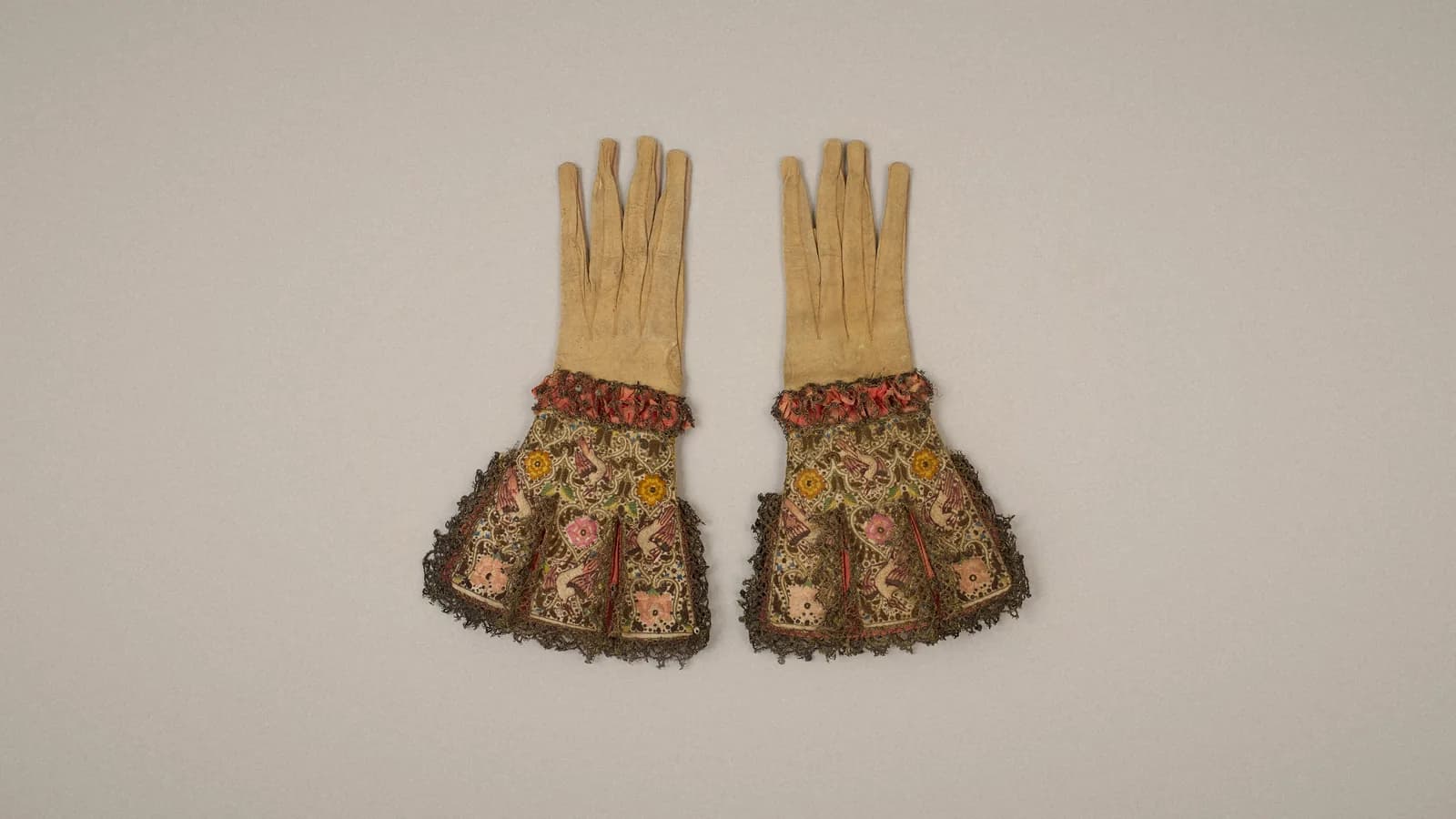
- 01Grasse's perfume trade grew out of leather: France's UNESCO nomination says local tanning needed aromatic ingredients to prepare the hides and scent the gloves.
- 02France's 2014 heritage inventory sheet on Grasse's perfume skills says its authors know of no other territory that gathers growing, processing and composing perfume in one place.
- 03The story that Catherine de' Medici turned Grasse to perfume is a legend: the Musée du Parfum in Paris says no document truly attests her visit.
- 04UNESCO inscribed the skills related to perfume in Pays de Grasse on 28 November 2018: growing perfume plants, processing natural raw materials and composing perfume.
- 05Chanel names neroli, May rose and jasmine from Grasse in N°5 Parfum, though Grasse's perfume museum says Egypt and India today supply about 90 percent of the world's perfume jasmine.
France's tourism site calls Grasse, a hill town north of Cannes, "the world capital of perfume". The trade behind that title grew out of its tanneries, and its story is one chapter of our sourced history of perfume.
Why is Grasse the perfume capital of the world?
Grasse still gathers all three stages of perfume making in one place: growing the plants, processing natural raw materials and composing perfume. UNESCO's listing of the Grasse perfume skills names exactly those three. The 2014 inventory sheet on those skills, written for France's heritage inventory, says its authors know of no other territory that gathers all three.
Geography helped. The history of Grasse by the Musée du Parfum in Paris credits southern sun, mild Mediterranean air, cool nights from the altitude and plentiful streams. That museum belongs to a perfume house founded in Grasse in 1926. France.fr puts the town on a hillside about 20 kilometers from Cannes, rising from 100 to 1,000 meters.
Did Grasse really smell of leather?
Grasse's tanneries did: thanks to its many springs and wild aromatic plants, the town was renowned for tanning from the Middle Ages, says the 2014 inventory sheet. The Musée du Parfum dates a large tanning industry there to the 15th century, one that gave the town a European reputation. Grasse leather was famous for its quality and for a greenish color obtained by soaking it in myrtle, the Paris museum adds.
France.fr credits a local tanner with the idea of scented leather gloves, to overcome what its French edition calls "la forte odeur des peaux", the strong smell of the hides.
What were perfumed gloves?
Perfumed gloves were leather gloves scented to mask the smell of tanned hide, and for a time they were a fashion, says the Musée du Parfum. France's nomination file to UNESCO explains why a tanning town needed scent:
...a craft industry long dominated by leather tanning, which called for aromatic ingredients to prepare the hides and to scent the gloves that were made.
France, nomination file No. 01207 to UNESCO (for inscription in 2018)
Glover-perfumers found the essences they needed close at hand, the inventory sheet says. Peasants who distilled wild plants supplied them with almost all their output: wild orange from the Italian Riviera, lavender, cassie (a mimosa relative), myrtle and the mastic tree.
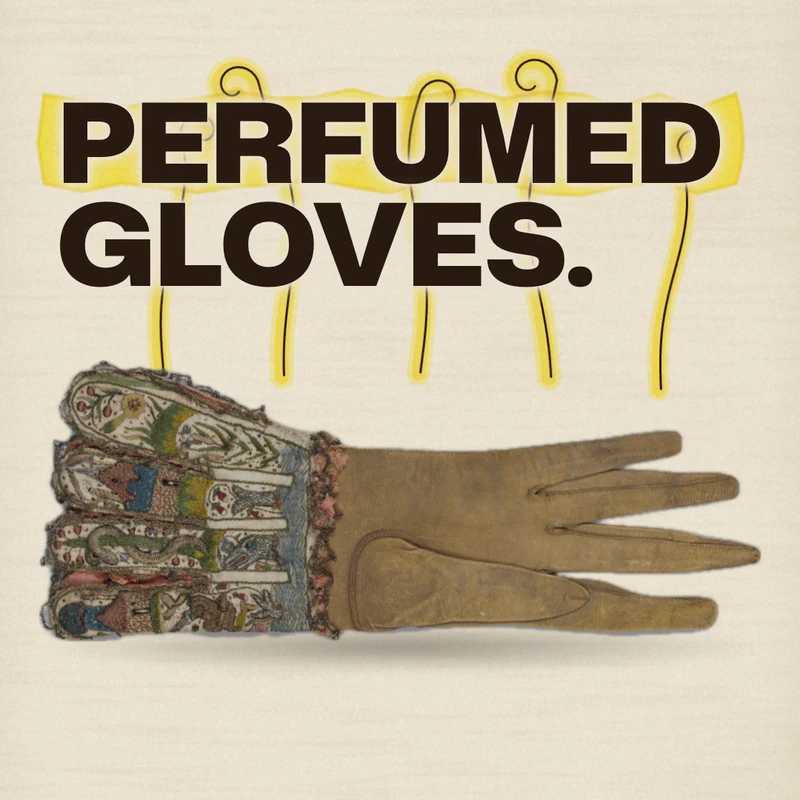
Making them was skilled work: a master glover-perfumer trained for four years as an apprentice and three more as a journeyman, the same sheet says. Growing demand for scented skins fueled the town's growth and prosperity, according to the Musée du Parfum.
Did Catherine de' Medici make Grasse famous?
Catherine de' Medici's part in the rise of Grasse is a legend: the Musée du Parfum in Paris says no document truly attests her visit to the town. In France.fr's version, a local tanner gave the queen a pair of perfumed gloves and she was won over at once. The fashion then reached the court and high society, it says, and orders poured in.
The Paris museum tells the story in the conditional: the queen, fond of perfumed gloves, reportedly recommended Florentine techniques during a stay, so the town supposedly turned to perfume. Then it adds:
Il n'existe toutefois aucune documentation attestant véritablement de la visite de la reine de France à Grasse.
Musée du Parfum, Paris, "Histoire de Grasse, des tanneurs aux parfumeurs", 19 October 2018
In English: no document truly attests the queen's visit to Grasse (our translation). The museum also doubts a second story, in which an Italian brought Florence's fashion for perfumed leather: if that were enough, it asks, why did other tanning towns not follow?
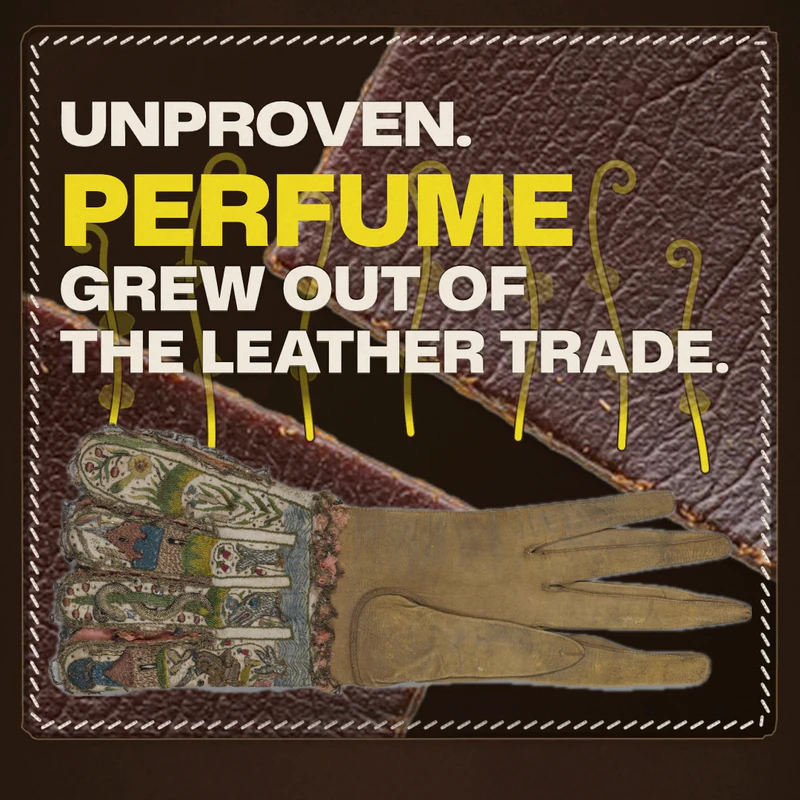
Nothing more formal supports the gift story. France.fr cites no source for it, and the UNESCO texts and the 2014 inventory never mention the queen. They explain the change through local plants and the needs of the leather trade. Our verdict: a legend, in the terms of our guide to perfume myths. No document places the queen in Grasse, which is why our Eau Facts video stamps the story unproven.
How did Grasse go from gloves to perfume?
Grasse moved from gloves to perfume between the 16th and 18th centuries, as glover-perfumers (gantiers-parfumeurs) replaced the tanners and then gave up leather, says the 2014 inventory sheet. Grasse's public perfume museum, the Musée International de la Parfumerie (MIP), agrees on its page about the perfume skills. Tanners who scented their leather with local essences, it says, gradually became perfumers.
| When | What happened | Source |
|---|---|---|
| 15th century | Tanning gives Grasse a European name | Musée du Parfum |
| 16th century | Glover-perfumers succeed the tanners; perfume skills date from "at least" this century | 2014 inventory sheet; UNESCO |
| c. 1560 or c. 1650 | Jasmine arrives (Musée du Parfum: c. 1560; inventory sheet: c. 1650) | Musée du Parfum; 2014 inventory sheet |
| January 1614 | Royal letters patent let the Paris glovers call themselves perfumers too | Franklin, 1884 |
| c. 1670 | Tuberose from Italy takes root | 2014 inventory sheet |
| 1724 | The guild gets statutes specific to Grasse (Musée du Parfum only) | Musée du Parfum |
| 18th century | Glover-perfumers give up leather for perfume | 2014 inventory sheet |
| 19th century to the 1960s | "Exceptional" flower production; factories train their own perfumers | 2014 inventory sheet |
| 1946 | Jean Carles founds the Roure factory's perfumery school | 2014 inventory sheet |
| 1960s | International groups buy Grasse factories; synthetics spread | MIP |
| 2002 | The Grasse Institute of Perfumery is founded | 2014 inventory sheet |
| 28 November 2018 | UNESCO inscribes the Grasse perfume skills | Ministère de la Culture; UNESCO |
Neither the Musée du Parfum nor the inventory sheet cites a record for its jasmine date, so we give both. The sheet, written for France's national inventory, is the more formal of the two.
The Musée du Parfum says Louis XIII created the guild of master glover-perfumers in 1614. Alfred Franklin's 1884 history of the Paris glover-perfumers, built on original documents, shows an older trade. The city's glovers had medieval statutes, and letters patent of January 1614 let them call themselves perfumers too; new statutes followed in March 1656. We did not find the Grasse statutes of 1724.
What did UNESCO list in Grasse?
UNESCO listed skills, not a place: the cultivation of perfume plants, the knowledge and processing of natural raw materials, and the art of perfume composition in Pays de Grasse. Its intergovernmental committee inscribed them on 28 November 2018, according to France's Ministry of Culture, and UNESCO's decision 13.COM 10.B.14 notes they had been on France's own inventory since 2014.
The nomination singles out the May rose and Grasse jasmine as local varieties adapted to the terroir. It lists hydraulic distillation, enfleurage (extraction with fats) and solvent extraction, and warns that enfleurage "would seem to be most at-risk".
The knowledge passes on slowly: an estimated seven years to train a distillation manager, and ten before a perfumer is operational, the nomination says. Most of it is still learned in the perfumeries, alongside schools such as the Grasse Institute of Perfumery. How Jean Carles trained his students is set out in the Jean Carles method.
The file also names the MIP, which its presentation page describes as a public museum with the Musée de France label. The museum opened in January 1989, and its plant conservatory lies in gardens at Mouans-Sartoux.
Which perfumes use flowers from Grasse?
Chanel N°5 (No. 5) is the clearest case: Chanel's N°5 Parfum page says its top notes of "Neroli from Grasse" blend into "May Rose and Jasmine from Grasse". The MIP adds that the May rose (Rosa centifolia) survives around Grasse partly through a partnership between Chanel and a company in Pégomas. The perfume's sales legend is weighed in whether Chanel N°5 is the best-selling perfume ever.
Louis Vuitton's Heures d'Absence is another. It takes its name from the house's first perfume of 1927, says Louis Vuitton's article on it; we tell that story in Louis Vuitton's first perfume. The perfume's US product page, as archived in June 2026, names three key notes, centifolia rose, jasmine and mimosa, each "from Grasse". Louis Vuitton and Dior opened Les Fontaines Parfumées, a restored bastide in the heart of Grasse, in September 2016, says an LVMH release. It houses the creative workshops of the two houses' master perfumers. Perfumes built around flowers like these form the floral family.
Grasse's own harvest is small today, the MIP says. Its page on the plant conservatory dates the town's peak to the first half of the 20th century, when much of what its factories processed grew locally. From the 1960s, it says, international groups bought Grasse factories, and their synthetics came at very attractive prices.
Jasmine, the town's flagship flower, moved abroad. Picking is the costliest part of the production chain, the MIP notes. In the 1970s and 1980s building spread over farmland, and jasmine growing moved to the Nile Delta in Egypt, then to southern India. Today, says the MIP's undated page, those two countries supply about 90 percent of the world's perfume jasmine, in roughly equal shares.
Thousands of tonnes of flowers were processed in the early 20th century, the MIP writes. In 2000, some tens of tonnes remained, from 40 hectares of jasmine, rose, tuberose, violet and mimosa. LVMH's 2016 release put Grasse's output at "only 30 tons per 40 hectares" of perfume flowers.
The skills outlasted the fields. Young growers, most of them heirs to family land, are fighting to keep the tradition, the MIP adds. The nomination calls the Jasmine Festival in Grasse, the Jasminade, a major summer event.
Part of Eau Facts, the Fragnatique team's series on fragrance history and science, also told in short videos on Instagram at @eaufacts. Researched from the sources listed above, drafted with AI assistance and checked against each source before publishing.
Frequently asked
- Is there a perfume museum in Grasse?
- Yes. The Musée International de la Parfumerie is a public museum with France's Musée de France label, inaugurated in January 1989, according to Musées de Grasse. Works begun in 2006 doubled its surface to 3,500 square meters. Its gardens at Mouans-Sartoux, covering nearly 3 hectares, have been the museum's conservatory of perfume plants since 1 January 2010.
- Where is Grasse?
- Grasse is in the Alpes-Maritimes department of south-east France, between the sea and the mountains and not far from Italy, as France's UNESCO nomination describes the area. France.fr places the town on a hillside about 20 kilometers north of Cannes, spreading from 100 to 1,000 meters above sea level. The perfume region around it, the Pays de Grasse, takes in nearby towns such as Mouans-Sartoux and Pégomas.
- Which flowers are grown around Grasse for perfume?
- France's UNESCO nomination names jasmine, rose, orange blossom, tuberose, iris and violet as locally grown perfume plants, each needing its own care, and singles out two local varieties, the May rose and Grasse jasmine. The Musée International de la Parfumerie says some tens of tonnes of flowers were still processed in 2000, from 40 hectares of jasmine, rose, tuberose, violet and mimosa.
- Is Grasse still a perfume town today?
- Yes, though its fields are far smaller than a century ago. UNESCO inscribed in 2018 the skills that its growers, raw material specialists and perfumers still practice, and the Grasse Institute of Perfumery, founded in 2002, teaches perfume composition. The town's perfume museum says synthetic materials and building on farmland pushed flower growing out after the 1960s, and that Egypt and India today grow about 90 percent of the world's perfume jasmine.

Explore Fragnatique