Plenty of tools now promise that you can create your own perfume with AI, but few explain the whole route from an idea to a liquid you can wear. People want the actual sequence: what to tell the software, what to expect back, what to buy, and how many rounds it usually takes.
This guide lays out that sequence and marks which steps the software does and which stay with you.
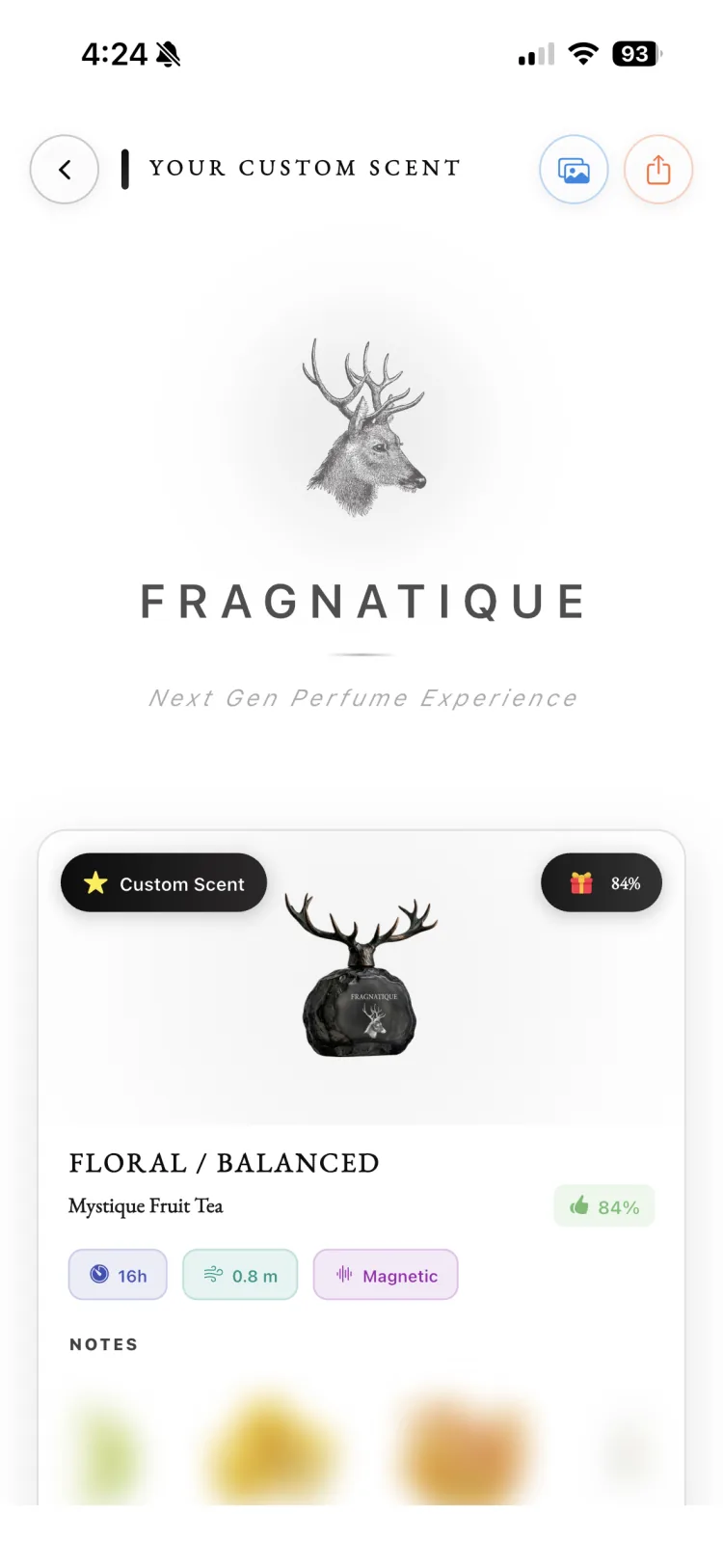
Scent Lab turns an idea into a manufacturing document
Answer the Lab's questions and it returns a formula and an exportable PDF that follows IFRA safety standards, one a producer can actually read.
Open it on iOS1 answer
Most useful answer firstMost useful answer
Think of it as two halves: the AI drafts the formula, and you make and judge it. Skipping either half is where most first attempts go wrong.
On screen: drafting the formula
- Write a brief, not a wish. "Fresh and sexy" gives a model nothing to work with. A useful brief names a reference ("like a cold gin and tonic"), a family (citrus, woody, floral), the structure you want (a bright opening that settles into dry woods), when you will wear it, and how far it should carry. If you can name a perfume you like and what you would change about it, say so.
- Ask for amounts, not notes. A list of notes is a mood. You need materials with weights or percentages that add up to 100. Without proportions there is nothing to weigh.
- Check the safety layer. Restricted materials should be held against the IFRA Standards for fine fragrance (Category 4), and declarable allergens should be listed. If the tool does not do this, look up each material's IFRA limit from the supplier before buying.
- Keep the version. Save the formula with a date. Every later change is measured against it.
On the bench: making and judging it
- Buy small. A precision scale (0.01 g), perfumer's alcohol, glass bottles, blotters, gloves, and the materials in small quantities. Substitutions change the result, so buy what the formula names.
- Pre-dilute and weigh. Many beginners pre-dilute each material at 10 percent in alcohol, then build a small batch by weight. Work in grams, never drops.
- Dilute to strength. For an eau de parfum, a concentrate of roughly 15 to 20 percent in alcohol is a common starting point.
- Rest it. Leave the batch in a cool, dark place. A simple blend can be judged after a day or two; richer ones keep changing for weeks.
- Evaluate on blotter, then skin. Smell it at the opening, after an hour and after several hours. Patch test the diluted perfume on a small area of skin and stop if it reacts. Never test undiluted materials on skin.
- Feed back and iterate. Tell the tool what happened in plain words: "opening too sharp", "the woods vanish after two hours". Expect three to five rounds before a formula feels finished.
What AI genuinely adds
It turns a vague idea into a structured, balanced starting point in minutes, catches restricted materials before you buy them, and makes iteration cheap. It does not know how the blend smells on your skin, and its prediction of how a blend ages is an estimate, not a measurement.
Doing it in Fragnatique
The Scent Lab covers the on-screen half: you describe the scent in everyday words, and Fragnatique's proprietary formulation algorithm returns an original formula as a manufacturing-ready document that follows IFRA safety standards. The Scent Lab guide says more about it. For the bench half, our guide to making perfume at home safely covers equipment, dilution maths and patch testing in detail.
One rule for the whole process: if you plan to sell what you make, stop at the test batch and read the rules for your market first. A formula you wear yourself and a product placed on sale are regulated very differently.