
Key facts
- 1971Berglund and colleagues measure how strong 28 odorants feel at rising concentrations.
- 0.12 to 0.66Range of the smell exponents tabled for 24 odorants in 1979, all below 1.
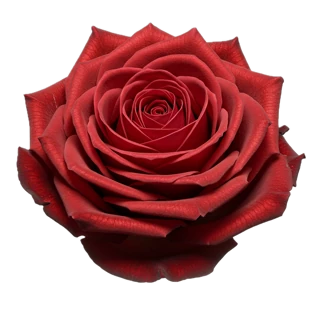
- Geraniol 0.20A main molecule of rose oil; doubling it works out to about 1.15 times as strong.
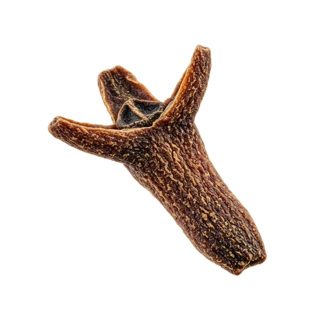
- Eugenol 0.64A major part of clove oil; doubling it works out to about 1.56 times as strong.
- Twice the liquidWhat a second spray does double: the bottle empties twice as fast.
How do scientists measure how strong a smell is?
By asking people to put numbers on it. In a 1971 study in Perception and Psychophysics, Berglund and colleagues had people rate the strength of 28 odorants at several concentrations, a method called magnitude estimation. A 1979 paper in the Journal of the Society of Cosmetic Chemists described the same method as a tool for perfumery, and a 2021 review in Molecules still models smell strength this way.
Why doesn't double the perfume smell double?
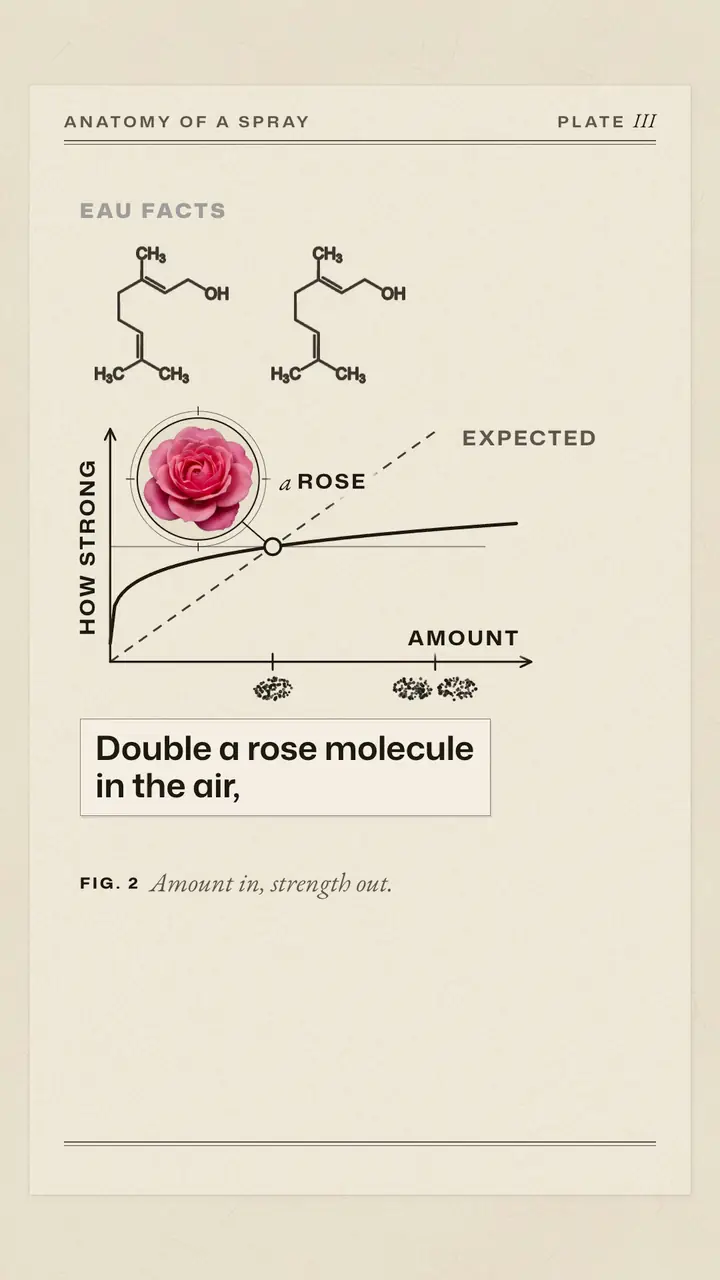
Because felt strength follows a power curve that flattens. The 1979 paper says the exponent of that curve is almost always less than 1.0. Its table of 24 odorants runs from 0.12 to 0.66, and every value is below 1. With an exponent below 1, doubling the amount always gives less than double the felt strength, so the nose squeezes extra perfume rather than adding it up.
Do some notes grow stronger faster than others?
Yes, but none reach double. Geraniol, which a 2016 review names with citronellol as a main component of Damask rose oil, has an exponent of just 0.20. Eugenol, which PubChem calls a major component of clove essential oil, has 0.64, one of the highest in the table; only 1-butanol, not a perfume material, is higher at 0.66. Doubling eugenol works out to about 1.56 times as strong.
Sources
Primary sources only. Every statement on this page restates one of them, read by the Fragnatique team.
- Berglund et al., Individual psychophysical functions for 28 odorants, Perception and Psychophysics 9, 1971doi.org
- Moskowitz et al., Psychophysical measurement as a tool for perfumery, J. Soc. Cosmet. Chem. 30(2), 1979library.scconline.org
- Mahboubi, Rosa damascena as holy ancient herb with novel applications, J. Tradit. Complement. Med. 6(1), 2016pmc.ncbi.nlm.nih.gov
- PubChem, Eugenol (CID 3314)pubchem.ncbi.nlm.nih.gov
- Rodrigues, Nogueira and Faria, Perfume and Flavor Engineering, Molecules 26(11), 2021pmc.ncbi.nlm.nih.gov