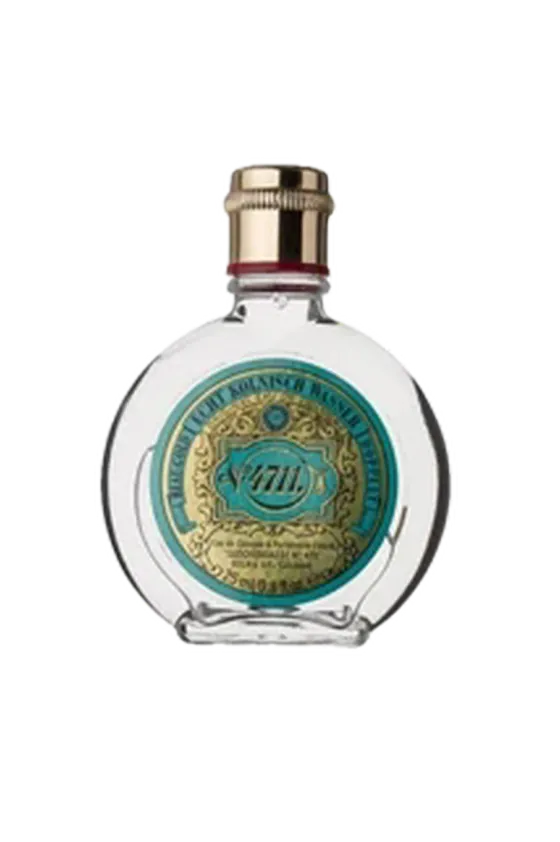



Why does perfume seem to vanish in the cold?
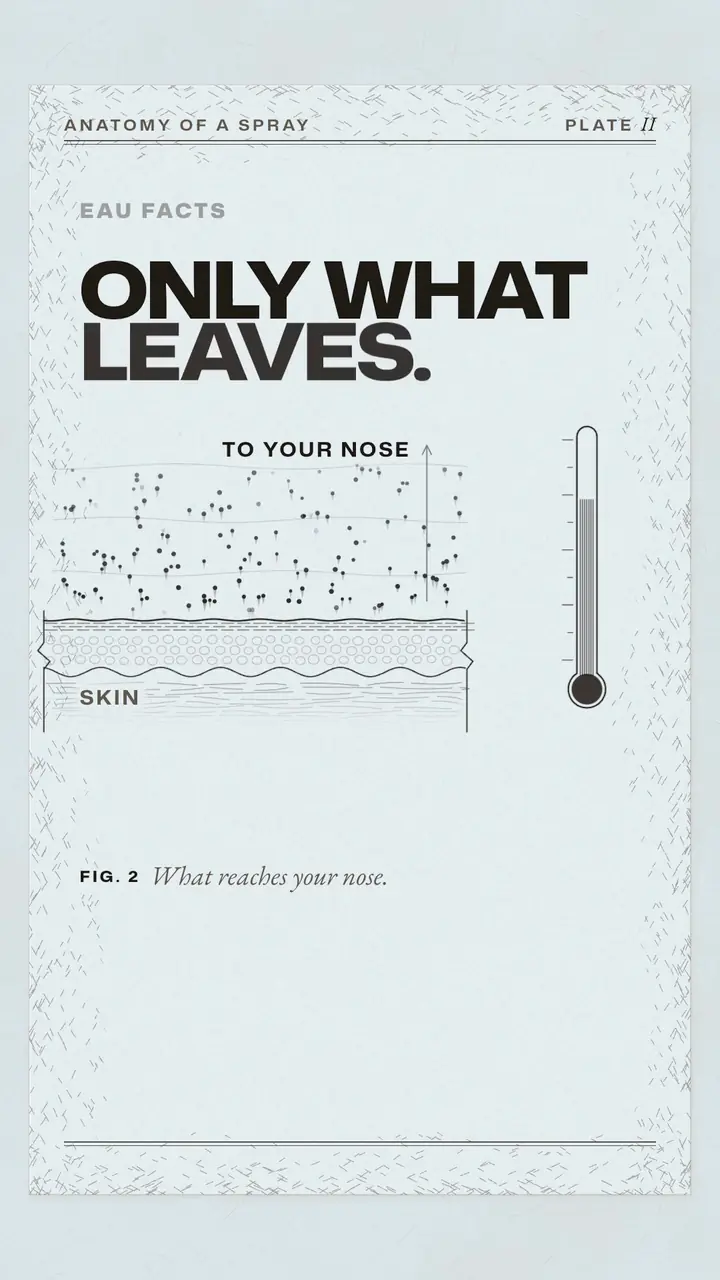
Because you only smell what leaves your skin. A 2021 review in Molecules explains that each ingredient's vapour pressure and its share of the blend set how much of it is in the air, and that air is what reaches the nose. The review models how strong a smell is from that concentration in the air, not from the amount sitting on the skin.
Cold air lowers that release at the source. A 2004 review of human responses to cold in Aviation, Space, and Environmental Medicine describes how cooled skin sensors trigger the narrowing of blood vessels in the skin, a primary defence against falling body temperature. Less warm blood near the surface means cooler skin, and cooler skin means a slower perfume.
Does cold weather damage perfume?
No. Vapour pressure falls steeply as temperature drops, a relation physicists call the Clausius-Clapeyron equation. The NIST Chemistry WebBook lists the heat needed to evaporate limonene, a citrus molecule, at about 49.6 kJ per mole, and linalool at about 55.3 kJ per mole: these figures describe how quickly a molecule leaves, not whether it survives. In the cold the molecules stay on the skin; they simply leave more slowly.
Why does my perfume come back when I walk inside?
Because warmth speeds the release up again. The perfume chemist Jellinek put it plainly in a 1960 talk published in the Journal of the Society of Cosmetic Chemists: “If you have a perfume in an open bottle and you warm the bottle, the odor will be intensified.” The same holds on skin. What did not evaporate on the walk is still there, so a warm room brings it back to the nose.
Where should you spray perfume in winter?
On the warmest skin you have. A 2019 study in the Annals of Dermatology measured skin surface temperature at 15 sites on 30 adults in a room at 24.4 °C. The front of the neck was the warmest site, at 35.0 °C, against 34.7 °C for the forehead, 33.8 °C for the palm, 32.6 °C for the forearm and 30.4 °C for the ear. The wrist itself was not measured, so the forearm is the closest stand-in.
Where the scent sits also matters for how much reaches your face. In a 2015 study with a heated manikin, a tracer gas released at the chest gave the highest concentration in the breathing zone, while the same gas released at the upper back gave negligible exposure.
Does a winter coat change how far perfume travels?
It changes the warm air that carries it, in tests that used a manikin and tracer gas rather than perfume. A 2014 study in Building and Environment found that body heat drives a layer of air up the front of the body, peaking at 0.24 metres per second in a 20 °C room and 0.16 at 26 °C. Clothing cut the peak speed near the face by 17 percent when thin and tight, and by 40 percent when thick and loose. The 2015 follow-up found that a cooler room increased transport to the breathing zone.
Do fresh perfumes stop working in winter?
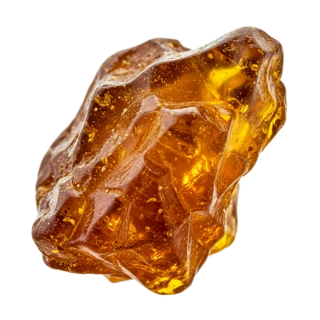
No, they just open more gently outdoors. The Molecules review describes a perfume as top, middle and base notes: top notes, typically citrus, last 15 to 30 minutes on the skin, middle notes 3 to 4 hours and base notes, typically amber or musk, more than 4 hours. Cold slows every layer, but none of them is lost. Your fresh perfumes do not need a winter break.
Key facts
- Vapour pressureEach ingredient's vapour pressure and share set how much reaches the air and the nose, the 2021 Molecules review explains.
- Narrowed vesselsCooled skin triggers the narrowing of blood vessels in the skin, a primary defence against cold, Stocks and colleagues wrote in 2004.
- 1960Jellinek: warm a perfume in an open bottle and its odour is intensified.
- 35.0 °CThe front of the neck, the warmest of 15 skin sites measured on 30 adults in 2019.
- 32.6 °CThe forearm in the same study, the closest measured site to the wrist.
- 40 percentHow much thick, loose clothing cut the peak speed of the warm air rising past a manikin's face in 2014.
What this means when you choose a perfume
Cold is no reason to put away a fresh citrus perfume: it slows down, it does not spoil. Spray the front of the neck or the chest, the warmest and best placed skin in the studies above, rather than the wrist alone. Judge the scent again after a few minutes indoors, where warmth brings back what the cold held in.
Explore citrus perfumesSources
Primary sources only. Every statement on this page restates one of them, read by the Fragnatique team.
- Rodrigues, Nogueira and Faria, Perfume and Flavor Engineering, Molecules 26(11), 2021pmc.ncbi.nlm.nih.gov
- Stocks et al., Human physiological responses to cold exposure, Aviat. Space Environ. Med. 75(5), 2004ntrs.nasa.gov
- NIST Chemistry WebBook, D-Limonene, phase change datawebbook.nist.gov
- NIST Chemistry WebBook, Linalool, phase change datawebbook.nist.gov
- Jellinek, Evaporation and the Odor Quality of Perfumes, J. Soc. Cosmet. Chem. 12(3)library.scconline.org
- Lee et al., Regional Variation of Human Skin Surface Temperature, Ann. Dermatol. 31(3), 2019pmc.ncbi.nlm.nih.gov
- Licina et al., Building and Environment 75, 2014doi.org
- Licina et al., Science and Technology for the Built Environment, 2015doi.org