


Key facts
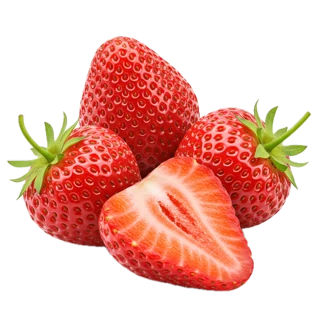
- Ethyl isobutyrateThe strawberry-like odour in the blending experiments.
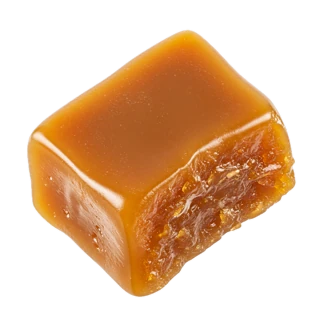
- Ethyl maltolThe caramel-like odour mixed with it.
- PineappleWhat the mixture smelled like, more than either of its parts.
- 2014A review in Frontiers in Psychology explains how the brain can treat a mixture as one new odour.
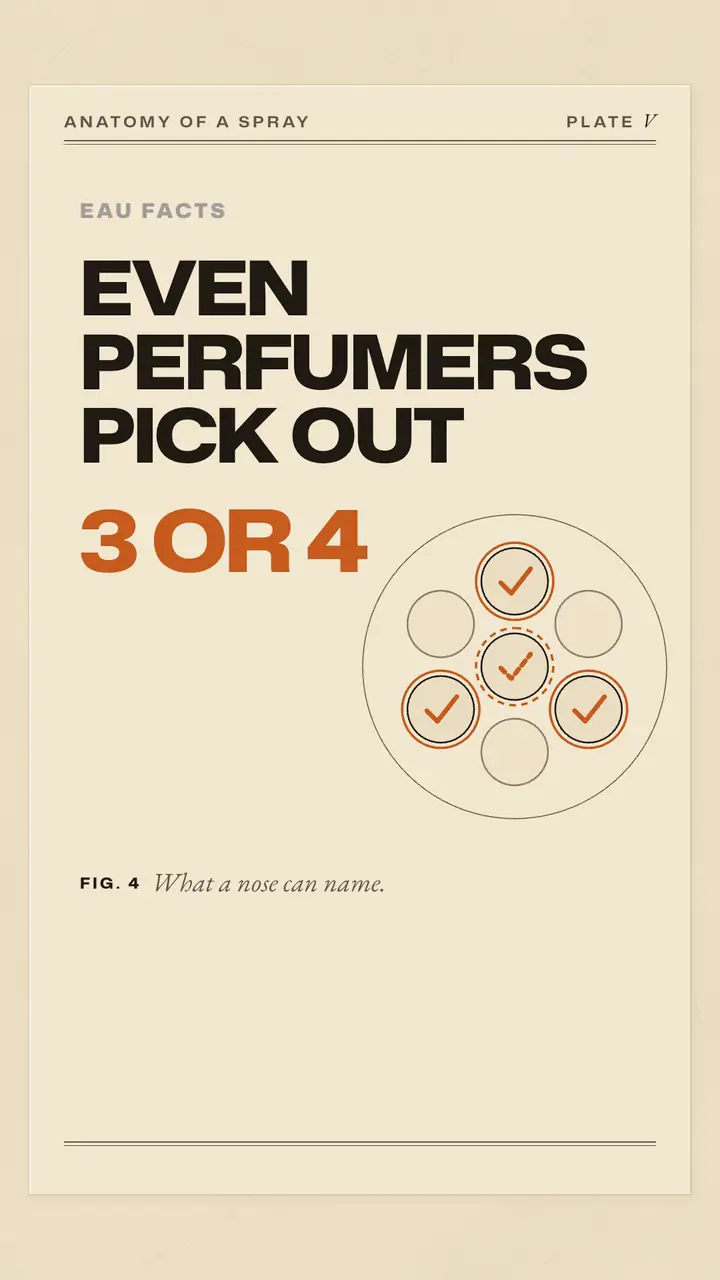
- 3 or 4The most components trained panellists and eight professional perfumers and flavourists could identify in 1996.
- 123 subjectsIn a 1989 test with one to five odorants, few correctly named the parts of a mixture.
Why did strawberry and caramel smell like pineapple?
Because the mixture took on a smell of its own. A 2020 paper in Molecules describes how a mix of ethyl isobutyrate, strawberry-like, and ethyl maltol, caramel-like, was judged more typical of a pineapple odour than its parts were. A 2014 review shows the same result from 20 untrained people: the pineapple note was significantly stronger in the blend than in either single odorant.
Does the brain always blend two smells?
Often, not always. The 2014 review in Frontiers in Psychology explains that the brain can process an odour mixture as one new object whose quality is not that of its components. It can also work the other way: people asked to focus on the parts perceived the blend less as one smell. Laing and Francis wrote in 1989 that odours in mixtures blend to form a new odour with few of the characteristics of the constituent odours.
How many smells can a nose pick out of a mix?
Three or four at most. In a 1996 study, a trained panel of 10 and an expert panel of eight professional perfumers and flavourists could discriminate and identify only three or four components of a complex mixture, and training did not raise that limit. In the 1989 test with 123 people, identification was best for single odours, and few people named the parts of mixtures correctly.
How should you test a layered pair?
As one perfume. Since two scents worn together are perceived as a blend with its own character, and their parts cannot all be picked out, the layers do not simply stack. Spray the pair on the same patch of skin and judge the result as a new smell, not as one perfume plus another.
Sources
Primary sources only. Every statement on this page restates one of them, read by the Fragnatique team.
- Tromelin et al., Exploring the Characteristics of an Aroma-Blending Mixture, Molecules 25(13), 2020pmc.ncbi.nlm.nih.gov
- Thomas-Danguin et al., The perception of odor objects in everyday life, Frontiers in Psychology 5, 2014pmc.ncbi.nlm.nih.gov
- Livermore and Laing, J. Exp. Psychol. Hum. Percept. Perform. 22(2), 1996pubmed.ncbi.nlm.nih.gov
- Laing and Francis, The capacity of humans to identify odors in mixtures, Physiology and Behavior 46(5), 1989pubmed.ncbi.nlm.nih.gov