Why Can't I Smell My Own Perfume? What Science Says
You stop smelling your own perfume because of olfactory adaptation: steady exposure dulls your sensitivity to that one odor, while others still smell it.
- 01You stop smelling your own perfume because of olfactory adaptation: repeated or prolonged exposure to an odor lowers your sensitivity to that odor, and sensitivity recovers over time once the exposure stops (Dalton, Chemical Senses, 2000).
- 02The drop in perceived intensity is relatively fast, and adaptation sets in sooner in the brain than at the receptors in the nose (Pellegrino and colleagues, Physiology & Behavior, 2017).
- 03After two weeks of continuous exposure to an odorant at home, detection thresholds rose, and for most people reduced sensitivity was still evident up to two weeks after the last exposure (Dalton and Wysocki, Perception & Psychophysics, 1996).
- 04Adaptation happens in the person exposed, and only to that odor: people who have not been breathing your perfume all day still smell it, so spraying more mainly gives them more.
- 05Recovery needs time away from the odor; in a 2011 test, sniffing coffee beans did no better than lemon slices or plain air. A general loss of smell is different: the NHS advises seeing a GP if it has not gone back to normal in a few weeks.
You cannot smell your own perfume because your sense of smell has adapted to it: repeated or prolonged exposure to one odor lowers your sensitivity to that odor, and the sensitivity recovers over time once the exposure stops. Adaptation is specific to the odor and to the person exposed, so the people around you, who have not been breathing your perfume all day, can still smell it.
Why can't I smell my own perfume but others can?
Because olfactory adaptation is specific to the odor and to the person exposed. Olfactory adaptation is a drop in sensitivity to an odor caused by repeated or prolonged exposure to that odor. In Pamela Dalton's 2000 review in Chemical Senses, "repeated or prolonged exposure to an odorant typically leads to stimulus-specific decreases in olfactory sensitivity to that odorant, but sensitivity recovers over time in the absence of further exposure." Dalton, a psychologist at the Monell Chemical Senses Center in Philadelphia whose research covers exposure frequency and adaptation, describes two measurable changes: the detection threshold rises, so a faint trace of the odor is no longer noticed at all, and the response to concentrations above that threshold is reduced, so what you do notice seems weaker.
The key words are stimulus-specific. Adaptation is not a general dulling of the nose; it belongs to the odor you have been exposed to, in the person who was exposed. A colleague who walks into the room has not spent the day inside your perfume, so for them it is still a new stimulus.
Sensory adaptation allows organisms to reach behavioral equilibrium with the ambient environment and respond primarily to changes in stimulation.
Pamela Dalton, Chemical Senses, 2000
The system is tuned to changes in stimulation rather than to constants, and a perfume on your own skin, breathed in all day, is a constant.
Two terms recur in the research. Habituation is the decreased behavioral response to an odor created by repeated exposure; adaptation refers to the neural processes behind that decrease. That is how a 2017 review in Physiology & Behavior by Pellegrino, Sinding, de Wijk and Hummel defines the pair; three of its four authors were at the Interdisciplinary Center on Smell and Taste at TU Dresden. The everyday names, olfactory fatigue and being nose blind to a scent, cover both.
Why does it happen so fast?
Because the drop in perceived intensity is relatively fast, and it sets in sooner in the brain than in the nose. Pellegrino and colleagues sum up what psychophysics combined with modern techniques of neural measurement indicate: "habituation to odors, or decrease of intensity, is relatively fast with adaptation occurring more quickly at higher cerebral processes than peripheral adaptation." There is no single figure in minutes, and Dalton's review explains why: the size of the decrease and the time course of adaptation and recovery "are dependent on the concentration of the odor and on the duration of exposure."
Dalton's review also sets out the evidence that both the nose and the brain take part. When an odor is presented to one nostril only, adaptation appears in both nostrils, although it is deeper, and slower to recover, in the exposed one. And studies have found "relatively small decreases in peripheral response following repeated stimulation despite substantial reductions in perceived intensity." Read plainly: the receptors in the nose still respond to the odor, only a little less, while it feels much weaker. Much of the quieting happens further in.
Why can't I smell my perfume anymore?
Because wearing the same perfume or cologne day after day is long-term exposure, and in a study that tested two weeks of exposure, the loss of sensitivity lasted for weeks too. In 1996 Dalton and Charles J. Wysocki, also at Monell, published in Perception & Psychophysics a study built for real life: "most experimental analyses of olfactory adaptation use brief odorant exposures which may not typify real-world experiences." Their volunteers were exposed continuously to one of two odorants in their own homes for two weeks, with psychophysical tests in the laboratory before and after.
The exposure produced "an odorant-specific reduction in sensitivity and perceived intensity compared with preexposure baselines": detection thresholds for the adapting odorant were elevated, and weak concentrations were rated less intense. Then comes the finding that matters for a signature scent.
For most individuals, reduced sensitivity to the test odorant was still evident up to 2 weeks following the last exposure.
Pamela Dalton and Charles J. Wysocki, Perception & Psychophysics, 1996
The authors write that this persistence "distinguishes this phenomenon from the adaptation seen following shorter exposures." Their abstract opens with a sentence any daily wearer will recognize: "Any individual living or working in an odorous environment can experience changes in odor perception, some of which are long lasting." The volunteers lived with a test odorant around the clock, which is not the same as wearing a perfume for a working day. The direction is the point: after long exposure, the way back is long.
It is also the quiet paradox of a signature scent, which our guide to finding one defines as a fragrance other people associate with you on contact: the people who meet you know it better than you do.
Wearing a fragrance every day, for a full working day or longer, is repeated and prolonged exposure in the sense of Dalton's review.
Is it olfactory fatigue, or has my perfume faded?
Often both, and they are different things. A perfume does change on skin over the day: its most volatile molecules evaporate first, which is why top notes fade within the first two hours or so, as our guide to the notes pyramid explains. That is chemistry in what you sprayed. Olfactory fatigue is a change in you: the studies above measured higher detection thresholds and lower intensity ratings in the people exposed. If your wrist gives you nothing while a friend across the table still notices the base notes, the perfume is still there, and adaptation is the likelier explanation.
A third possibility concerns particular molecules: whether everyone can smell a material such as Iso E Super at all is a separate question, which our post on Molecule 01 takes up.
Should I spray more if I can't smell my perfume?
No. Adaptation is specific to the odor you have been breathing, so more of the same perfume is more of the exposure that caused it; in Dalton's summary, the size of the drop and its time course depend on the concentration of the odor and on the duration of exposure. The people near you have not adapted, and they receive the full extra dose. The reliable gauge is someone else's nose.
How do I smell my own perfume again?
With time away from it. Sensitivity "recovers over time in the absence of further exposure," in Dalton's words, and how long that takes depends on how concentrated the odor was and how long you were in it. On your own skin the odor never fully goes away, so the research gives little reason to expect it back while you are still wearing it. What follows from the studies:
- Ask a nose that has not been wearing it. Adaptation is specific to the person and the odor, so a colleague or partner can tell you what you no longer can.
- Rotate, if smelling it yourself matters. A signature scent asks for consistent wear, and that is exactly the exposure that dulls it for you. A second perfume on alternate days gives the first one time without exposure, which is what recovery needs; because adaptation is specific to the odor, make the second one clearly different from the first.
- Allow for a long break. After two weeks of continuous exposure, most of Dalton and Wysocki's volunteers still showed reduced sensitivity up to two weeks after the last exposure, so a perfume worn every day for weeks may take that long to come back to you.
- Skip the coffee beans. Fragrance sellers often hand them out as a "nasal palate cleanser," note the authors of a 2011 exploratory study in Perceptual and Motor Skills, which put the idea to the test: after smelling three fragrances over nine trials, college students sniffed coffee beans, lemon slices or plain air, then picked out which of four fragrances they had not smelled before. Coffee beans did no better than lemon slices or air.
The Scent Journal in Fragnatique's Perfume Cabinet records the outside view too: next to how long a wear lasted and how loud it was, each entry asks "How many people noticed your scent?", a count taken from noses that have not adapted.
When is it a loss of smell, not adaptation?
When smells in general fade, not just one, and the change does not lift after time away. Adaptation is specific to an odor and reverses once the exposure stops. A lost or changed sense of smell is different. The NHS says such a change can be unpleasant but "it's not usually serious and may get better in a few weeks or months," and it lists the most common causes: illnesses such as a cold, flu or COVID-19, sinusitis, an allergy like hay fever, and growths in the nose (nasal polyps). Some medicines can also cause it and, rarely, more serious conditions like Parkinson's disease or epilepsy. Losing some sense of smell with age is common.
The NHS names four forms: loss of smell (anosmia), reduced sense of smell (hyposmia), changes to how things smell (parosmia) and smelling things that are not there (phantosmia), like smoke or burnt toast. Its advice is to see a GP if "your sense of smell does not go back to normal in a few weeks." Treating the cause might help, it says, and "a treatment called smell training can help some people," although sometimes the change cannot be treated and may be permanent. It adds a safety note: without a sense of smell you may not notice gas leaks, fires or food that has gone off.
So the check is simple. If coffee, soap and other people's perfume still smell as they should and only your own scent has gone quiet, the pattern fits adaptation. If smells in general have faded and stay faded for a few weeks, follow the NHS advice and see a GP.
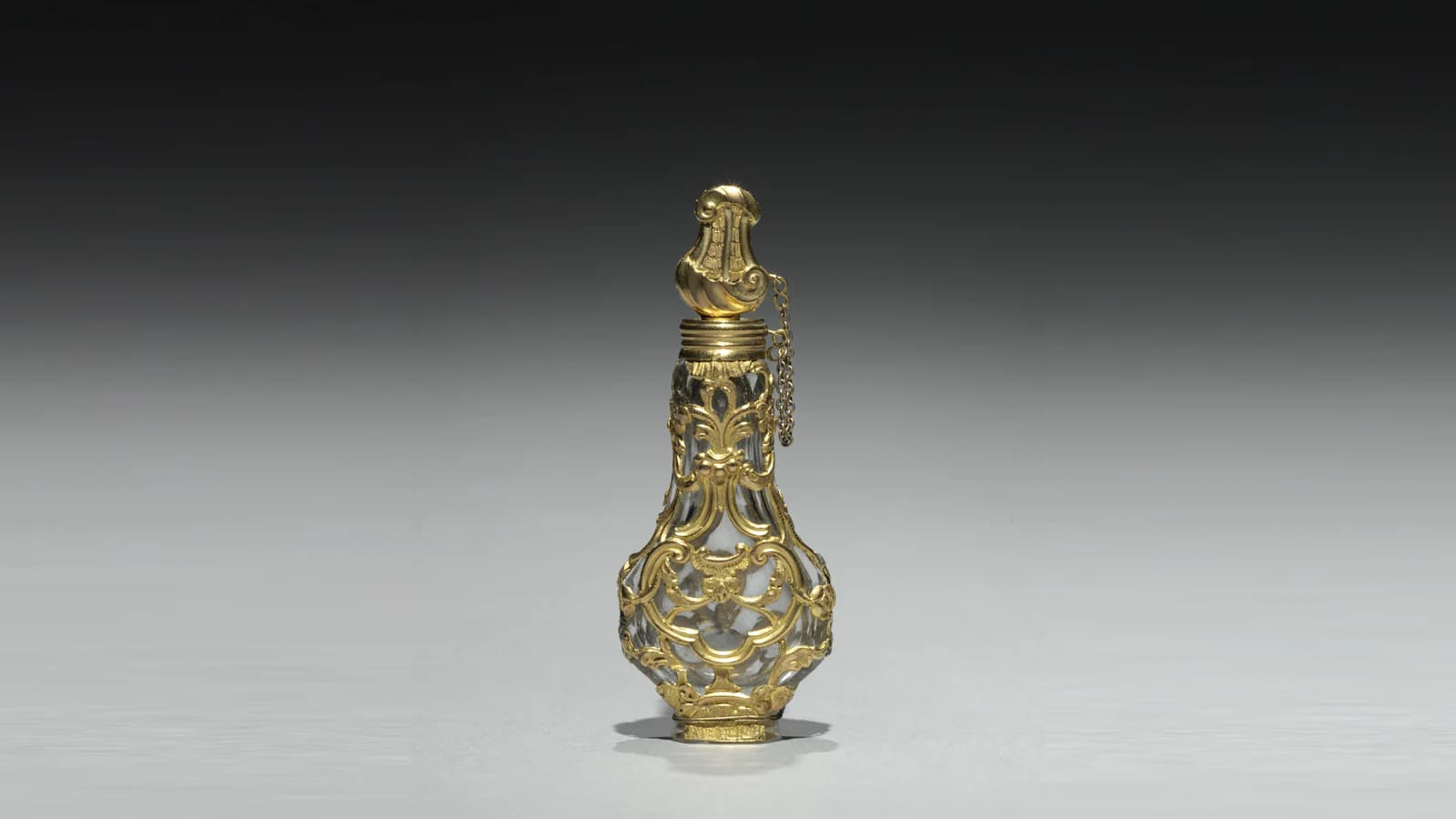
Our cover shows a French scent bottle of about 1775, clear glass mounted in gold scrollwork and 7 centimeters tall, from the Cleveland Museum of Art's open-access collection. If a second bottle is the plan, the perfume finder starts from your taste and names the notes behind each match, so the second scent can be built differently from the one your nose has filed as background.
Frequently asked
Why can't I smell my own perfume but others can?
Because adaptation happens in the person exposed, and only to the odor they were exposed to. Pamela Dalton's 2000 review in Chemical Senses describes repeated or prolonged exposure to an odorant leading to stimulus-specific decreases in sensitivity to that odorant. The people around you have not been breathing your perfume all day, so their sensitivity to it is intact. The perfume can still be on your skin; what has risen is your threshold for it.
How long does it take for your nose to get used to a perfume?
There is no single figure. Pellegrino and colleagues' 2017 review in Physiology & Behavior describes the decrease in perceived intensity as relatively fast, with adaptation setting in sooner in the brain than at the receptors, and Dalton's 2000 review says the size of the drop and its time course depend on the odor's concentration and the length of exposure. At the long end, in Dalton and Wysocki's 1996 study, two weeks of continuous exposure at home raised detection thresholds, and for most people reduced sensitivity was still evident up to two weeks after the last exposure.
Do coffee beans reset your nose?
A 2011 study that tested the idea found no benefit. In the exploratory study, published in Perceptual and Motor Skills, college students smelled three fragrances over nine trials, sniffed coffee beans, lemon slices or plain air, and then picked out which of four fragrances they had not smelled before; coffee beans did no better than lemon slices or air. What the adaptation research describes is recovery over time without the odor (Dalton, 2000).
Should I spray more perfume if I can't smell it?
No. Adaptation is specific to the odor you have been breathing, so more of the same perfume is more of the exposure that caused it, and Dalton's 2000 review notes that the size of the drop depends on the odor's concentration and the length of exposure. The people near you are not adapted, so they receive the full extra dose. Judge the amount by other people's reactions, not by your own nose.
Is olfactory fatigue the same as losing your sense of smell?
No. Olfactory fatigue, or adaptation, is specific to one odor and recovers over time once the exposure stops. A lost or changed sense of smell is a different matter, and the NHS lists its most common causes as illnesses such as a cold, flu or COVID-19, sinusitis, an allergy like hay fever and nasal polyps; some medicines and, rarely, conditions such as Parkinson's disease or epilepsy can also cause it. The NHS advises seeing a GP if your sense of smell does not go back to normal in a few weeks.

Written by Fragnatique Team