


Key facts
- 15 to 30 minutesHow long top notes, typically citrus, last on the skin, the 2021 Molecules review says.
- 3 to 4 hoursThe review's figure for middle notes.
- More than 4 hoursBase notes, typically amber or musk, which give a perfume its staying power.
- 1.55 mmHgPubChem's vapour pressure for limonene, a citrus molecule, at 25 °C.
- 0.000118 mmHgPubChem's vapour pressure for vanillin, the vanilla molecule, at 25 °C.
- 1955Poucher sorts perfume materials into top, middle and base by evaporation coefficient.
What are top, middle and base notes?
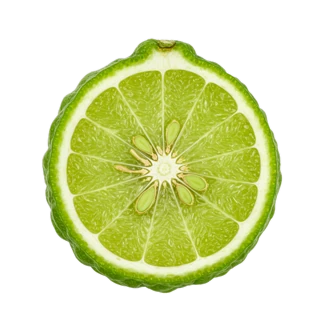
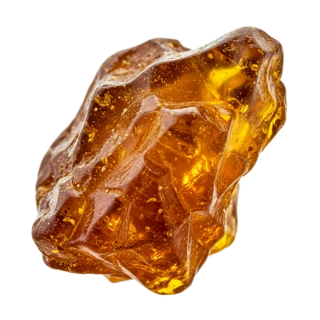
Groups of ingredients that leave the skin at different speeds. The Molecules review describes a perfume as top, middle and base notes plus solvents. Top notes give the first impression, typically citrus; base notes, typically amber or musk, give the staying power. Perfumery's classic split, published by Poucher in 1955, ranks materials by evaporation coefficient: 1 to 14 for top notes such as bergamot, 15 to 60 for middle notes such as eugenol, 61 to 100 for the base.
Why do some molecules leave faster than others?
Because of vapour pressure. The review explains that each ingredient's vapour pressure and its share of the blend set how much of it is in the air, and that air is what reaches the nose. PubChem lists limonene, a citrus molecule, at 1.55 mmHg at 25 °C and vanillin at 0.000118 mmHg. The review's own worked example uses limonene as the top note and vanillin as the base.
When should you judge a new perfume?
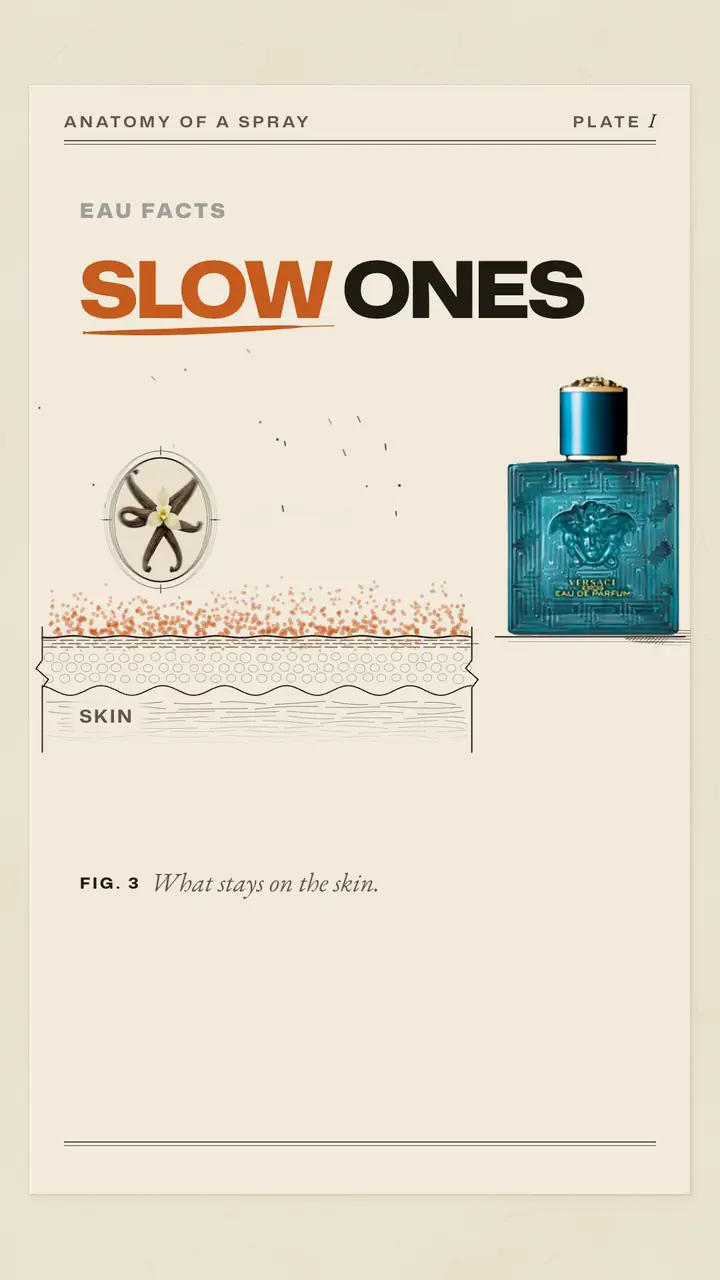
After the opening has passed. The perfume chemist Jellinek said in a 1960 talk that perfumes are usually complex mixtures containing materials of widely different vapour pressures. That is why the first minutes are dominated by the fast part, which is mostly gone within half an hour. The smell that stays on your skin after that is the one you will live with, so it is the one to judge.
Sources
Primary sources only. Every statement on this page restates one of them, read by the Fragnatique team.
- Rodrigues, Nogueira and Faria, Perfume and Flavor Engineering, Molecules 26(11), 2021pmc.ncbi.nlm.nih.gov
- PubChem, Limonene (CID 22311)pubchem.ncbi.nlm.nih.gov
- PubChem, Vanillin (CID 1183)pubchem.ncbi.nlm.nih.gov
- Jellinek, Evaporation and the Odor Quality of Perfumes, J. Soc. Cosmet. Chem. 12(3)library.scconline.org
- Poucher, J. Soc. Cosmet. Chem. 6(2), 1955library.scconline.org