
Every perfume listing shows a pyramid of top, heart and base notes, and many also show accords. People want to know what these terms actually mean, why two perfumes with almost the same note list can smell completely different, and which part of the description is most useful when choosing a new perfume or reading a match.
This guide explains the vocabulary and how to use it.
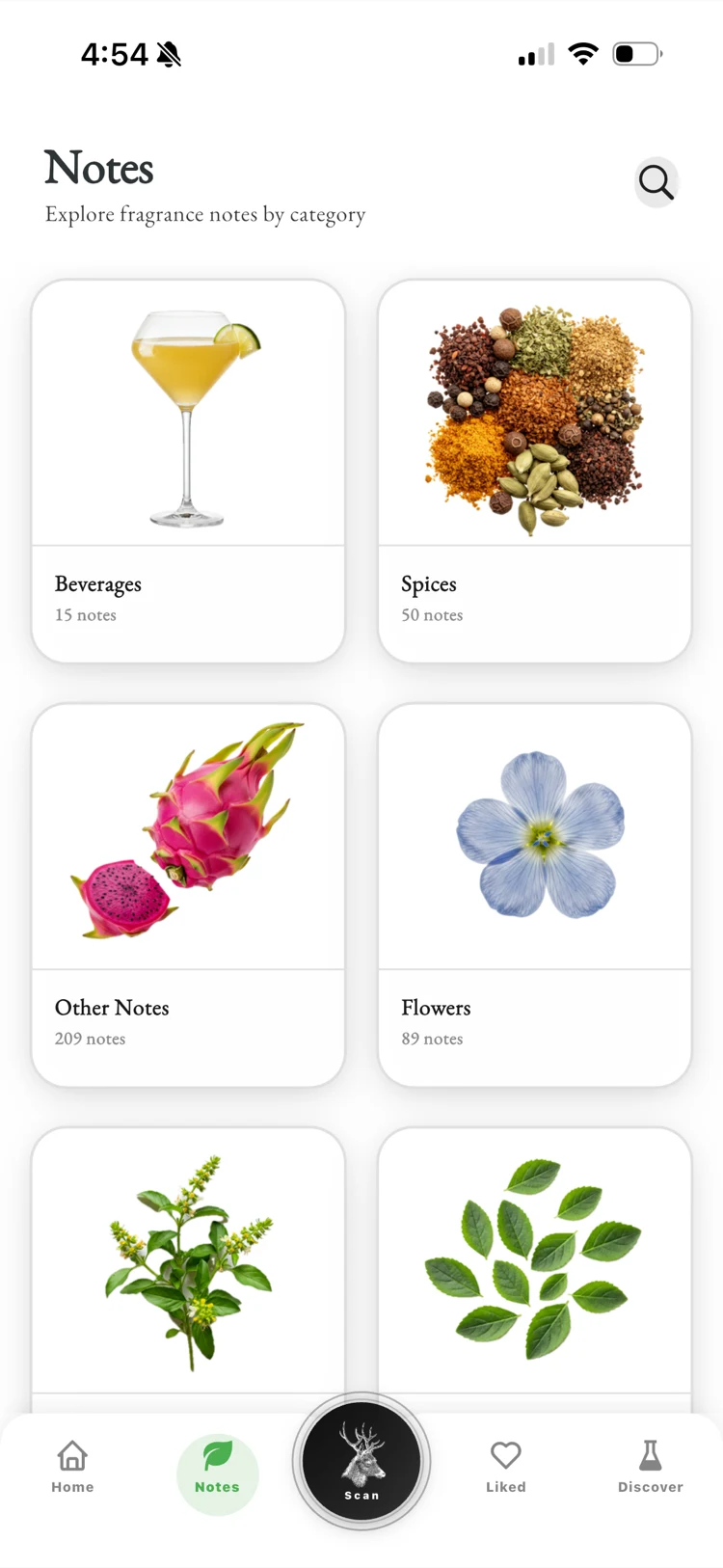
Every note, browsable on its own
Every note discussed here has its own page in the app: what it smells like, which families use it, and which bottles in the catalogue lean on it hardest. Start from a note instead of a bottle and work outwards.
Open it on iOS1 answer
Most useful answer firstMost useful answer
The notes pyramid describes time. A perfume is a mix of materials that evaporate at different speeds, so what you smell changes as it dries down.
| Tier | When you notice it | Typical materials |
|---|---|---|
| Top notes | First minutes, often gone within about an hour | Citrus (bergamot, lemon), light herbs, pink pepper |
| Heart notes | From about the first hour, for several hours | Florals (rose, jasmine, iris), spices, green notes |
| Base notes | Underneath from the start, dominant late on | Woods, resins, vanilla, musks, amber materials |
The timings are approximate. Concentration, skin, temperature and the materials themselves all move them, and modern perfumes often blur the tiers on purpose.
What a note is, and what it is not
A note names an impression ("rose", "sandalwood"), not necessarily one raw material. "Rose" can be a natural rose oil, a single aroma molecule, or a reconstruction from several. "Amber" in perfumery is not fossil amber at all but a warm blend, often of labdanum, vanilla and resins. So a note list tells you what the perfume contains in words, not how much of each or how the parts interact.
What an accord is
An accord is several materials balanced so they read as one new impression, the way a chord is several notes heard as one sound. Classic examples:
- Fougere: lavender, coumarin (a hay-like, tonka-like material) and oakmoss, the base of many barbershop scents.
- Chypre: bergamot over a mossy, woody base.
- Amber (oriental): warm resins, vanilla and labdanum.
Some tools also use "accord" more loosely for a perfume's overall character on axes such as woody, fresh or sweet.
Why accords matter more for choosing
Two perfumes can both list bergamot, iris and vetiver and smell unrelated, because in one the iris is the centre and in the other it is a trace under a loud vetiver. What you actually experience is the structure: which accord dominates, how sweet or dry it is, how it changes over time. People who say "I love sandalwood" often love a particular creamy, woody-sweet accord rather than the note itself.
How to use this when choosing a perfume
- Look at the family and main accords first: they predict whether the style suits you.
- Read the base notes for what you will live with for most of the day.
- Treat the top notes as the first impression, the part most likely to mislead you on a blotter in a shop.
- Test on skin and smell it again after two hours and after six.
How matching uses it
A match score that compared note lists alone would rate those bergamot-iris-vetiver perfumes as near twins. Fragnatique's proprietary matching algorithm looks past the note list, and every perfume's page shows its pyramid and main accords; the methodology page explains the families and accords. Our AI perfume finder writes out which notes and accords drove each match, so you can check the reasoning against what you know you like.