Molecule 01: The Perfume Made of One Molecule, Iso E Super
Molecule 01 contains one aroma molecule, Iso E Super, says Escentric Molecules; a 2019 chemistry review credits an impurity of about 5 percent with its smell.
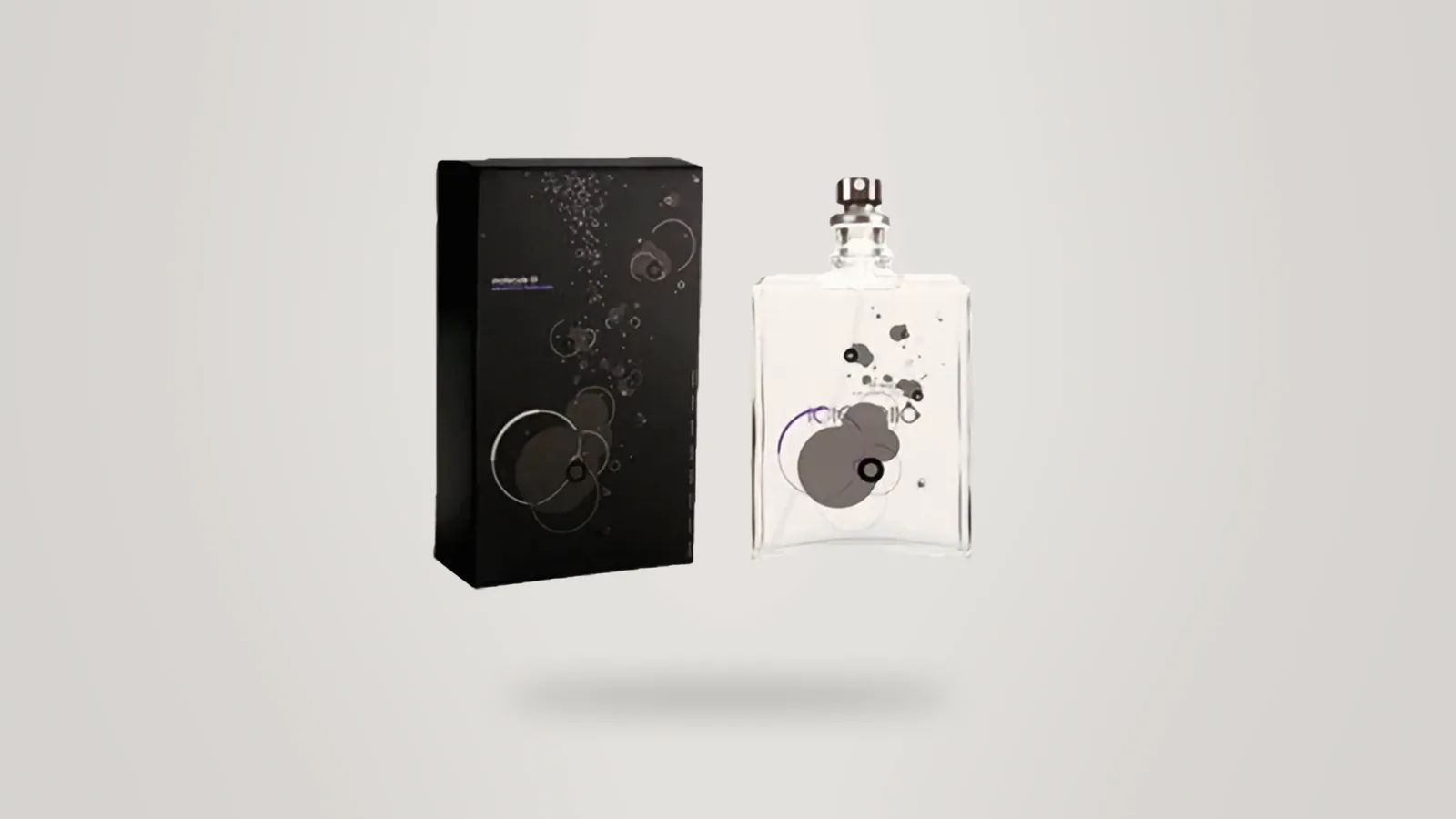
- 01Escentric Molecules says the only ingredient in Molecule 01 is the aroma molecule Iso E Super; its product page lists alcohol and water beside the fragrance.
- 02According to a 2019 chemistry review, an impurity of about 5 percent, now called Iso E Super Plus, is credited with Iso E Super's characteristic smell.
- 03A 2019 chemistry review lists Terre d'Hermès at 55 percent Iso E Super and Dior's Fahrenheit at 25 percent of the perfume oil.
- 04Escentric Molecules says regular users may become hyposmic to Iso E Super, partly blind to its smell, and suggests a one-month break from the fragrance in that case.
- 05IFRA caps OTNE, sold as Iso E Super, at 20 percent of a fine fragrance; EU law requires labels to name it above 0.001 percent in leave-on products.
This perfume is made of a single molecule
Open on InstagramTranscript
This perfume is made of a single molecule. Some people can't smell it at all.
It's Molecule 01, and its only ingredient is Iso E Super.
The twist? Its signature smell comes from an impurity of about five percent.
A chemistry review lists Terre d'Hermès at fifty-five percent Iso E Super, and Dior's Fahrenheit at twenty-five.
The brand says some noses barely detect it, and regular wearers may stop noticing.
So, is your nose broken if you can't smell it?
Usually not. The brand says it's often temporary, and suggests a one-month break.
Has your own perfume ever vanished on you?
Narrated by an AI voice.
Geza Schön created Molecule 01 in 2005, according to a 2019 review in the Beilstein Journal of Organic Chemistry; Escentric Molecules' journal dates its launch to 2006. Its material is older. The house says Iso E Super was created in a laboratory at International Flavors & Fragrances (IFF) in 1973. A figure in the review dates it to 1972.
What is in Molecule 01?
Molecule 01 contains one aroma molecule, Iso E Super, and no other odorant, according to the Escentric Molecules FAQ. The house puts it in one line:
The only ingredient in Molecule 01 is the aroma-molecule Iso E Super.
Escentric Molecules, FAQs
The bottle still holds more than that one substance. The Molecule 01 product page lists "Alcohol Denat., Parfum (Fragrance), Aqua (Water)", so its "100% Iso E Super, pure and singular" describes the fragrance part of the formula.
How much of the bottle is fragrance? The FAQ says every Escentric Molecules perfume except Escentric 02 Extrait de Parfum is an eau de toilette, typically 5 to 15 percent perfume concentrate. It gives no exact figure for Molecule 01.
Schön, whom the house calls its creator, explained the idea in a 2008 commentary on the two launches. He built two perfumes on one "real fragrance raw material": Escentric 01, with 65 percent Iso E Super among other materials, and Molecule 01, which "consists exclusively" of it.
The review's authors, Alexey Stepanyuk and Andreas Kirschning, then at Leibniz University Hannover, call Iso E Super "the most successful synthetic fragrance ever".
What does Iso E Super smell like?
Its supplier, the perfumer behind Molecule 01 and the chemists who study it describe Iso E Super as woody and ambery. Schön calls it a "transparent woody aroma chemical". The IFF ingredient page for Iso E Super says "Smooth, woody, amber with unique aspects giving a 'velvet' like sensation". The review gives the main compound's odor as "woody, floral, ambergris, violet, old-wood, lemony".
IFF received two US patents on it in 1975, both naming John B. Hall and James M. Sanders as inventors. US 3,911,018, granted on 7 October, covers the process and its products; US 3,929,677, granted on 30 December, covers perfumes that contain it. Both call the products useful amber and fruity amber fragrance ingredients.
In a formula, IFF rates its impact as medium in the top, heart and base alike, with a substantivity, or staying power, of more than 48 hours. The review files woody and amber odors among the bottom notes, those perceived mainly as a perfume dries. Our guide to woody fragrances covers the family.
Escentric Molecules frames it as an effect more than a smell. Its FAQ quotes Schön calling Iso E Super "less an aroma than an effect which lends an indefinable radiance to the wearer". The product page adds that Molecule 01 "has been said to cause animal magnetism", but neither the house's FAQ and product pages nor the 2019 review calls it a pheromone. Our Hedione story covers research on another perfume molecule and a possible human pheromone receptor.
Is Molecule 01 really a single molecule?
Molecule 01 is one material but not one compound. The 2019 review says Iso E Super materials are "not handled as single isomers but rather as varying mixtures", because no industrial synthesis is very selective.
The review roots Iso E Super in the terpenoids of geranium and bergamot oils, two materials of Houbigant's Fougère Royale of 1882. Its starting material, myrcene, is a major constituent of geranium oil, though industry obtains it from turpentine, "a side product in paper manufacturing". A Diels-Alder reaction joins myrcene to a second building block, then an acid closes a second ring, as IFF's patents describe.
That acid step yields "several other cyclisation products", the main one being Iso E Super. A minor one, Iso E Super Plus, is an impurity of about 5 percent. It "was made responsible for the characteristic smell", the review says, citing a 1999 paper in Helvetica Chimica Acta. The impurity was analyzed in Givaudan's laboratories and patented as Iso E Super Plus; a figure in the review dates it to 1990.
The authors also compared Molecule 01 by gas chromatography with another commercial sample and their own product. The samples smelled similar but not identical, because isomers present in very small amounts "impact the nuances of a scent significantly". Even the two mirror-image forms of Iso E Super Plus differ: one has an "intense woody odor", the other a "faint odor".
The review also compares odor thresholds, the lowest concentration a nose can detect. Iso E Super's own is 500 nanograms per liter. For Iso E Super Plus it gives 5 nanograms in its text but 5 picograms, a thousand times less, in a table. Either way, the impurity is detectable at least 100 times more dilute (our arithmetic).
Why can't some people smell Molecule 01?
Escentric Molecules' FAQ gives three possible reasons for Molecule 01 seeming odorless. First, Iso E Super belongs with materials such as musk that some people are highly sensitive to, while others find them hard to detect. Most people, it adds, detect them "within a normal range of sensitivity". Second, the molecule seems to come and go:
It's one of the mysterious qualities of Iso E Super that it seems to vanish and re-appear.
Escentric Molecules, FAQs
The house ties this to the way the molecule bonds with smell receptors, releasing only slowly. That is the brand's account; the review says only that how molecules affect perception is "hard to predict".
The third reason is anosmia or hyposmia, full or partial smell-blindness. "Regular users may become hyposmic to Iso E Super," the FAQ says. Hyposmia to one particular smell, such as musk or Iso E Super, is "in most cases" temporary, it adds, and it suggests that regular users take a one-month break from the fragrance.

For anyone who finds Molecule 01 hard to detect, the house suggests Escentric 01, "a hyper-portrait of Iso E Super" at 65 percent. No source we read counts how many people cannot smell it; our check of popular perfume myths marks the claim as reported.
How much Iso E Super do other perfumes contain?
The 2019 review lists 14 other perfumes whose perfume oil is 18 to 80 percent Iso E Super. Terre d'Hermès is at 55 percent and Dior's Fahrenheit at 25. The shares are of the concentrate before dilution and count Iso E Super Plus too. The review's table, in its order:
| Perfume | House | Iso E Super in the perfume oil |
|---|---|---|
| Molecule 01 | Escentric Molecules | 100% |
| Perles | Lalique | 80% |
| Orb_ital | Nomenclature | 75% |
| Poivre Samarcande | Hermès | 71% |
| Escentric 01 | Escentric Molecules | 65% |
| Terre d'Hermès | Hermès | 55% |
| Incense Kyoto | Comme des Garçons | 55% |
| Incense Jaisalmer | Comme des Garçons | 51% |
| Fierce for Men | Abercrombie & Fitch | 48% |
| Kenzo Air | Kenzo | 48% |
| Encre Noire | Lalique | 45% |
| Féminité du Bois | Shiseido | 43% |
| Fahrenheit | Dior | 25% |
| Trésor | Lancôme | 18% |
| Aventus | Creed | 18% |
The table runs "down to about 20%" and leaves out the many perfumes below that. The review cites Schön's 2008 commentary for it, though it includes later launches, and gives no method. Treat these as the review's figures, not tests of bottles on sale today.
Is Iso E Super safe?
Iso E Super is allowed in perfume, within limits. The fragrance industry's standards body, IFRA, restricts it, and EU law lists it among the fragrance allergens that labels must name.
IFRA's standard for OTNE (short for its chemical name) lists Iso-E Super among its commercial names. First published in 2008 and revised in 2020, it caps how much a finished product may contain, for example:
- Fine fragrance (Category 4): 20 percent
- Body lotion (Category 5A): 5.1 percent
- Bar soap and other rinse-off body products (Category 9): 2.4 percent
- Candles and other products not meant for skin contact (Category 12): no restriction
The standard names dermal sensitization and systemic toxicity as the properties behind these limits. IFRA's guidance on using its standards shows the effect. On skin sensitization alone, fine fragrance would be allowed 20.4 percent and leave-on hair products 41.1, against caps of 20 and 0.67. A perfume that doubles as a hair mist would have to meet 0.67 percent.
The guidance calls this framework "the self-regulating system of the industry" and says following the standards may not be enough on its own for regulatory compliance. EU law adds a labeling rule. Under Regulation (EU) 2023/1545, a cosmetic product must list the material as tetramethyl acetyloctahydronaphthalenes in its ingredients. The rule applies above 0.001 percent in leave-on products and 0.01 percent in rinse-off ones.
Products that do not comply could be placed on the EU market until 31 July 2026 and may stay on sale until 31 July 2028. Our look at natural and synthetic perfume safety covers the other allergens this rule added. As the house gives no exact concentration for Molecule 01, we do not set the bottle against IFRA's cap.
Is Iso E Super the same as Ambroxan?
No: PubChem's record for Iso E Super and its record for (-)-ambroxide, which lists Ambroxan as a synonym, describe two different molecules. Escentric Molecules bottles them apart too: its FAQ names Iso E Super as the molecule of Molecule 01 and Ambroxan as that of Molecule 02.
| Iso E Super | Ambroxan | |
|---|---|---|
| PubChem record | CID 108242 | CID 10857465, (-)-ambroxide |
| Formula | C16H26O | C16H28O |
| Molecular weight | 234.38 g/mol | 236.39 g/mol |
| Chemical family | ketone (an ethanone) | ring ether (a naphthofuran) |
Ambroxide has two more hydrogen atoms and a different ring system. The house also calls Ambroxan "nature-identical", while its product pages say Iso E Super "does not exist in nature". Some of OTNE's ten commercial names in IFRA's standard, such as Ambergris Ketone and Ambralux, are easy to mistake for Ambroxan.
Part of Eau Facts, the Fragnatique team's series on fragrance history and science, also told in short videos on Instagram at @eaufacts. Researched from the sources listed above, drafted with AI assistance and checked against each source before publishing.
Frequently asked
- Is Iso E Super a base note?
- Not only. IFF, the company that sells it, rates its note impact as medium in the top, heart and base alike, and gives its substantivity, how long it lingers, as more than 48 hours. The 2019 review in the Beilstein Journal of Organic Chemistry classes woody and amber odors as bottom notes, the ones perceived mainly in the dry-down, and describes Iso E Super's main compound as woody and ambergris-like.
- Is Iso E Super natural or synthetic?
- Synthetic. The 2019 review calls it a synthetic terpenoid, and Escentric Molecules says it does not exist in nature. It is made from myrcene, a terpene that industry obtains from turpentine, a by-product of paper making: a Diels-Alder reaction joins myrcene to a second building block, and an acid then closes a second ring. IFF's 1975 patents describe the same route. So its starting material has a natural origin, while the molecule itself is made by synthesis.
- Who makes Iso E Super?
- International Flavors & Fragrances (IFF) sells it under the name Iso E Super. IFF held the 1975 US patents on it, which name John B. Hall and James M. Sanders as inventors: US 3,911,018, granted on 7 October, covers the process and its products, and US 3,929,677, granted on 30 December, covers perfumes that contain it. IFRA's standard lists ten commercial names for the same chemical, OTNE, among them Ambergris Ketone and Ambralux.
- Is Molecule 01 a pheromone?
- None of the sources we checked calls it one. Escentric Molecules' product page reports only that Molecule 01 has been said to cause animal magnetism, and cites no study. The house's FAQ describes Iso E Super as an effect that lends the wearer radiance, and the 2019 chemistry review treats it as a woody, ambery fragrance material. Neither calls it a pheromone or reports a test of such an effect.

Explore Fragnatique