Anyone who starts buying fragrance materials soon meets the letters IFRA on supplier pages and certificates. Home perfumers want to know what the limits actually are, how to read them, and whether they matter for a bottle that will never leave the house.
This guide explains the system in plain terms and where the line between hobby and regulated product sits.
Scent Lab turns an idea into a manufacturing document
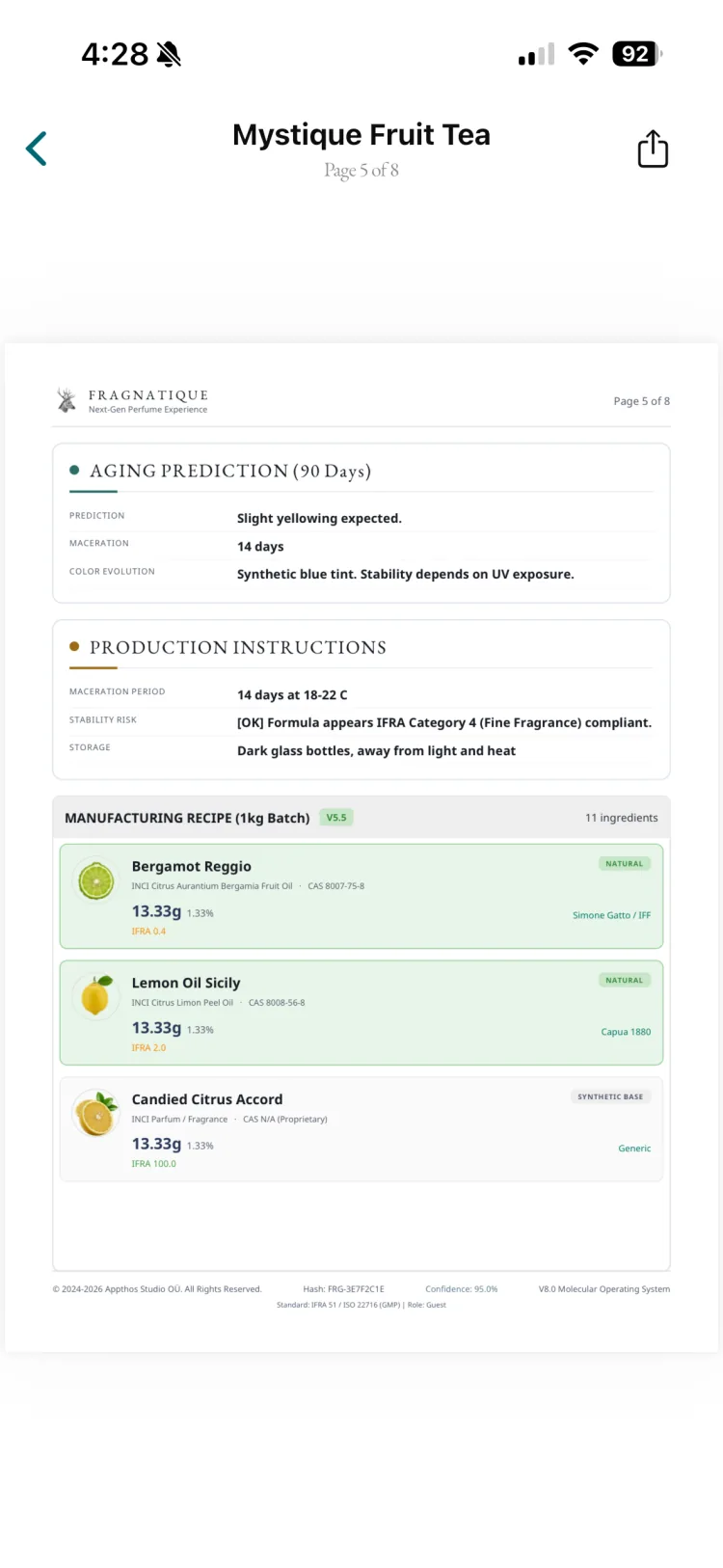
Answer the Lab's questions and it returns a formula and an exportable PDF that follows IFRA safety standards, one a producer can actually read.
Open it on iOS1 answer
Most useful answer firstMost useful answer
What IFRA is
The International Fragrance Association (IFRA) publishes the IFRA Standards, which it describes as a risk management system for the safe use of fragrance ingredients. A Standard can take three forms:
- Prohibition: the material must not be used at all.
- Restriction: a maximum level for each product type.
- Specification: conditions on the quality or form of a material.
The Standards are updated in numbered amendments. The 51st Amendment was notified on 30 June 2023. A 52nd Amendment has been through public consultation, and IFRA expects to publish its formal notification in January 2027, with longer transition periods before it applies.
How the limits work
Limits are set per product category, because exposure differs between a perfume left on skin and a soap rinsed off. Fine fragrance (eau de parfum, eau de toilette, parfum, cologne) is Category 4. Each restricted material has a maximum percentage in the finished product for that category.
The key point most beginners miss: the limit applies to the finished, diluted perfume, not to your concentrate. If a material is limited to 1 percent in Category 4 and your concentrate is diluted to 20 percent, the material can make up at most 5 percent of the concentrate. A second trap: some materials are restricted indirectly, because a natural oil contains a restricted component (citrus oils and furocoumarins, oakmoss and its allergens).
Where to find the numbers
Ask the supplier for each material's IFRA certificate. A good certificate states the maximum use level in each category for the amendment it was issued under. Keep the certificates with your formula.
Do they apply if you only make perfume for yourself?
Legally, in most places, no one enforces them on a private hobbyist. IFRA compliance is a condition of IFRA membership and, in practice, of selling to responsible manufacturers and retailers.
Practically, yes, follow them. The limits exist mainly because some materials cause skin sensitisation, and sensitisation can be permanent: once your skin reacts to a material, it may react to it in every product you use afterwards. A home-made perfume is still worn on your skin, often daily. Three habits cover most of the risk:
- Stay under each material's Category 4 limit, calculated on the finished dilution.
- Wear gloves when handling undiluted materials.
- Patch test the diluted perfume and stop if your skin reacts.
When it stops being a hobby
Selling, or giving away in a way that counts as placing on the market, turns your perfume into a regulated cosmetic. In the EU, Regulation (EC) No 1223/2009 requires a responsible person, a safety assessment and a notification before sale, and Regulation (EU) 2023/1545 expanded the list of fragrance allergens that must be named on the label when present above 0.001 percent in leave-on products. IFRA compliance feeds that safety assessment but does not replace it.
How software helps
Doing the dilution arithmetic for every restricted material by hand is where mistakes happen. The Scent Lab in the Fragnatique app checks each formula against IFRA Amendment 51 and lists declarable allergens; our methodology page explains what that check covers and where it stops. It is guidance for design, not a regulatory dossier. For dilution maths and equipment, see our guide to making perfume at home safely.