
Key facts
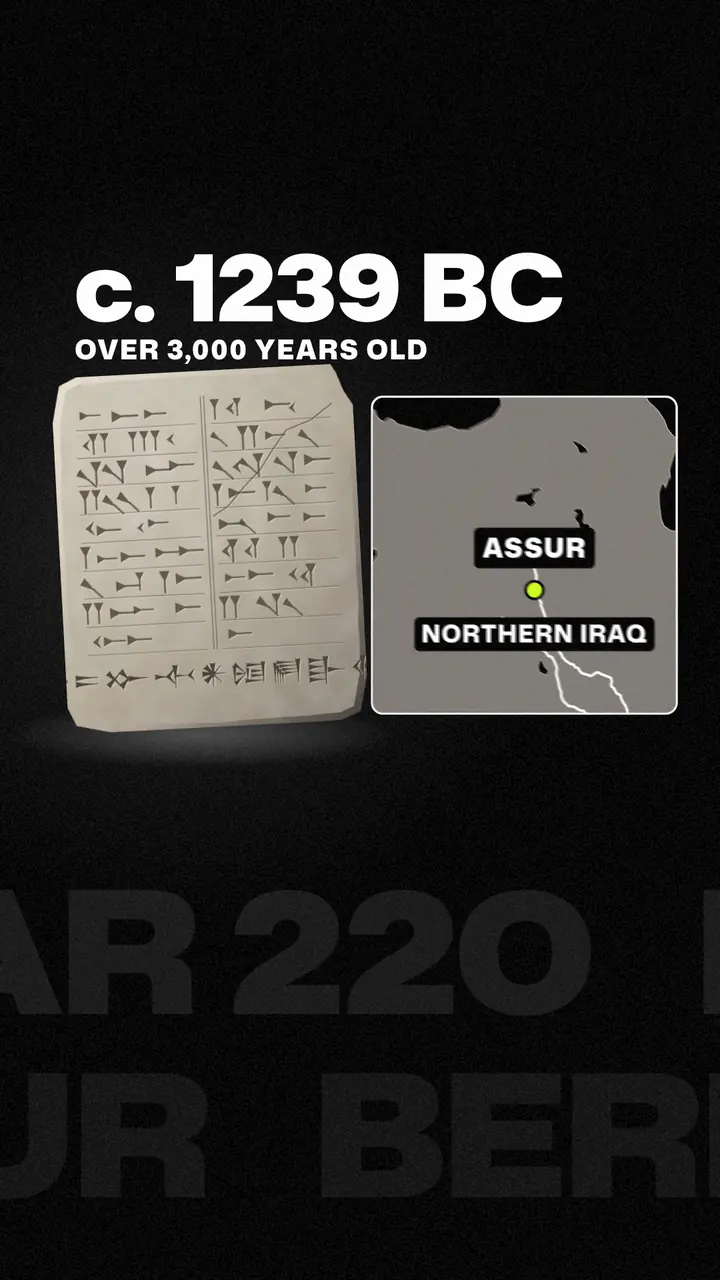
- c. 1239 BCThe Assur tablet's colophon is dated by the eponym Šunu-qardū, 1239 or 1229 BC.
- VAT 10165The clay tablet is kept in the Vorderasiatisches Museum, Berlin, CDLI records.
- 40 filtrationsThe grade of scented oil Assur's recipes describe as fit for a king.
- Lipit-IrraHead of a perfumer's workshop in Larsa, at least five centuries before Tapputi.
- Papyrus EbersAn Egyptian scroll from the late 16th century BC with an older kyphi recipe that names no maker.
- 1959Martin Levey's book opens the study of chemistry in Mesopotamian aromatics.
Where is Tapputi's tablet today?
CDLI records the tablet as clay, excavated in Assur, modern Qalat Sherqat in northern Iraq, dated to the Middle Assyrian period and kept in the Vorderasiatisches Museum in Berlin as VAT 10165. Ebeling first published it in the KAR volumes of 1919 to 1923. Its closing line is dated by the eponym Šunu-qardū, which the TCMA eponym table places in 1239 or 1229 BC, and the signs before her name mark her as a woman.
How did Tapputi make perfume?
Without alcohol or a still. The ORACC translation of the recipe has the aromatics stay the night in water to soften, then sieved through a cloth, the fire heated and the oil poured in; the word distil never appears. A 2023 chapter by Escobar describes Assur's recipes as maceration, heat extraction and filtration, repeated many times: after 20 filtrations the oil was fit for trade, and after 40 it was described as fit for a king.
Who made perfume before Tapputi?
A peer reviewed CDLJ article from 2014 shows that Lipit-Irra was promoted to head of the perfumer's workshop in the early Old Babylonian kingdom of Larsa. The Met dates that Isin-Larsa period to about 2000 to 1750 BC, at least five centuries before Tapputi. Egypt is older too: Leipzig University Library dates the Papyrus Ebers to the last quarter of the 16th century BC, and its kyphi recipe names no maker.
Was Tapputi history's first chemist?
That title is a modern label. Escobar notes that Tapputi is often hailed as history's first chemist, then asks whether her recipe can really be called chemistry and what the drawbacks of that label are. CDLJ dates the first scholarly discussion of the technology behind Mesopotamian aromatics to Martin Levey's 1959 book on chemistry in ancient Mesopotamia, more than three thousand years after the tablet.
Sources
Primary sources only. Every statement on this page restates one of them, read by the Fragnatique team.
- ORACC, TCMA, KAR 220 (P282617), translation 2021oracc.museum.upenn.edu
- CDLI, Artifact P282617 (VAT 10165)cdli.earth
- ORACC, TCMA Eponymsoracc.museum.upenn.edu
- Escobar, Tappūtī-bēlat-ekalli, AlchemEast (2023)alchemeast.eu
- Middeke-Conlin, Cuneiform Digital Library Journal 2014:1cdli.earth
- The Metropolitan Museum of Art, object 323920 (Isin-Larsa period)metmuseum.org
- Leipzig University Library, Papyrus Ebers: the scrollpapyrusebers.de
- Littman et al., Near Eastern Archaeology 84:3 (2021)doi.org