How Is Perfume Made? From Flower to Bottle
Perfume is made in six steps: raw materials, extraction (distillation, pressing, solvents or enfleurage), composition, maceration, filtration and bottling.
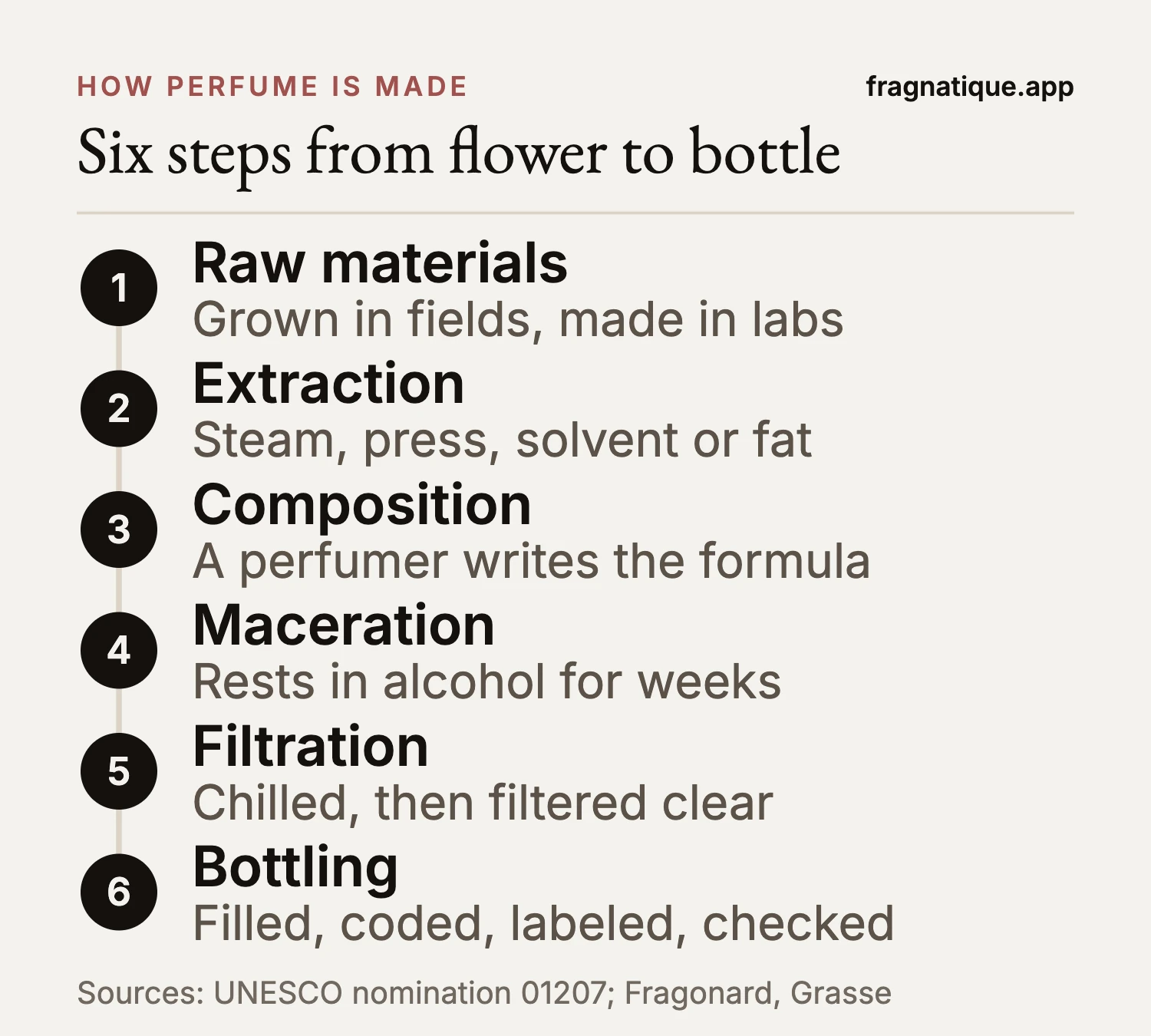
- 01Perfume is made in six steps: raw materials are grown or made, their scent is extracted, a perfumer writes the formula, the concentrate macerates in alcohol, the liquid is filtered, and it is bottled.
- 02An essential oil comes from a still or, for citrus peel, a press; solvent extraction leaves a solid, waxy concrete, and alcohol draws an absolute out of it, leaving the waxes behind. ISO 9235 is the international vocabulary standard for these words.
- 03Enfleurage, catching flower scent in fat, is the method France's UNESCO nomination calls "most at-risk"; Fragonard says its cold form was used widely around Grasse until the late 1950s and has since been replaced by solvent extraction.
- 04UNESCO inscribed the perfume skills of Pays de Grasse on 28 November 2018: the cultivation of perfume plants, the knowledge and processing of natural raw materials, and the art of perfume composition.
- 05At Fragonard's factory in Grasse the concentrate macerates in alcohol for several weeks, is chilled to minus 5 degrees Celsius and filtered until perfectly clear, then bottled, coded and checked.
Perfume is made in six steps: raw materials are grown or made, their scent is extracted, a perfumer writes the formula, the concentrate macerates in alcohol, the liquid is filtered, and it is bottled. The first three steps match what UNESCO inscribed on 28 November 2018 as the skills related to perfume in Pays de Grasse: the cultivation of perfume plants, the knowledge and processing of natural raw materials, and the art of perfume composition.
How is perfume made, step by step?
Six steps take a perfume from plant to bottle. Here is each in brief, with the source that describes it.
- Raw materials. Natural materials are grown and harvested: France's nomination file to UNESCO names jasmine, rose, orange blossom, tuberose, iris and violet as plants grown around Grasse, each needing its own care. Other materials come from laboratories, such as vanillin, whose making from coniferin was published in 1874.
- Extraction. The scent is taken out of the plant by hydraulic distillation, by enfleurage ("extraction using fats") or by solvent extraction, the methods the same nomination lists; citrus oil is pressed out of the peel instead.
- Composition. A perfumer writes the formula, seated at an organ, "a stand on which all the bottles of essences he will be using are laid out", in the words of Fragonard's Grasse factory.
- Maceration. The concentrate is mixed with alcohol and left in vats "for several weeks", Fragonard's historical factory says.
- Filtration. The macerate is chilled to minus 5 degrees Celsius and filtered "until a perfectly clear liquid is obtained", according to the same page.
- Bottling. The liquid is filled, coded for traceability, labeled and checked by operators at the end of the line, as Fragonard describes its semi-automatic bottling lines.
The rest of this article takes the steps in order, then looks at the words on the labels, the people who hold the skills, and where you can watch them work.
Where do perfume raw materials come from?
From fields, forests and laboratories. UNESCO's listing says the practices of Pays de Grasse have been developed "since at least the sixteenth century", in "a craft industry long dominated by leather tanning". Grasse's perfume museum, the Musée International de la Parfumerie (MIP), tells the same story: from the 16th century, tanners who scented their hides with local essences gradually became perfumers, which strengthened the growing of perfume plants and the processing of natural raw materials. We tell that story in why Grasse became the perfume capital.
Growing the plants is a skill in itself. The nomination file says perfume plant cultivation involves knowledge of soil, weather and nature observation, and horticultural practices such as pruning, training, grafting, irrigation and fertilization. It also says why the fields shrank: flower farming "has been scaled back, due to the increase in synthetic products and competition from other production centres".
Citrus comes from the peel. Bergamot, a citrus grown mainly for the essential oil in its peel, is "cultivated almost exclusively along the southern coast of the Calabria region", and more than 90 percent of the world's production comes from there, according to a 2015 review in Frontiers in Pharmacology. The oil is "obtained by rasping and cold pressing the fruit peel", the review says. Our guide to citrus fragrances covers the family built on these oils.
Woods, resins and animal materials each have their own supply story: the musk of the musk deer and the frankincense tree are both under pressure in the wild.
The laboratory is the other field. In 1874 the chemists Ferdinand Tiemann and Wilhelm Haarmann published, in the Berichte der deutschen chemischen Gesellschaft, the conversion of coniferin into "das aromatische Princip der Vanille", the aromatic principle of vanilla, as the title of their paper puts it: vanillin. Houbigant's history of the house says Paul Parquet created Fougère Royale in 1882 with "the coumarin, isolated from tonka bean", a story told in our article on the fougère family. Guerlain's page on Jicky says Aimé Guerlain created it in 1889 and that it "was classified straightaway as 'the first modern perfume'"; the house's product page for the eau de parfum adds that he used "the two newly discovered Vanillin and Coumarin molecules". How natural and synthetic materials are regulated today is the subject of our article on natural versus synthetic perfume.
How do you get the scent out of a flower?
By steam, by pressure, by a solvent or, in the past, by fat, depending on the plant. France's nomination lists the methods Grasse mastered: "hydraulic distillation, enfleurage (extraction using fats) and eventually, solvent extraction", and adds that the town's inhabitants "have largely contributed to perfecting them", adapting the method to each plant.
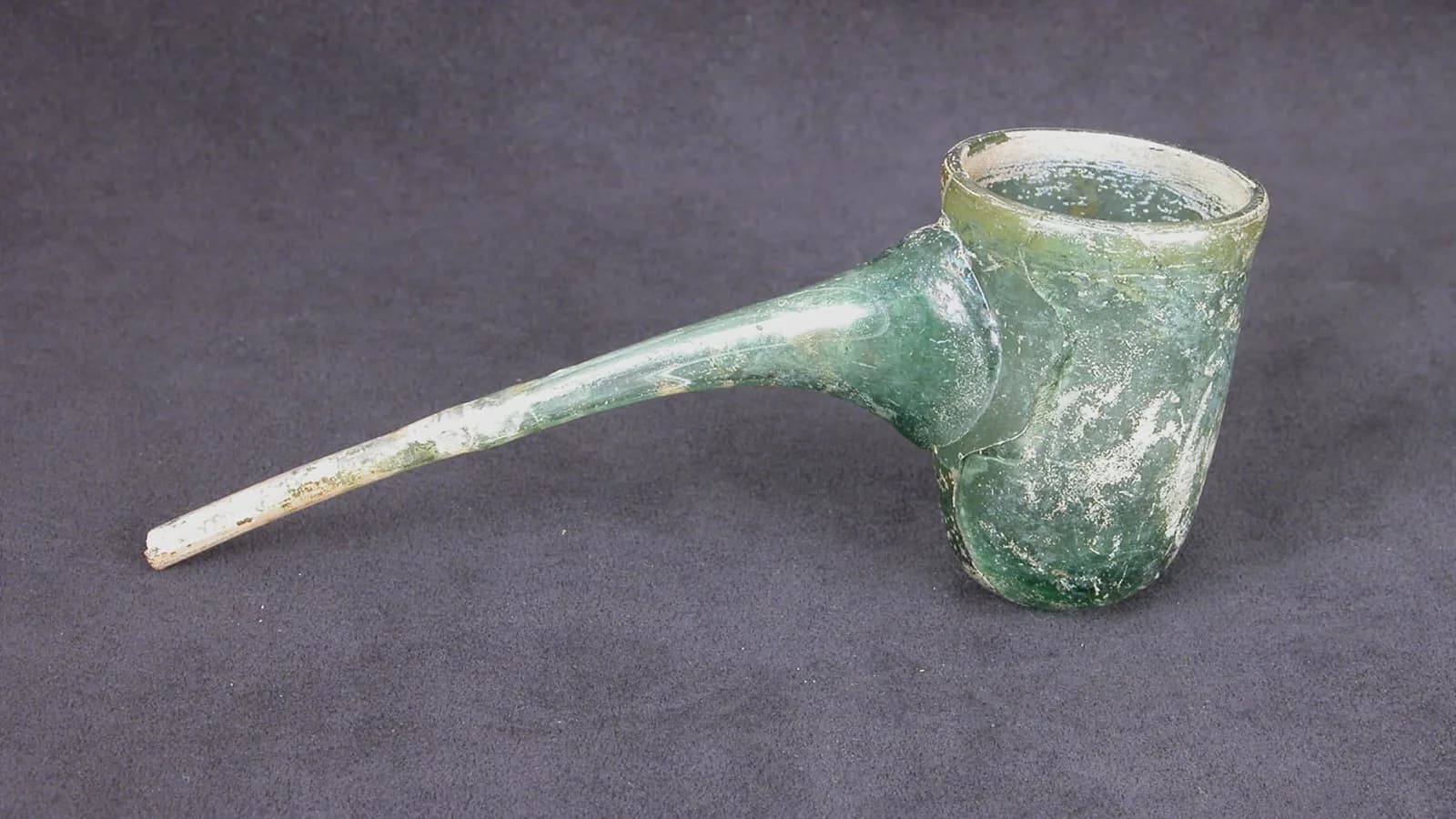
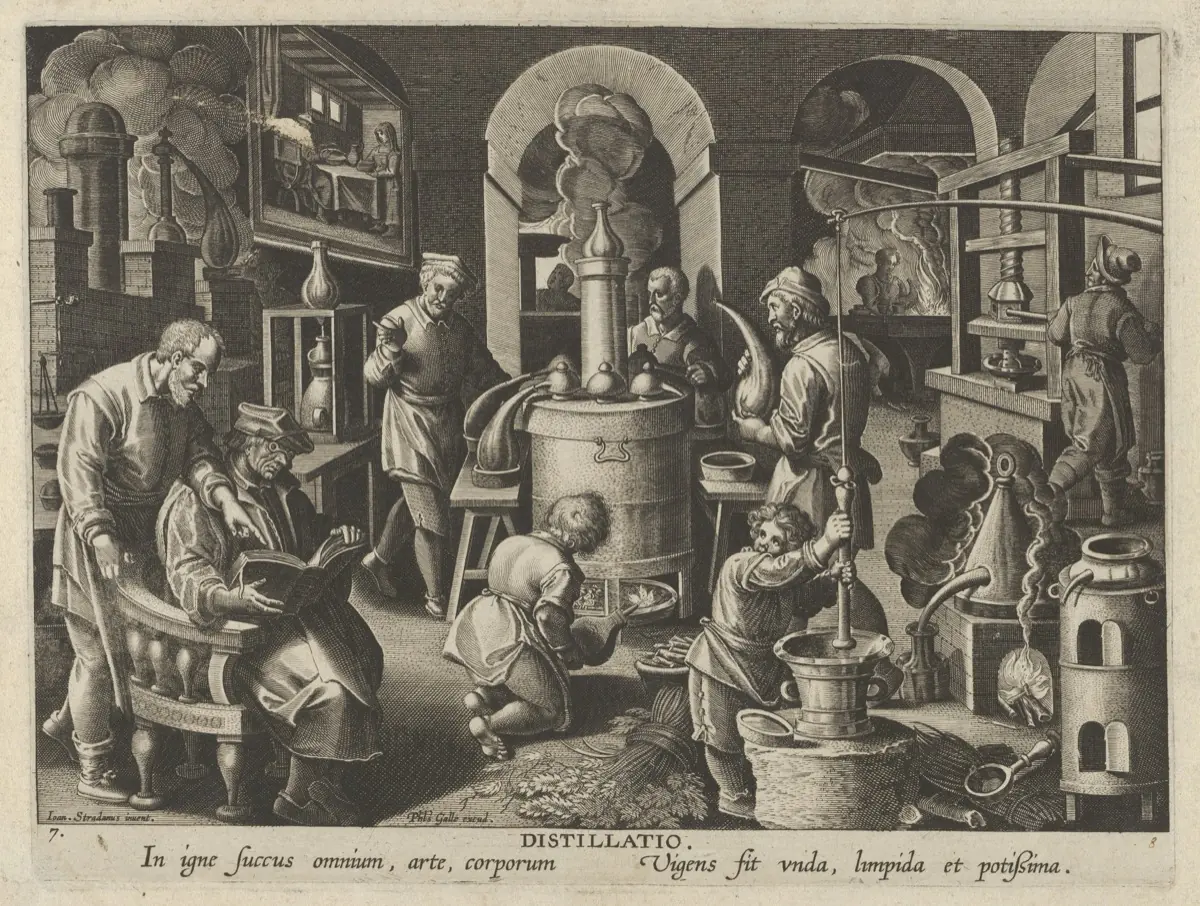
Steam distillation is the most common. Britannica calls it "by far the most common and important method of production": steam carries the volatile oil out of the plant, and once the steam condenses, the oil is separated from the water. Fragonard's Fabrique des Fleurs displays its stills and says the process "is still widely used nowadays to extract essential oils"; in use since antiquity, "the technique was perfected by the Arab world as early as the 8th century". The green glass alembic on our cover was excavated at Nishapur in Iran and dates from the 9th to 11th century, according to the Metropolitan Museum of Art.
Cold pressing suits citrus. Britannica says expression "is applied only to citrus oils": the outer peel is squeezed in presses, and the oil is separated from water and cell debris. The EFEO and IFRA guidelines on natural complex substances give the bitter orange tree as an example of one plant, two oils: bitter orange oil "is obtained from the peel of Citrus aurantium (Rutaceae) by cold pressed extraction and/or followed by distillation", while petitgrain oil comes from the same species "by steam distillation of the leaves and twigs of the plant", and the two smell very different.
Solvent extraction is for delicate flowers. A volatile solvent takes up the perfume oil together with the plant's waxes, and removing the solvent leaves "a solid substance called a concrete", Britannica explains. Fragonard says enfleurage "has today been replaced by modern techniques such as volatile solvent extraction or supercritical carbon dioxide extraction", and the MIP adds a newer process, "éco-extraction", developed in Grasse from the 2000s. The yield is tiny. A 2019 paper in the Swiss journal Chimia says one ton of jasmine flowers, grown on about 2,000 square meters, gives "ca. 2.3 kg of jasmine concrete" after extraction and evaporation. "This natural extract, more expensive than gold, was used in practically every perfume at the beginning of the 20th century", the authors write. Perfumes built on flowers like these form the floral family.
| Method | What goes in | What comes out | Source |
|---|---|---|---|
| Steam distillation | Leaves, twigs, roots or flowers, with steam | Essential oil | Britannica; Fragonard; EFEO and IFRA |
| Cold pressing (expression) | Citrus peel | Essential oil, "by cold expression" in IFRA's nomenclature | Britannica; EFEO and IFRA; Navarra et al. 2015 |
| Solvent extraction | Delicate flowers, with a volatile solvent | Concrete, then absolute | Britannica; Chimia 2019 |
| Enfleurage | Flowers laid on purified fat | A scented fat called a pomade, then an absolute | Britannica; Fragonard; UNESCO nomination |
What is the difference between an essential oil, a concrete and an absolute?
They are different products of different processes, and the trade has a standard for the words. ISO 9235, "Aromatic natural raw materials, Vocabulary", is the international standard that defines them; its third edition was published in 2021. The EFEO and IFRA guidelines call natural complex substances "well described in ISO standard 9235" and list the most common ones: essential oils, concretes and absolutes, oleoresins and resinoids, CO2 extracts, and infusions and alcoholic extracts. IFRA's ingredient nomenclature follows the same standard and keeps "Essential oil by steam distillation", "Essential oil by cold expression", "Concrete" and "Absolute" as separate categories.
In one sentence each, after Britannica's articles on essential oils and on perfume:
| Term | What it is | How it is made |
|---|---|---|
| Essential oil | A volatile oil isolated by a physical process from a single plant species, and named after it, as rose oil or peppermint oil | Steam distillation in most cases; pressing for citrus peel |
| Concrete | The solid, waxy extract left when a volatile solvent is removed from fresh flowers | Solvent extraction, then evaporation of the solvent |
| Absolute | The concentrated flower oil that alcohol draws out of a concrete, leaving the waxes undissolved | Alcohol treatment of a concrete, or of the scented fat from enfleurage |
The names matter in law, too. For registration under REACH, the European Union's chemicals regulation, the EFEO and IFRA guidelines identify a natural extract by its source first and then its process, with the part of the plant where that changes the composition; for an extract, "at least the solvent used shall be specified". That is why the guidelines say petitgrain oil, from the same tree as bitter orange oil, should be registered separately.
What is enfleurage, and is it still used?
Enfleurage is extraction with fat, and it has nearly disappeared. France's nomination defines it in three words, "extraction using fats"; the Pays de Grasse site on these skills, written by members of the association that carried the UNESCO nomination, describes it as the absorption of scent molecules by oil or fats, one of the territory's "ancestral" techniques.
Britannica describes the cold method as it was practiced in southern France: flowers are spread over "a highly purified mixture of tallow and lard" for 24 to 72 hours, then replaced, until the fat is saturated with their oil. The product is called a pomade, and alcohol then draws an absolute out of it. Fragonard describes both forms. Hot enfleurage, "or maceration, consists in infusing the flowers in previously heated fats". Cold enfleurage "was developed for the most fragile flowers, such as jasmine or daffodil": a layer of odorless grease is spread on the walls of a glass frame, which is then covered with flowers. It was "used widely in the Grasse region until the late 1950s", the house says, and has since been replaced by solvent extraction. Britannica calls both fat methods "chiefly of historical importance".
The nomination file is blunt about their future:
Technical progress is causing certain skills and methods to disappear; enfleurage would seem to be most at-risk.
France, nomination file No. 01207 to UNESCO (for inscription in 2018)
The same file says "there are no schools that teach all the subtleties of distillation, enfleurage or solvent extraction": the techniques are learned in the perfumeries, mostly by word of mouth.
Who writes the formula?
A perfumer, and it takes years. UNESCO's listing says that beyond technical skill, the art of perfume composition "calls for imagination, memory and creativity". Fragonard puts it in a musician's terms: the perfumer composes seated at an organ, a perfume "is made up of an accord, which means a blend of several notes", and "a perfume can take several years to compose". The formula can be long. "A perfume can contain from twenty to more than a hundred different components," the house says, and the raw materials of perfumery, "once limited to natural ingredients of plant or animal origin", are today "supplemented by synthetic products".
The training is longer than the composing. France's nomination estimates seven years to train a distillation manager, and says perfumers "only become operational after ten years of training". The MIP lists the trades that process the raw materials: distillers, quality and research engineers, chemists, and related crafts such as coppersmiths and glass blowers. How one teacher in Grasse taught the craft is the subject of our article on the Jean Carles method, and our guide to famous perfumers follows the people who wrote the best known formulas.
A formula also has rules. IFRA, the fragrance industry's association, describes the IFRA Standards as "a globally recognized risk management system for the safe use of fragrance ingredients", and says they "set limits, restrict or ban the use of certain fragrance materials only when there are concerns over their safe use".
Fragnatique's Scent Lab takes the same route in miniature. It asks about character, mood and how strongly the scent should carry in fourteen guided steps, then proposes a formula of named raw materials, with the IFRA limit beside each fragrance material; the manufacturing document it exports adds a maceration period and storage in dark glass, away from light and heat. To try writing a formula of your own, start in the Scent Lab.
How is perfume macerated, filtered and bottled?
The concentrate is weighed, diluted, rested, cleared and filled. At Fragonard's Fabrique des Fleurs, the laboratory is "where the raw materials are weighed with extreme precision, then blended to form the concentrate", which is then taken to the historical factory in the center of Grasse and poured into the maceration vats.
There, the house says, "large stainless steel vats" hold the perfume concentrates mixed with alcohol, "left to macerate for several weeks". Some vegetable waxes from the natural raw materials may solidify during maceration, so "the macerate is chilled to -5°C in a stainless steel machine and filtered until a perfectly clear liquid is obtained". That duration is Fragonard's own, not a rule for every house. How much concentrate goes into the alcohol is what names such as parfum and eau de toilette describe, and our guide to EDP, EDT and parfum sets the houses' own figures side by side.
Bottling follows. On the semi-automatic line at the Fabrique des Fleurs, empty bottles are placed in trays and conveyed to the filling station, the pump is fitted by hand, "a code is printed on the bottom of bottle by an ink jet printer to provide traceability", the bottle is labeled by the machine, and "at the end of the line, operators carry out quality control". At the historical factory, the house fills its gilt aluminum flasks, called estagnons, which "protect the fragrance from light".
What the alcohol carries to your skin then unfolds in the order our guide to the notes pyramid describes: the volatile materials first, the heavy ones last.
Where can you see perfume being made?
In Grasse, in a public museum and in working factories. The Musée International de la Parfumerie was created in 1989 as a public establishment with the Musée de France label, its presentation page says. Its history page dates the inauguration to January 1989, which it calls the bicentenary year of French perfumery, traces its origins to a private museum that François Carnot founded in Grasse in 1918 with a section set aside for perfumery, and says works begun in 2006 doubled the museum to 3,500 square meters.
Fragonard, a Grasse house founded in 1926, opens two factories to visitors, with free guided tours: the historical factory in the town center, with its stills, maceration room and bottling line, and the Fabrique des Fleurs, built in 1986 south of the old town and named after the botanical garden of perfume plants around it. A perfume museum has occupied the historical factory's third floor since 1975. France's Ministry of Culture announced the UNESCO listing on 28 November 2018, the day the committee, meeting in Port Louis, Mauritius, inscribed it.
The process is old; the bottles on the shelf are its latest chapter, and our sourced history of perfume sets it in order. To see what sits inside a bottle, open a note page in the Fragnatique app; to write a formula of your own, start in the Scent Lab.
Part of Eau Facts, the Fragnatique team's series on fragrance history and science, also told in short videos on Instagram at @eaufacts. Researched from the sources named in the text, drafted with AI assistance and checked against each source before publishing.
Frequently asked
How long does it take to make a perfume?
Years for the formula, weeks for the liquid. Fragonard's factory pages in Grasse say a perfume can take several years to compose and that the concentrate is left to macerate in alcohol for several weeks before it is chilled, filtered and bottled. The people take longest: France's UNESCO nomination estimates seven years to train a distillation manager and says perfumers only become operational after ten years of training.
What is an absolute in perfume?
An absolute is the concentrated flower oil that alcohol draws out of a concrete, the solid, waxy extract left when a volatile solvent is removed from fresh flowers; the alcohol leaves the waxes undissolved, as Britannica explains. Enfleurage ends in an absolute too, drawn with alcohol out of the scented fat. ISO 9235 is the international vocabulary standard for these words, and IFRA's ingredient nomenclature keeps concrete and absolute as separate categories. The yield is small: a 2019 paper in the Swiss journal Chimia puts one ton of jasmine flowers at about 2.3 kg of concrete.
Is perfume still made from real flowers?
Yes, alongside molecules made in laboratories. France's nomination to UNESCO names jasmine, rose, orange blossom, tuberose, iris and violet as plants grown around Grasse, while warning that flower farming has been scaled back because of synthetic products and competition from other production centres. Fragonard says the raw materials of perfumery, once limited to natural ingredients of plant or animal origin, are today supplemented by synthetic products, and that a perfume can contain from twenty to more than a hundred components. The mix is old: Guerlain says Aimé Guerlain created Jicky in 1889 using the newly discovered vanillin and coumarin molecules.
What is maceration in perfume making?
Maceration is the rest the mixture of concentrate and alcohol takes before bottling. Fragonard's historical factory in Grasse describes large stainless steel vats in which the perfume concentrates are mixed with alcohol and left to macerate for several weeks. Some vegetable waxes may solidify during that time, so the macerate is chilled to minus 5 degrees Celsius and filtered until a perfectly clear liquid is obtained. The weeks are Fragonard's own figure, not a rule for every house. The same word also names hot enfleurage, an old way of steeping flowers in warm fat.
How is perfume made from flowers?
By distillation, by solvent extraction or, in the past, by enfleurage. In a still, steam carries a flower's volatile oil out and the oil is separated once the steam condenses. Delicate flowers such as jasmine go to solvent extraction, which leaves a waxy concrete, and alcohol then draws the absolute out of it. Enfleurage laid the flowers on purified fat until the fat was saturated with their oil; Fragonard says the cold method was used widely around Grasse until the late 1950s.

Written by Fragnatique Team