
If software recommends perfumes, identifies bottles and writes formulas, does it in some sense know what they smell like? This is one of the most common questions asked about AI and fragrance, and the honest answer has two parts: what consumer apps do, and what research labs can do.
This guide separates the two, so you can judge what an AI perfume tool is actually telling you.
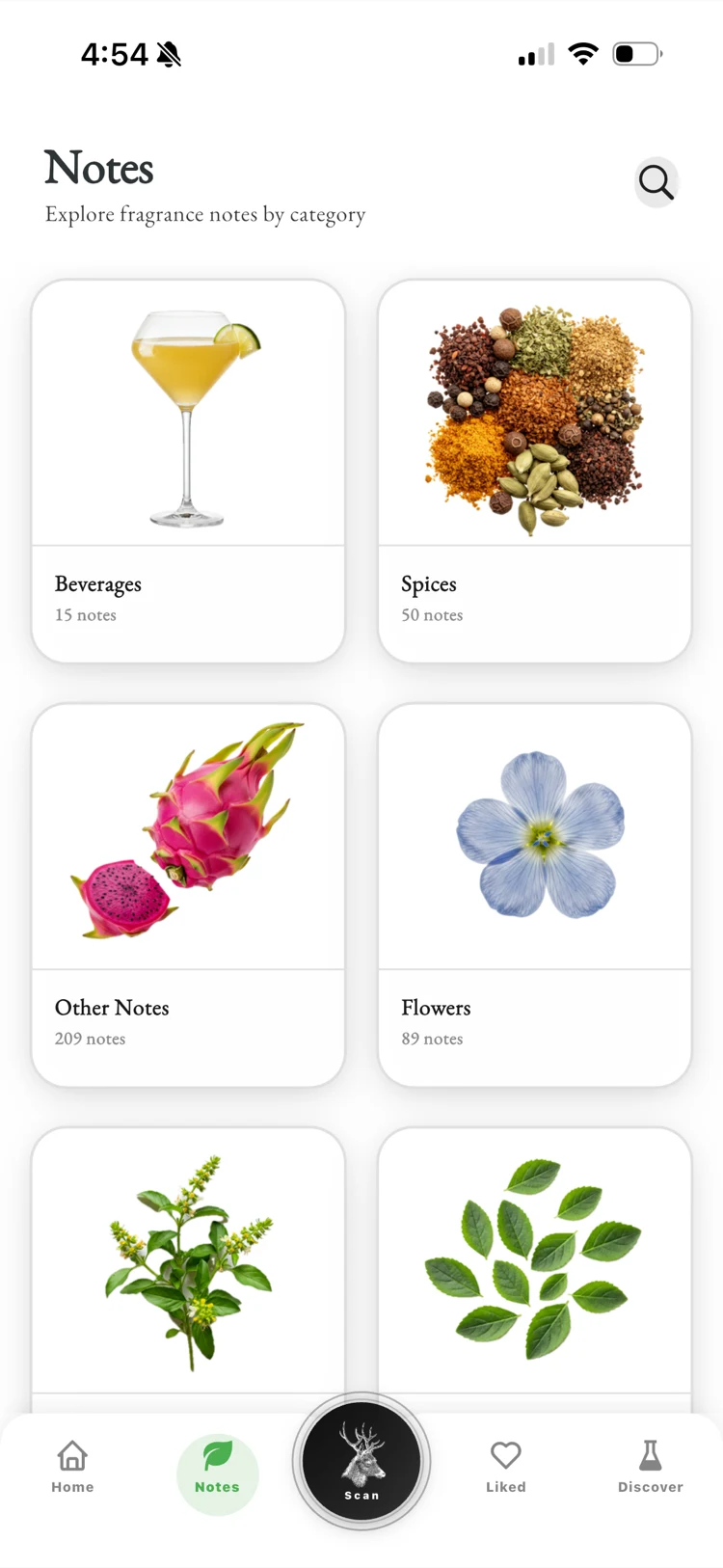
Every note, browsable on its own
Every note discussed here has its own page in the app: what it smells like, which families use it, and which bottles in the catalogue lean on it hardest. Start from a note instead of a bottle and work outwards.
Open it on iOS1 answer
Most useful answer firstMost useful answer
No AI perfume app smells anything. A phone has no sensor for odour molecules, and the models behind recommendation and formula tools never receive the air around a bottle. What they work with is description.
What consumer AI tools actually use
- Structured data about each perfume: its notes pyramid (top, heart, base), its family, its accords, and practical traits such as longevity and projection.
- Data about materials: which raw materials produce which effects, how volatile they are, and how they are restricted.
- Language: what is written about a perfume by its maker and its wearers. Large language models are good at connecting "smoky, dry, like a struck match" to the materials that usually produce that impression.
- Your own signals: what you like, dislike and own.
From that, a model predicts how a perfume will read and whether it fits a taste. The prediction can be very useful, but it is an inference from descriptions, not a perception.
What research systems can do
Two lines of work are real and worth knowing about, because they are often blurred together in headlines:
- Predicting odour from molecular structure. A 2023 paper in the journal Science (Lee and colleagues, "A principal odor map unifies diverse tasks in olfactory perception") trained a graph neural network to predict how a molecule smells from its structure. On hundreds of new molecules, its predicted descriptions matched a trained human panel's average more closely than the typical individual panellist did. That is prediction from chemistry, still with no nose involved.
- Electronic noses. Sensor arrays combined with machine learning can detect and classify certain odours, and are used in areas such as food quality and gas detection. Published reviews note that they are sensitive to humidity and temperature and struggle to separate similar smells. They are nowhere near reading a complex perfume the way a perfumer does.
Why this matters when you use an AI tool
- It cannot know your skin. The same perfume wears differently on different people and in different weather. No dataset contains your skin.
- It cannot detect a batch change. Reformulations, an old bottle that has turned, or a fake with the right label all look identical to a data model.
- It can still narrow the field well. Choosing from tens of thousands of perfumes is the part humans do badly and data does well. Smelling the last few is the part only you can do.
How Fragnatique handles it
Our recommendations, scanner and Scent Lab all work from structured data about each perfume, as described on our methodology page, and matching is done by Fragnatique's proprietary matching algorithm. Every match comes with a written reason so you can see what the prediction rests on. Our guide to perfume AI lists the same limits plainly: AI cannot smell, cannot know your skin and cannot vouch for a bottle. Treat any AI shortlist as a list of samples to try, and let a full day of wear make the decision.